
Yes, we’ll get to the AI of it all. But can we start with the music and the conversation?
Steven Soderbergh’s “John Lennon: The Last Interview,” which premiered on Friday at the Cannes Film Festival, would have been a notable Cannes entry regardless of how it was made, because of the intimate look it gives at Lennon’s state of mind only a few hours before he was shot to death in front of his New York City home in December 1980.
Within the first minutes of the documentary, we hear Lennon say that he wants to make music “until I’m dead and buried, which I hope isn’t for a long time.” Sadly, he’d go straight from the interview to the recording studio, make music for a few hours and then return home to be killed, making that opening quote all but unbearable for an audience and all but irresistible for a filmmaker.

Soderbergh isn’t an exploitative type, but the director knows gold when it’s in front of him, which it was in the form of an interview that Lennon and his wife, muse and artistic partner Yoko One did on the afternoon before he died. It was an interview for the San Francisco radio station KFRC to promote his and Yoko’s new “Double Fantasy” album, which had been released in November. John and Yoko had talked at length to other people leading up to the album’s release, including the Playboy Interview and a nine-hour chat with Rolling Stone, but this was to be their only radio interview, which meant that the audio quality that Soderbergh had to work with was high.
And so was the content of the interview. Although the interviewers had been warned to keep the conversation to “Double Fantasy” and not ask about the Beatles, John was in an expansive mood for what turned into a two-hour-and-45-minute conversation. Mostly philosophical and ruminative, he talked about music and fatherhood and peace and love and the drug-fueled “lost weekend” he’d spent while separated from Yoko in the early 1970s. And he talked plenty about the Beatles, because no John Lennon story can avoid them.
At one point, he draws a through-line that connects the music over his entire career, from “The Word” (“the word is love”) to “All You Need Is Love” to “Give Peace a Chance” to “Imagine.”
For anybody who’s read the other interviews John and Yoko did around that time, there’s nothing terribly revelatory about the conversation in “John Lennon: The Last Interview.” But the immediacy that comes from hearing him talk about it can be thrilling, and Soderbergh’s and Nancy Main’s judicious editing fits plenty of the 165-minute interview into a 97-minute film.

(One caveat: John and Yoko’s answers are a lot more interesting than the four radio interviewers’ questions and comments, which can sometimes be distracting.)
But if the audio quality of that interview is high, the video quality is nonexistent. The filmmakers had to come up with things to look at while we’re listening, and the result is a barrage of images that expertly walk the fine line between exciting and exhausting.
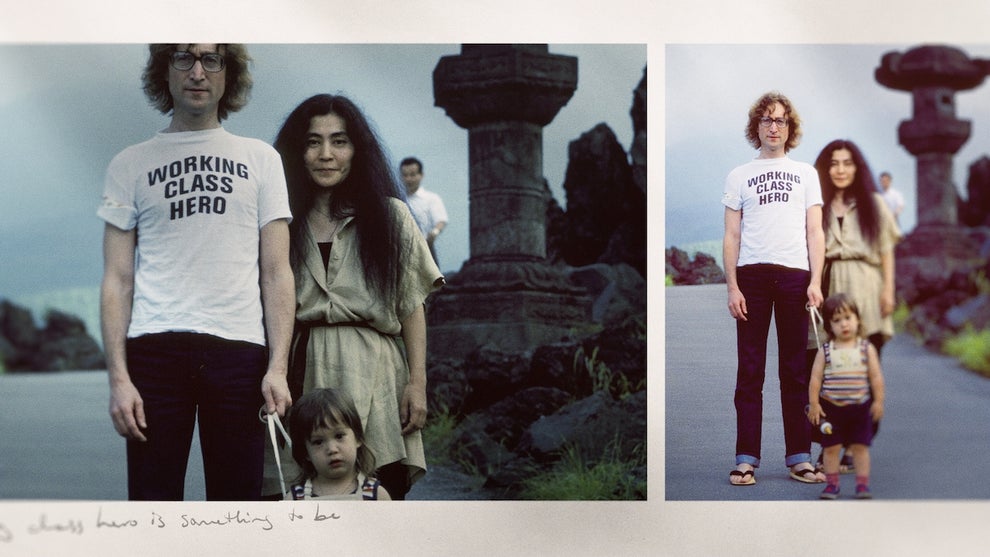
Pulling more than 1,000 photos and video clips from the archive, Soderbergh gives parts of the film the feel of a hyperkinetic photo album: John talks and the camera pans to a different photo with every line, sometimes with every phrase. Music comes in, the photos cut to the beat, and it’s all carefully assembled to be almost chaotic.
And in the sequences in which John and Yoko talk about abstract ideas and concepts rather than events for which photos and films exist, the film does turn to AI footage, which has made “The Last Interview” a hot-button topic in Cannes. Soderbergh partnered with Meta to create what he has estimated to be 10% of the movie’s footage, mostly fantasy-type sequences that he said would cost too much to do using VFX.
The AI footage includes split-screen compositions with lovers caressing on one side of the screen and different paint colors mixing on the other, and a sequence of crying babies clad in ’60s clothing. Ordered up by Soderbergh and then tweaked to his specifications once it was created, none of it is designed to mislead the audience into thinking it’s real; it’s closer to the surrealism that would have been done with animation back in the days of, say, “Yellow Submarine.”
But it also has the potential to take away entertainment-industry jobs, which is why there’s been resistance in Hollywood and why directors like Guillermo del Toro have made “F—k AI!” a battle cry of sorts. In the case of “John Lennon: The Last Interview,” Soderbergh insists that the film could not have been made without AI – and he’s a respected enough Hollywood iconoclast that he may get the benefit of the doubt.

Certainly, the technology contributes to the fabric and the style of this film, though the cornerstones are John Lennon’s words and his music. This isn’t biography, it’s philosophy that uses biographical moments to make its points. or to help John make his points. He repeatedly says he still believes in love, and declares, “The ’70s weren’t good. Let’s make the ’80s good.”
And if that’s not wrenching enough for those who know how 1980 ended, he later adds, “We’re going into an unknown future, but where there’s life, there’s hope.”
At times like this, things turn unbearably elegiac, and Soderbergh slows down the frenetic pace of the imagery to take a cue from the songs you just knew he was going to use in the homestretch. There’s “God,” with its soft coda that proclaims, “the dream is over,” and then Lennon’s version of the healing ballad “Stand by Me,” then his song to his soul mate, “Grow Old With Me.”
Of course, he didn’t get a chance to grow old with her, which is why the words and, yes, the images in “The Last Interview” mean as much as they do.