
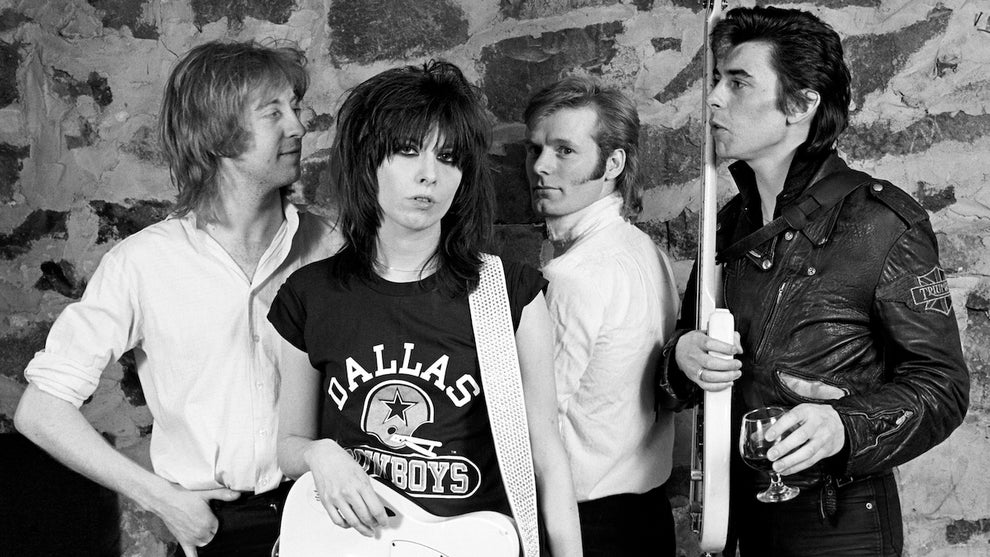
When “Pretenders” was announced as one of the galas at this year’s Toronto International Film Festival, the title appeared on the list without any advance word or details about what it was. The director, Joss Crowley, was best known for documentaries and music films, so it made sense that it might be a doc about the rock band of that name – but would Chrissie Hynde, the famously opinionated and press-shy leader of the band, really want to cooperate with a feature length portrait?
Well yes, “Pretenders” really is a documentary about the Pretenders. And no, Hynde really didn’t want to cooperate with it. She admits as much late in the film, when Crowley asks her, during the last of three years’ worth of interviews, “Have you enjoyed talking?”
“I wouldn’t say I’ve enjoyed it,” she says immediately.
So there’s a built-in tension in “Pretenders,” the in-depth story of a pioneering rock ‘n’ roller who’d just as soon not go too in-depth. Hynde did interviews over the course of three years but only agreed to be filmed for the final session – and even that was done with her a little out of focus and partially obscured by a large microphone.

Throughout, she somehow comes across as both wildly frank and thoroughly cautious. If she wants to talk about something, she’s open and blunt, but the film is also filled with moments in which she says things like “I don’t want to talk about it” or “that’s all I’m going to say about that.”
The thing is, tension is an appropriate baseline for the story of Hynde and the Pretenders. The first song on the first Pretenders album, “Precious,” is part love song, part kiss-off anthem that’s best known for her declaration, “Not me, baby, I’m too precious, I had to f— off,” delivered in such a rush that it sounds like she’s telling the listener to f off.
The Pretenders were brash and edgy, springing out of the mid-1970s British punk scene that also produced the Sex Pistols and the Clash, but they could also drop in melodic gems like “Kid” and their cover version of the Kinks’ “Stop Your Sobbing,” which became their first hit. Their debut album, which came out in 1979, was jarring and confrontational but with real moments of beauty; it also announced a wholly original talent and introduced a group that within three years would lose two of its four members to drug-related deaths.
But for the story of an often brash and unruly band, the movie is surprisingly conventional. For the most part, it moves chronologically and relies on archival footage and talking-head interviews with band members, friends and admirers that include Elvis Costello, the Smiths’ Johnny Marr and Garbage’s Shirley Mansion. Although there’s a little attitude in the way the film uses audio interviews and expects viewers to pick up on who’s talking, it’s mostly more straightforward than the story it’s telling.

When Hynde is doing the talking, she tells her story quickly, talking fast, delivering info in quick bursts and moving on. She grew up in Akron, Ohio, saw the city fall into ruin, hung out with bikers until it was too dangerous to do that, took drugs and read underground comics and went through the usual rebellious period.
“They were really good people, my parents,” she says. “I mean, I didn’t like them … ”
In 1973, she got out of Ohio, went to London and loved every bit of the experience because “nobody knew me and I could do whatever I wanted.” After a while, though, she yearned for something else. “I was f—ing depressed,” she says. “Everyone I knew was in a band except me.”
So she started a group that came to include bassist Pete Farndon, guitarist James Honeyman-Scott and drummer Martin Chambers. They got a record deal in short order and had hits on their first album – including “Brass in Pocket,” which became their signature song even though Hynde didn’t like it and didn’t want to release it as a single. She says she would rather have been No. 11 on the charts instead of No. 1, but that was hardly an option. “It happened fast,” she says, “and we just went with it.”
The narrative comes from Hynde, from Chambers and from road manager Stan Tippins, who kept detailed diaries for years and can turn to the specific pages where he wrote about key moments. But success was tough for the Pretenders: After the first album was a hit, Farndon got into heroin and because so unreliable that they kicked him out of the band in June, 1982. Two days later, Honeyman-Scott died.
“On a Sunday, we had a four-piece band,” Chambers says. “On Wednesday, we’ve got two people left.” Ten months later, Farndon also died, but a reconstituted Pretenders continues. “What else would I do?” Hynde says.

It’s a story of lots of drugs and lots of egos, but also real passion and pretty great music before, after and during the troubles. “Pretenders” leaves out a lot of the last two or three decades, focusing on the first few albums and on the best known songs: “Brass in Pocket,” “Back on the Chain Gang,” “Don’t Get Me Wrong” …
And mostly, it focuses on Hynde’s view of those years, which gives it a bite that separates it from many similar music docs. “I never feel proud of anything,” she insists. “I always think, Oh, we got away with it.”
Joss Crowley gets away with “Pretenders” because he has some thrilling archival footage, and because Hynde and Chambers are always blunt and honest, even when they’re sometimes being evasive. And then toward the end, Hynde makes it clear what she thinks about the whole thing when she she sums up the experience of doing interviews for the documentary.
“F—ing hell,” she says. “Is that what being in therapy is like?”