
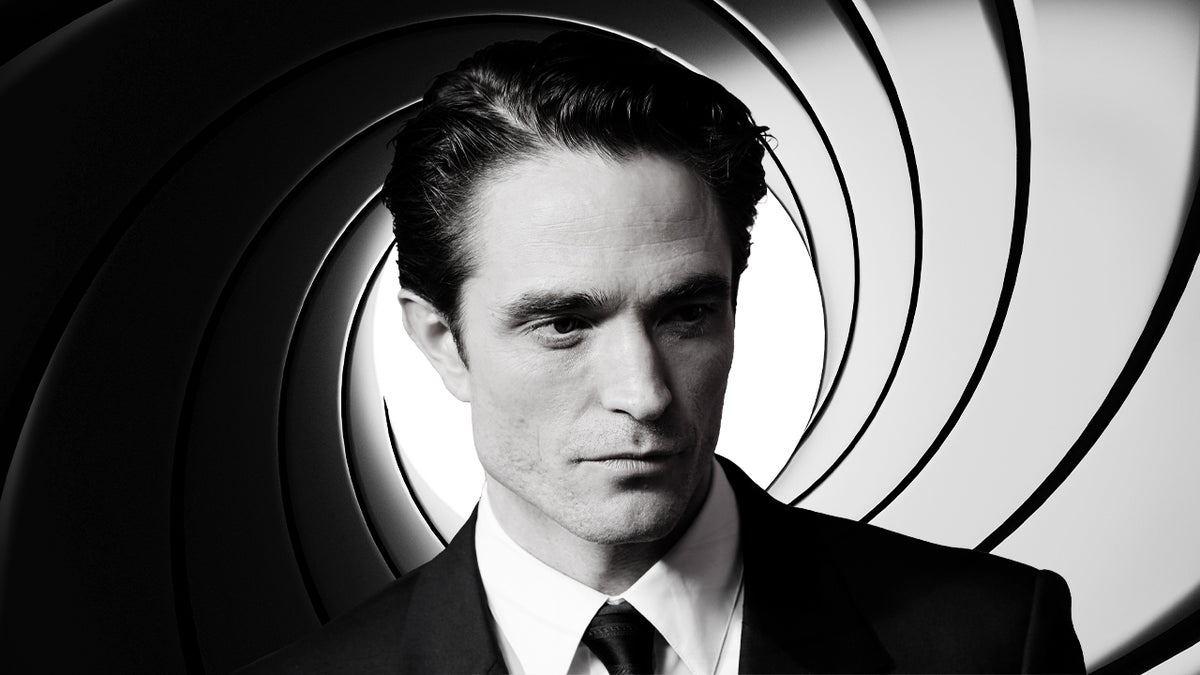
When it was announced early Monday morning that Robert Pattinson was cast as the next James Bond for Amazon MGM Studios’ forthcoming feature, to be directed by Denis Villeneuve, it wasn’t a shock, exactly.
He had entered the casting demolition derby late, but clearly Amazon was bullish, and Pattinson had just worked with Villeneuve on “Dune: Part Three.” Once he entered the picture, it felt to some like the role was Pattinson’s to lose. And he didn’t lose. He’s the new 007. Shaken, not stirred.
And the response to the casting decision, which is overwhelmingly positive, speaks to the way that Pattinson has been able to seamlessly oscillate between interesting, character-driven smaller movies and gargantuan corporate productions.
“Perfect choice! He’s a great human being but just a phenomenal actor and as a lifelong Bond fan I’m tremendously excited by the thought of Denis directing Pattinson in the role,” said one studio exec.
There were others, though, who were ruffled at the idea that one actor will now be both Batman and James Bond. These people argued that other contenders like Jack Lowden or Callum Turner, who have led films of their own but aren’t huge stars, would have marked a better choice for a total reboot of the franchise.

Robert Pattinson Is the New James Bond
Indeed, whereas Sean Connery, George Lazenby, Timothy Dalton and Daniel Craig were largely unknowns when they were cast as 007, Pattinson is already a bona fide movie star. The change of pace for the franchise speaks to larger issues in Hollywood, particularly the lack of viable fresh talent and the fact that, to survive as a movie star in the year of our lord 2026, you don’t just need one multi-film franchise under your belt; you probably need a few. The world is not enough.
Pattinson is Edward Cullen, Batman and now James Bond. He starred in two A24 hits this year alone and has a juicy role in the upcoming “Dune 3: Part Three.” But to some, his omnipresence is seen as a bug and not a feature.
“[It] takes the audience out of the movie. There’s no question from a casting perspective, the central complaint young audiences have today is that the same actors are cast over and over again. It makes everything homogeneous and thus, boring and safe. Casting Pattinson signals exactly that,” said one top agent.
From the get-go, the new Bond producers David Heyman and Amy Pascal wanted to do something different with 007 and go younger. Post-Navy Bond. Instead they cast a 40-year-old who has starred in four of the most iconic pieces of IP of all time.
But the first Millennial Bond didn’t have a traditional route to fame, and indeed began in IP before earning creative clout through a series of radical choices with sharp filmmakers. Meet the New Movie Star, possibly the Last Movie Star.
Franchise favorite to arthouse king
As an actor, Pattinson has had one of the more fascinating Hollywood trajectories. Born in London, his first film was Mira Nair’s “Vanity Fair” which, in a Kevin-Costner-as-the-body-in-“Big Chill” twist, his scenes were ultimately deleted. His second film, however, was 2005’s “Harry Potter and the Goblet of Fire,” where he played doomed contestant Cedric Diggory, killed at the hands of Ralph Fiennes’ villainous Voldemort. While he didn’t star in a movie for another few years, when stardom finally called, the ring was loud – in 2008 he played Edward Cullen, a glittery, sad boy vampire, in the first “Twilight” movie. It was a sensation and turned Pattinson into a teen bop icon (#TeamEdward forever).
There would be four more installments in the “Twilight” franchise and while he tried to fit into the slot Hollywood wanted him in (like the melodrama “Remember Me” and the slick period romance “Water for Elephants”), it was clearly a round hole/square peg scenario.
Before the final “Twilight” sequel was released, Pattinson was already starring in a weird David Cronenberg movie (“Cosmopolis”) and his post-franchise career saw him starring in in post-apocalyptic A24 movies (“The Rover,” where he gets to sing Keri Hilson’s “Pretty Girl Rock”), Cronenberg’s “Map to the Stars” and Werner Herzog’s “Queen of the Desert,” where he played T.E. Lawrence aka Lawrence of Arabia. In 2016, he had a small role in James Gray’s “The Lost City of Z,” ostensibly because he just wanted to work with Gray. (Gray recently admitted that he had underestimated Pattinson even after casting him. “When we were in the jungle, or actually even in England, I started to see a different side of him. Almost a sensitivity of glass — something very fragile that the camera was picking up that I had not intended or anticipated,” Gray said.)

More bold choices followed – the Safdie Brothers’ gritty crime drama “Good Time,” Claire Denis’ sticky sci-fi movie “High Life,” Robert Eggers’ boisterous two-hander “The Lighthouse.” You got the impression that most of the movies he made in the immediate aftermath of “Twilight” could have only been made because of his involvement. There’s something noble about that. Heroic even. And when he did move back into the realm of traditional blockbusters, he was only working with the best and brightest.
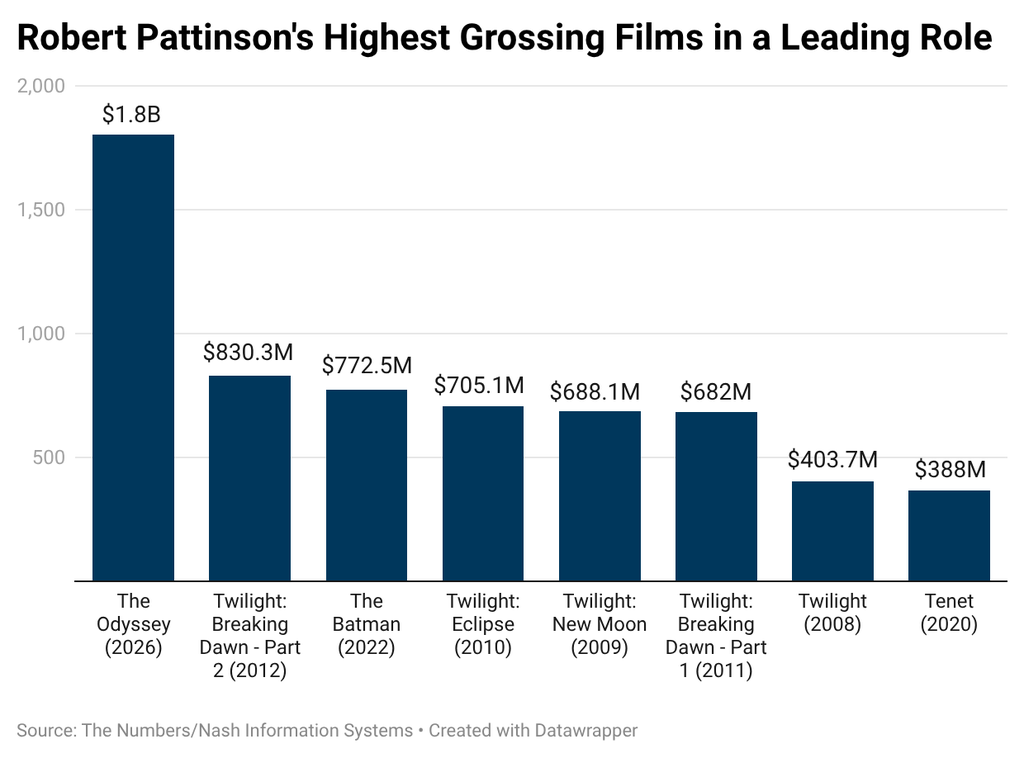
He played a crucial supporting role as Neil in Christopher Nolan’s underrated time travel heist movie “Tenet” and, in his biggest move since “Twilight,” the title role in Matt Reeves’ moody “The Batman,” which freshly reinvigorated the character and earned a cool $772.3 million worldwide.
By 2024, the New York Times asked, “Is Robert Pattinson the Last True Movie Star?” A few weeks later, Pattinson would star in “Mickey 17,” an ambitious science fiction film from “Parasite” director Bong Joon-ho that allowed Pattinson to indulge in his love for quirky affectations (he plays a disposable clone with a funny voice) while also appearing in a mainstream blockbuster. (The blockbuster part was theoretical; ”Mickey 17” lost a ton of money but was embraced by some, embodying a cult favorite.)
By this year Pattinson’s equilibrium had been reached – the ying and yang balanced out, the chakras healed and alighted. He could star in smaller, more esoteric fare while also meeting his commitments as the Last True Movie Star. He appeared in “The Drama,” A24’s hot button romance, and helped it make more than $135 million worldwide alongside Zendaya; he appeared in Christopher Nolan’s “The Odyssey” (Universal’s biggest movie ever) and his off-kilter line reading of “Get these beggars out of here,” became an instant meme; and he starred as Chris Hansen, the former “Dateline” correspondent, in the kaleidoscopic “Primetime,” for “You Can See Everything” director Lance Oppenheim.
The fact that three of the year’s best movies also happen to star Pattinson speaks to both his innate talent and his ability to choose the best, most exciting projects. And that’s before December’s “Dune: Part Three,” in which he stars as an albino baddie — a role he chased after opining to Zendaya, “How do I get in one of those ‘Dune’ movies?” The casting may have been fortuitous — Pattinson worked with Bond director Villeneuve on the trilogy capper.
Now, after years where he favored the indie movie valley, Pattinson is fully entrenched in the studio world, either leading or becoming a part of multiple big budget franchises. The Last Movie Star also realizes that he needs IP – and not just one property, multiple properties. Between “The Batman,” 007 and “Dune,” he’s got a view to a kill.
The new business of movie stars
During the height of Marvel Studios’ box office supremacy, when a movie like “Captain Marvel” could come out and make more than $1 billion worldwide, the common refrain was that the character was the star, not the actor. And while it still might be the case that the number “007” hold more sway than any actor’s name (one agent we spoke to said that Pattinson’s casting “isn’t smart because Bond has never needed a movie star to play the role. The role is the star”), this line of thinking has also lent Hollywood an unwillingness to cultivate new movie stars.
When the property means more than the performer, what’s the hurry?
There are some exceptions, of course. Glen Powell seems like the right man for the job, with preexisting franchises like “Twisters” and “Top Gun: Maverick” and original fare like “Anyone But You” and Netflix’s “Hit Man;” ditto Aaron Pierre, who has anchored originals like “Rebel Ridge” and made DC Studios’ “Lanterns” must-see TV (he’ll bring the character to the big screen in next year’s “Man of Tomorrow”).
But otherwise, movie stars are in short supply. One major filmmaker recently bemoaned the lack of leading men to me, when in decades past we had a deep bench with Tom Cruise, Denzel Washington, Brad Pitt, Tom Hanks and the like. Now the youngest guys in that group are in their early 60s, and there still aren’t suitable replacements.
Perhaps this is why Amazon MGM Studios was so keen to attach Pattinson over other, lesser-known names on the list. Maybe the only way you can really be well-known is to star in multiple properties. If the IP used to be the star, then the way the stars of today can be forged is by putting themselves into several IP-based franchises.
Take Scarlett Johansson, for instance. She is maybe most commercially known for her work as the Black Widow in Marvel Studios’ movies, but she will also star alongside Pattinson in “The Batman: Part II” and is the lead in this new generation of “Jurassic World” movies. Her first dinosaur-filled outing, 2025’s “Jurassic World: Rebirth,” made $872 million globally last year and another one is on the way. Next year, she also stars in a new installment of “The Exorcist” franchise for director Mike Flanagan.
Not that this puts a damper on her smaller work; she’s in Oscar hopeful “Paper Tiger” this year and has a voice role in Brad Bird’s long-awaited sci-fi noir “Ray Gunn,” on Netflix next month. And should Wes Anderson come calling for a week of work, she’ll be there.
In the same way that Johansson has established herself as a movie star through personalizing what would have otherwise been fairly anonymous studio gigs, Pattinson has maintained his personal brand through one-offs and franchise fare.
The Last Movie Star can exist anywhere and everywhere.
Of course, it’s unclear if Pattinson will constantly have to juggle this many franchises at once. According to a source with knowledge of the deal, the protracted production of “The Batman: Part II,” which saw Steven Soderbergh stepping in for director Reeves, has allowed Pattinson to slip out from under his contract, which held the star to a third and final outing patrolling the dangerous streets of Gotham.
TheWrap reached out to Skydance for comment on Pattinson’s contract but didn’t hear back.
Even if he does have to split is time between “Batman” and James Bond, it should be fairly doable. These are massive productions that have long breaks in between movies. Think of the Cronenberg films that he could nestle in between saving the world from various forms of villainy.
The only thing harder than establishing yourself as a really-for-real movie star in this day and age is making sure that your schedule allows for competitive franchises, which are always in one state of production or another (a key pillar of you being a movie star in the first place).
But hey, you only live twice.
Umberto Gonzalez and Jeremy Fuster contributed to this story.
