
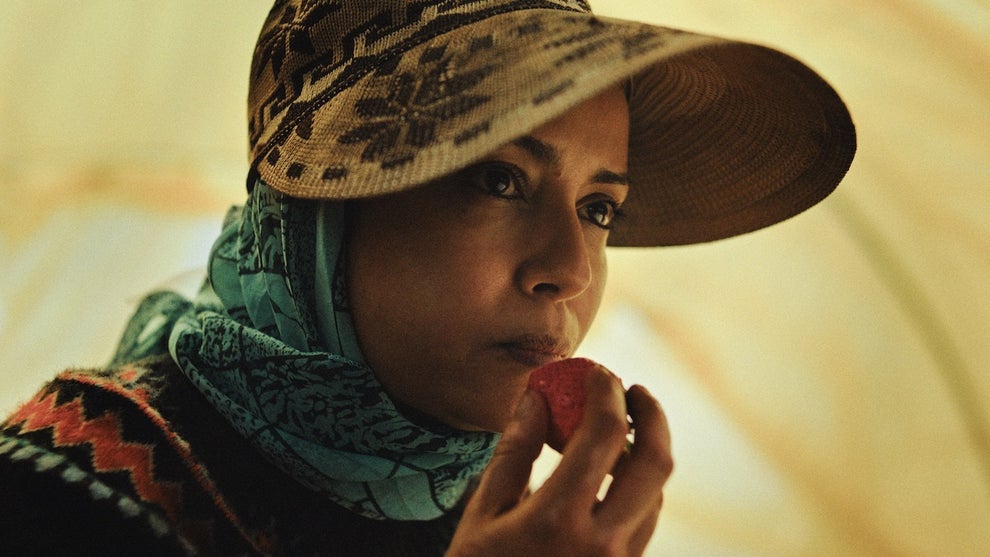
Three of the last four years, the Moroccan entry in the Oscars international race has been directed by a woman and has had a female protagonist — and for the last two years, that woman has found or reached for a sense of joy in tough circumstances. While Laila Marrakchi’s “Strawberries” has a ways to go before it can be this year’s Moroccan entry, it would give the country yet another female director and the fifth consecutive female protagonist.
The big difference is that the women at the center of “Strawberries,” which premiered in the Un Certain Regard section of Cannes on Monday, have precious little chance of finding any joy. Based on real cases, its central figures are immigrants who’ve come to Spain to do agricultural work for which they’re promised as much as 35 Euros a day, only to find brutal conditions and constant deductions in their pay.
Marrakchi, whose previous films are “Marock” in 2005 and “Rock the Casbah” in 2013, sketches the embattled community of workers with affection as they do what they can to survive jobs that are clearly more traps than opportunities. But the film does not pretend that there’s much light at the end of this tunnel. That “Strawberries” doesn’t leave the audience in despair is a tribute to the empathy of Marrakchi’s filmmaking and the life that can’t entirely be extinguished in these women.
The two central characters are Hasna (Nisrin Erradi), an Olympic gold medalist in taekwondo whose career ended in an unspecified (until late in the film) scandal, and Meriem (Hajar Graigaa), a younger woman from the country who becomes Hasna’s friend on the trip from Morocco to Spain.

In the opening scenes, they’re vaguely optimistic; sprightly music plays as a bus of new workers drives through vast fields covered with plastic tarps. The women are let off in the darkness and assigned rooms in makeshift housing, learning quickly that they’re expected to pay all sorts of undisclosed fees, beginning with two Euros for wifi.
Marrakchi depicts the job with brutal directness: It’s hard manual labor, exhausting and repetitive, with pay docked if you stop for any reason, including to take a bathroom break. When Hasna and Meriem shower off the grime after a long shift, one of the farm’s owners, Ivan (Paco Mora), hangs around the shower room and has a private conversation with Meriem that infuriates Hasna.
The film is slow-paced and fragmentary, jumping between the drudgery of work and glimpses of private lives; you can tell a community has been created in the toughest of circumstances, but these are women who are used to keeping quiet lest they endanger what little livelihoods they have. Nobody explains the ground rules or lays out the dangers to Hasna and Meriem; it takes them a while to figure out what’s going on, and it takes us a while, too. (In fact, the times when things aren’t spelled out are more effective than the times when they are.)

When Meriem does begin to figure things out, she ends up with a second job as a cleaner at Ivan’s house, with additional expectations. “To work in their houses, you have to let them take advantage,” Hasna tells her friend. “It’s disgusting.”
Regularly denied work for the skimpiest of reasons, Hasna at one point attacks one of the overseers and tries to take him down with her martial arts skills. Later, she heads into a nearby city and visits a legal-aid office for immigrant workers – not to lodge complaints about the farm, but to see if they can get her a different job.
Aid workers do try to help, but this is a rigged game in favor of the farm owners. The women aren’t being pressured into sex by their bosses, but the police go along with the farm owners and say they’re turning to prostitution of their own volition to make money. Meriem gets pregnant and almost dies of a miscarriage before she’s taken to a doctor, but the owners file a complaint accusing the aid workers of kidnapping her.
It’s one Catch-22 on top of another, but “Strawberries” finds the humanity in the middle of a nightmare. To the extent that it’s based on true stories of exploitation in the Mediterranean, the film is infuriating and saddening; to the extent that it can find a small touch of grace and hope in the faces of the women facing impossible lives, it is a valuable act of defiance.
