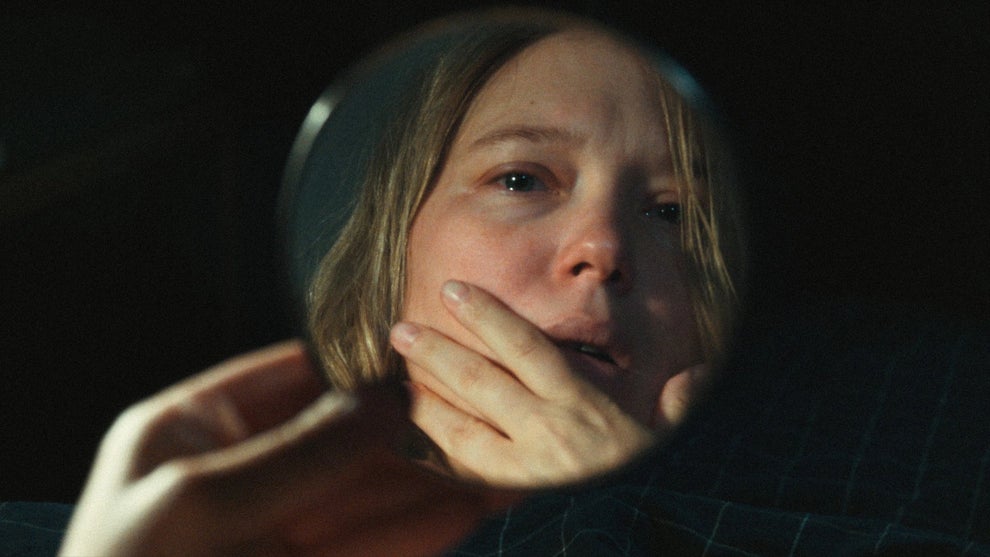
Not since “It Follows” has there been a better PSA for sexual abstinence than Arthur Harari’s “The Unknown,” a disquieting body horror thriller where characters swap bodies after intercourse.
Of course, that comparison may make the film sound like it has more genre elements than it does, when Harari’s film, adapted from the graphic novel he wrote with his younger brother, “The Case of David Zimmerman,” is much more psychologically rattling, opting to leave you with dread burrowed so deep, the only way to be free is to self-flagellate.
Anchored by raw performances from Léa Seydoux and Niels Schneider, who play various permutations of open wounds, it thrives on its terror by committing so fully to its high-concept thrills. You may feel tempted to pinch your skin, to make sure you’re still in the right body.
Indeed, the film’s haunting staying power is in how Harari presents the story’s concept so plainly and without luster, as if our lives can become the very parable unfolding on screen. Through simple camera movements, Harari conveys the film’s themes without overstatement. We meet David (Schneider) in first-person POV as he drives and steps out of his mother’s car. Holding an old photograph, he’s dismayed to find that there’s a large apartment complex in place of where a house should be. He stares at the photo in his hand and the building in front of him, before driving away. It’s devilish foreplay for the dissonance to come, where discrepancy between the real and imagined, the past and the present, marinate in the same physical space.

He begrudgingly goes clubbing with his friends, and as he leaves, cinematographer Tom Harari’s camera zooms in on a negative photo of Seydoux’s character (we don’t know it at this point, but her name is Eva). It feels like our eyes are being pulled into her own, an apt sentiment for what follows. At the nightclub, David spots the same woman in his photo, and he follows her into the basement. The two have painful, protracted sex, which ends with them both wordlessly climaxing. When David wakes up, he finds himself trapped in Eva’s body. Horrified, he tries to track himself down while wrestling with the ramifications of this metamorphosis.
The prickly effectiveness of “The Unknown” is how it showcases how the rest of the world seems to be turned against you after you experience trauma. The familiar is rendered terrifying, and spaces of comfort seem pregnant with a violence we didn’t notice before. It’s that stripping away of familiarity, the transformation back into something strange, that makes the film so unsettling. Seydoux’s Eva, as David, sells this dazed cognizance. It’s easier to portray vociferous outrage than it is a stilted disbelief, and Seydoux’s face is piercing, calibrating her confusion accordingly once David realizes the extent of what’s happened to him.
There’s a sinister sense of discovery to these early body swap scenes as well, where David, in his new body, is in his apartment, as Harari often utilizes handheld cameras in a way that feels like we’re watching a documentary of a new species the camera has just discovered. Arthur Harari captures how swift and violent this swap is, and the madness that accompanies the realization of its permanence. Is it an entity à la David Robert Mitchell’s film? Is it a spiritual attack? A confirmation of simulation theory? David is as much in the dark about the theories as he is about the woman he’s swapped bodies with. He thinks that by locating his own body, he might get some answers, but the truth is far bleaker. Without spoiling too much, David discovers that he’s not a unique case, and that there are many walking this earth in the wrong body for far longer than him, and they’re no closer to finding answers.
With this new wrinkle, “The Unknown” switches to a more existential gear. Can we ever be assuaged of our pain, or is the best we can do in this life to find kindred spirits who empathize? Is it possible to have peace without acceptance? These questions are what make the film cut to the bone. As David said, being forced to interact with the world anew and become a stranger to his own body obliterates his sense of self. How much of who we are is tied to the corporeal?
When that’s lost, are we able to rebuild, or do we spend the rest of our days incomplete?
Where the film gets at its most devastating is when the sleuthing and investigations stop, and David and others who have had their bodies taken from them begin to wrestle with the fact that they may be stuck like this forever.
Early on in the film, David, in Eva’s body, cross-examines the various scenarios for what happened: wondering if it was all a dream or if it’s the result of a bad trip. One reading of the film’s drama is our collective inability to reckon with the senselessness and violence of life. David’s life was upended so quickly, and with no solution in sight, he’ll spend the rest of his life ruminating on that grief. How are we to live when we see ourselves become the passenger to our lives and not the driver, to see the world cruelly and unjustly spinning on, while you’ve experienced such a profound violation? As Harari explores, sometimes it’s more tempting to die than to face the unknown.
