
When most people think of Robin Hood, they picture Errol Flynn, Kevin Costner, Cary Elwes or that weirdly sexy animated fox. They were hunky heroes, the whole lot of them, whether their films were frothy adventures, farcical parodies or badass action blockbusters. They played the version of Robin Hood who robbed from the rich and gave to the poor, which made the character an unambiguous good guy for over half a millennia, even though today he’d be Public Enemy No. 1 on Bari Weiss’ CBS News because he hacked Donald Trump’s crypto to fund LGBTQ Centers during Pride Month. (Where’s that Robin Hood when you need him?)
So it’s a bit jarring to watch Michael Sarnoski’s “The Death of Robin Hood,” which claims Robin Hood was really a homicidal maniac who never helped another human being in his life. Over the course of Robin’s implausibly long career, since he fights people to the death every day and can’t win forever, the legends of his crimes mutated into class war propaganda, which annoys him to no end. He knows he’s a bad person and eventually someone he’s wronged will get lucky and take their revenge. And he’s just old and tired enough to be OK with that — he just won’t make it easy for them.
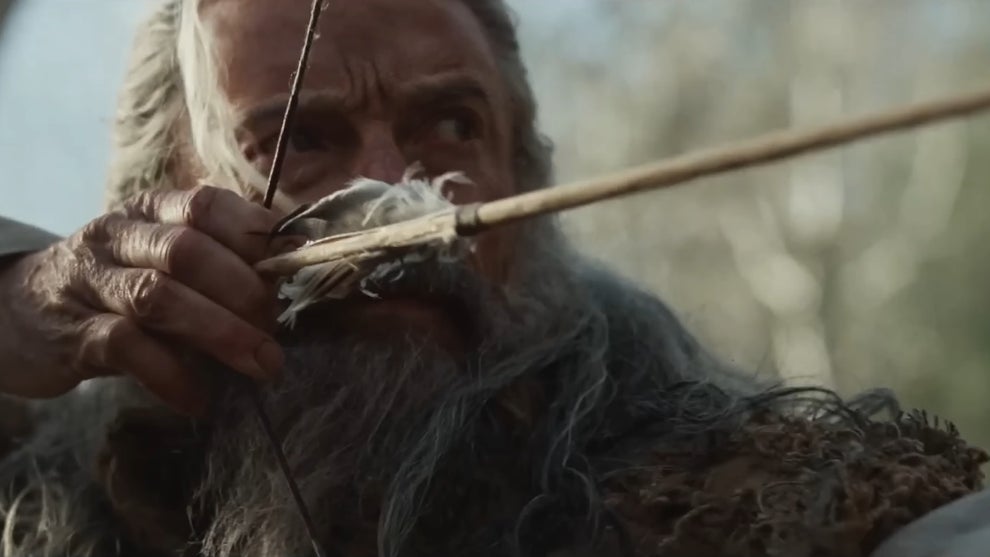
Hugh Jackman plays Robin Hood as a bearded recluse who, in classic action movie fashion, is called back for one last job. His last remaining friend, Little John (Bill Skarsgård), has been living a quiet life on a farm, but his wife and daughter are in danger and he needs Robin’s help. Sarnoski uses this prelude to get all the fight scenes out of the way, since he knows we expect Robin Hood — and Hugh Jackman — to kick at least some butt. But he also uses the time to prove medieval violence wasn’t cool, it was filthy and gruesome.

Robin survives the fight but he’s broken his leg and got stabbed God knows how many times, which would probably kill him since it’s the 13th century and he was punctured by rusty blades in a pile of filth. Fortunately, for Robin at least, Little John takes him to an island where Sister Brigid (Jodie Comer) can allegedly work miracles. Robin recuperates enough to get around, but he can barely walk or pull a bowstring, so he begrudgingly settles in, secure in the knowledge that neither Brigid nor her patients know who he is and plan to murder him. As a bonus, he eventually forms a bond with Margaret (Faith Delaney), a newly orphaned girl he nearly died saving.
The cliché of an aging badass who redeems themselves by protecting a kid is so old it has whiskers on it, but fair play to Sarnoski and Jackman, so does their version of Robin Hood. He is, after all, one of the vigilantes our entire romanticized notion of heroism, especially superheroism, comes from. But if all “The Death and Robin Hood” accomplished was giving Robin Hood the “True Grit” treatment, it would have been a waste of time. It might have been a well-crafted waste of time, since Sarnoski is nothing if not a skilled storyteller, but a waste of time nonetheless.
Instead, “The Death of Robin Hood” deconstructs the fundamental concept of action heroes and action filmmaking. There’s violence, but the point is that violence has to end, so here it finally does. Sarnoski’s handsomely photographed, absorbingly scored picture is pensive and mournful, teasing the possibility of atonement but arguing, in the end, there comes a point where you’ve done so much wrong that nothing you will ever do will balance the scales. Robin Hood, played quietly and astutely by Jackman, was never self-aware enough to cease his acts of villainy, but yet at the end of his life, he realizes, if nothing else, he really screwed up and his legacy will only lead to more violence for generations. Maybe even centuries.
The elephant in the room, of course, is that Jackman played this part before. It’s tempting to compare “The Death of Robin Hood” to “Logan.” It’s also appropriate, so let’s dig in: Both films star Jackman as a legendary hero at the end of his life, scarred in every way, who returns to his violent ways to save a young girl. But while both films argue that living a life of violence is tragic, whether you’re a hero or a villain, “Logan” still functions as an action movie. It’s sad that Jackman’s character endures so much, but it’s also rad as hell, in a relatively mature way.

“The Death of Robin Hood” quickly abandons its depictions of violence, after going out of its way to make it look as ugly as possible. This makes it less thrilling but conveys the same message more effectively. And since “The Death of Robin Hood” probably won’t have a sequel where Robin learns violence is fun again while teaming up with a wacky metahumor Ivanhoe, I think that gives Sarnoski’s film the edge.
If you’re attached to the idea of Robin Hood as a heroic anticapitalist class traitor, “The Death of Robin Hood” may be hard to swallow. To be fair, this is like learning Batman was real (yay!) but also a serial killer (boo!). At least, Sarnoski plays fair, adapting the rarely dramatized 17th century ballad that tells Robin Hood’s final story. But the original still made Robin Hood out to be a hero. Sarnoski can’t seem to imagine a world where anyone who does what Robin Hood does, regardless of his legacy, has life worth saving. It’s Christopher Nolan’s “Batman” if Nolan thought Batman was a terrible role model (and also hated action movies).
Michael Sarnoski dipped in complex moral waters before, in his brilliant directorial debut “Pig,” and wasn’t opposed to incorporating old-fashioned excitement while directing his otherwise thoughtful “A Quiet Place: Day One.” His latest isn’t deep enough or captivating enough to make the same impact as his previous movies, but it’s a mature work that makes a valid point, and Hugh Jackman gives an excellent lead performance. “The Death of Robin Hood” hits the target and that’s enough. It doesn’t also need to split Sarnoski’s earlier, better films in twain.
