
Credit where credit is due, director Zack Snyder has accomplished much in his career. First beginning as a commercial and music video director, over the past several decades he’s steered massive epics, offered new takes on classic superhero stories, and even created his own (nominally) original sci-fi universe. While continually divisive, to ignore his accomplishments is to do him a disservice.
With that being said, there is only one noteworthy accomplishment to be found in his latest feature “The Last Photograph,” and it is this: it is one of the worst films to ever screen at a major film festival. Running for 135 miserable minutes, it’s a film as overstretched and repetitive as it is undercooked, playing like a straight-to-video action movie of yesteryear that has been put through a blender, given a regressive core, and spit out on the screen.
Whether the resulting sludge makes its way out into the world in its current form is genuinely an open question, as it’s hard to imagine even the most die-hard of Snyder fans sticking with this one all the way through. Even if it were cut down to at least feel less interminable, that would just be rearranging deck chairs on this irredeemable cinematic disaster.

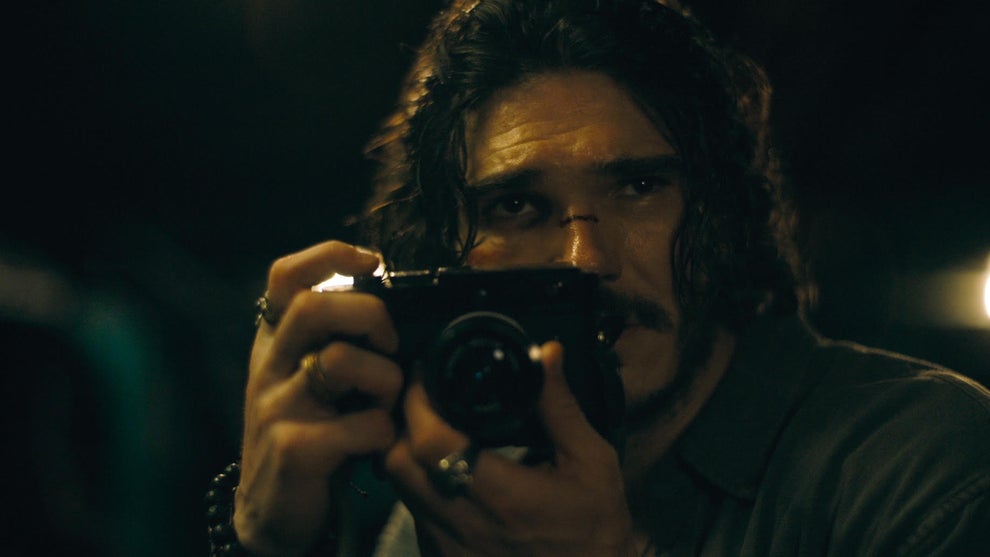
Ugly on both a formal level and on a narrative one, “The Last Photograph” — for which Snyder serves as director and cinematographer, and which was made independently — uses its insultingly generic “South American” setting to tell a haphazard revenge/rescue story about a former DEA agent (a one-note Stuart Martin) and a troubled photographer (an equally forgettable Fra Fee).
Characters, especially the women, lack anything approaching dimension or layers, existing as objects to be desired or put to death again and again. Despite making painfully strained attempts at profundity, Snyder gets completely lost in the jungle alongside his characters.
Reveling in gruesome violence to such a degree that you feel like your soul is being poisoned while watching it, the film opens with a brutal killing at a birthday party that is juxtaposed with a sex scene. This is the first of many moments where Snyder, working from a screenplay by his longtime collaborator Kurt Johnstad, seems to be throwing everything at the wall to see what will stick. But rather than be provocative in any meaningful way, it’s all just ugliness for the sake of ugliness. Children are shot in the head, people plead for their lives, two siblings are abducted, and Snyder’s queasily leering camera lingers on all of the depravity.
And that’s just the beginning of the movie.
The aforementioned former DEA agent Ethan soon learns of the killings via a photo taken by the sole survivor and photographer, Joe, and sets out with him to find the killers as well as the missing children. They’ll have to travel a long distance, getting into one repetitive confrontation after another that increasingly makes your eyes want to roll back in your head, and Ethan will have to face down a painful past we see through aggressively self-indulgent flashbacks. The awkwardness morphs into unintentional comedy at key points, with clunky lines of dialogue spoken through voiceover.
Not only is the film both unrelentingly grim and shallow, but there is so little actual care given to understanding more about this harsh world we’re thrust into. There are brief references to some sort of sociopolitical context informing the events of the film and a few half-hearted monologues about violence, though it’s clear Snyder couldn’t care less about any of it. He shoots the whole thing like the violence is actually the coolest thing in the world, dialing up the brutality with explosions and heads detonating before our eyes at every turn.
A passion project that he’s been trying to get made for decades, Snyder seems to want “The Last Photograph” to be something closer to “Apocalypse Now” or “The Searchers,” but he is no Francis Ford Coppola or John Ford. Instead, it comes across as a bad video game. The longer it goes on, the more this uninspired film feels like a scattered series of broadly sketched cutscenes rather than an emotionally meaningful meditation on violence.
When the film bizarrely tries to get serious with its subject matter, it only reveals its disastrous inadequacies. There is a moment where Joe confesses how, as a photographer, coming upon scenes of violence leaves him not mourning those who have been lost, but wishing he could make them look more visually interesting in his camera. But where something like the recent “Civil War” explored such tensions with subtle effectiveness, Snyder lacks any such restraint.
Indeed, the film has more in common with Joe given how it attempts to make its ugly violence aesthetically exciting, rather than focusing on the emotional impact of such devastation.
No matter which way you look at it, there’s nothing remotely insightful or interesting to the vileness on display here. It’s all just shootouts and CGI blood effects before it stumbles into a baffling ending that drags on for so long, you wonder if it exists purely to make us suffer for even longer.
If his future films are going to be like this, it’d probably be for the best if this was Snyder’s own last picture.