
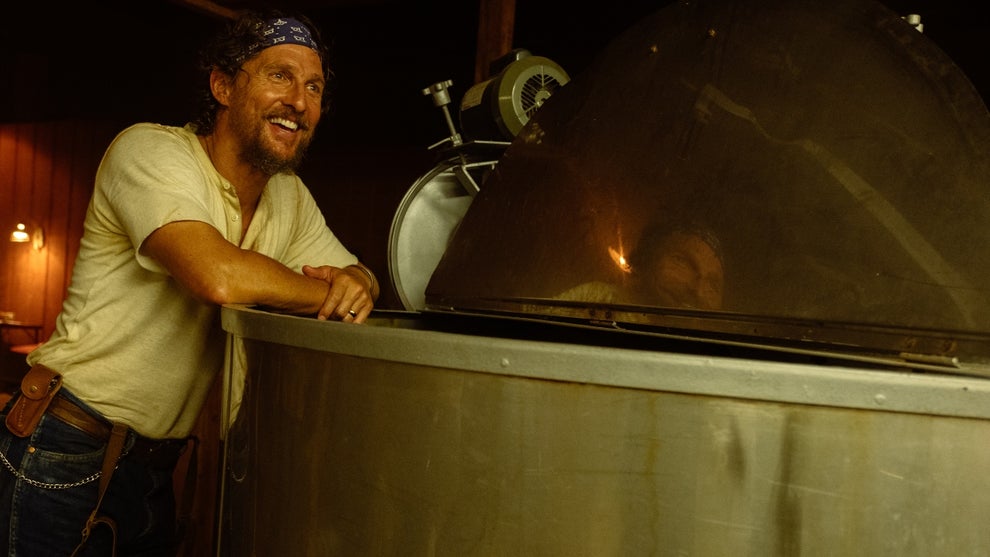
Andrew Patterson.
It’s a fairly anonymous name. But it’s one that you should remember. Because Patterson is one of the most exciting and vital American filmmakers working today, and his sophomore feature, “The Rivals of Amziah King,” out this Friday from Black Bear, is the kind of exuberant, expertly crafted follow-up film that makes you think that you’re watching one of the best films of the year before the title sequence finishes. (By the time the end credits roll, you’ll know that you’ve just watched one of the best films of the year.)
A tale both intimate and epic, “The Rivals of Amziah King” stars Matthew McConaughey as the title character, a bon-vivant in the rural south – harvesting honey, playing in a local band, trying to do right. He reconnects with a young woman who he had adopted when she was younger (newcomer Angelina LookingGlass) and brings her into the family business. He teaches her about honey and bees and the interconnected ways that bees and humans are braided together. Eventually the movie shifts into something slightly darker, taking on the contours of a heist movie or a southern-fried revenge tale, revealing its novelistic sprawl.
It feels like an ambitious second album, where the band decides to hire an orchestra and get Rick Rubin to produce.
And “The Rivals of Amziah King” is a long time coming. Patterson’s first film, “The Vast of Night,” which he self-funded, premiered at the Slamdance Film Festival in 2019 after being rejected, Patterson said, by 18 film festivals. The film, a canny riff on “The Twilight Zone” set in a small town in the 1950s that is beset by a possible alien invasion, was “languishing in film festival hell” until Slamdance. Amazon picked it up shortly after and it arrived on Prime Video during lockdown in 2020.
After “The Vast of Night,” Patterson said, “My whole life changes.” Before the movie, he had his own production company in Oklahoma and he self-financed “The Vast of Night,” partially using money he’d made while shooting commercials for the Oklahoma City Thunder. Following the film’s premiere, “Get new reps. Get new connections. Have people sending me stuff.”

Steven Soderbergh, he said, asked him to direct a movie for him – “a big one.” “And I told him I wanted to step up to something like that,” Patterson said. Other studios offered him huge franchise movies. And it’s easy to see why – “The Vast of Night” shows that he’s able to nimbly handle genre fare but imbue it with something emotional and true. Nothing else felt like “The Vast of Night” because nothing else could.
In the aftermath of the sci-fi indie, Patterson talked to J.J. Abrams’ Bad Robot about doing a new installment in their “Cloverfield” film series, but was worried about what he felt would be a long development process. He also wrote a pitch for a new iteration of “Invasion of the Body Snatchers” that nobody really understood (“I still think it’s a fantastic idea,” he said). Weirdly, we are sitting at a table behind what used to be Bad Robot’s office in Santa Monica, next to a fire pit which is belching flames. It is 90 degrees.
Patterson also imagined returning to the “Paradox Theater,” the “Twilight Zone”-style framing device of “The Vast of Night” for another spooky one-off. “You can do whatever you want,” Patterson said. But not now. “It needs to be far enough away that we that we appreciate what we’re doing the second time out, so that it’s not just like a cash grab,” he said. Patterson knows that there are filmmakers who have a big hit, try something else that doesn’t work very well and then immediately retreat to a sequel to that initial hit. He doesn’t want to do that.
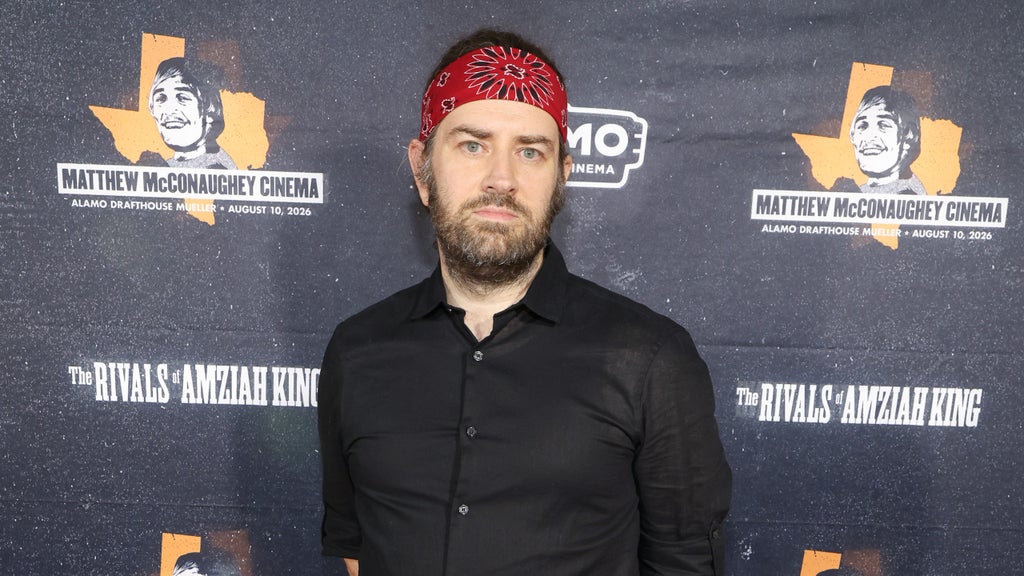
The intimate origins of “Amziah King”
Instead, he thought back to an idea that he had while “The Vast of Night” was languishing, waiting for a film festival – any film festival – to welcome it through the door. This idea involved bees.
“When I wrote it, it was the smallest thing. I wrote it thinking it was going to be the thing that I died making because I couldn’t get the first movie into the world. I literally wrote it being like, Alright, if I’m going to go out, I’m going to go out dying on a field from a bunch of bee stings,” Patterson said. He knew people in Oklahoma who had a bee farm and wrote it in a way that he could use locals to perform in the movie. Patterson didn’t need anything or anybody.
“I wrote it in a way that looked almost reckless in terms of what I would want to see in a movie, and to be honest, that is the best place to write a script. That’s when you’re the most creative and the most willing to risk it all on things that nobody would normally do in a script,” Patterson said.
But it didn’t exactly work out that way.

David Heyman, the British producer of the “Harry Potter” films, “Gravity,” “Barbie” and “Once Upon a Time in Hollywood,” had seen “The Vast of Night” and committed to producing whatever Patterson’s next movie wound up being. (In the extravagant second album analogy, Heyman is Rick Rubin.) Heyman started talking to Patterson during lockdown and the two would have long conversations at odd hours (Heyman is based in England), talking about the script and how they would secure financing.
“From there we went out to protect the script that I’d written because it was written in a sacred place when nobody could influence how or what it was. It was written in this stage of my career where I was the most creatively untouched by the need for box office or the need for approval,” Patterson said. “I literally just thought I was going to run out and make it, and I was just going to put it on a shelf. But I needed to create something in that window, and so the number one thing I did over the years that it took to get it to theaters was I protected that vision.”
Enter Matthew McConaughey.
When Patterson first approached the actor, he was busy, but the film ended up getting pushed a few months and when they returned to McConaughey, the timing lined up perfectly. A project the actor was set to do had fallen through at the last minute and, in Patterson’s words, he was “hungry to work.” They delivered the script over a weekend and by the following Tuesday, McConaughey had committed.
“Matthew was the great creative collaborator on this movie, mostly because he always wanted to define what was going on under the hood of this narrative at all times,” Patterson said. “He would say things to me like, ‘Look, whether you know it or not, this movie is about a princess becoming a queen. How can we make sure in every single scene of this movie we underline that?’” The idea informed how Patterson framed the actress, and her character’s transition from being quieter to a truly imposing figure. Patterson would ask McConaughey questions about his character but also the larger world of the movie and take those insights to heart.
“But the most important thing Matthew did for this movie is he protected my vision,” Patterson said.
When I asked from who, Patterson demurred.
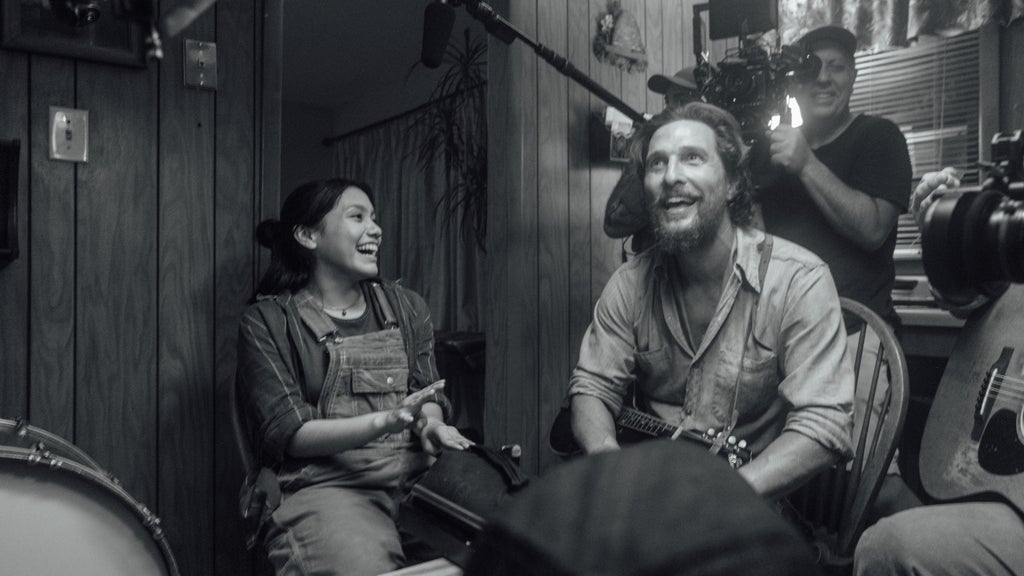
Reshoots, test screenings and a bet on a new distributor
The filmmaker admitted that the movie did drag on. While they finished principal photography in 2023, they did additional photography in 2024 (“You shoot a movie in the summer and then you post over the winter. Well, you can’t just run out and grab a whole bunch more photography in the middle of America. Leaves turn brown and they fall off trees, and the grass turns”). Patterson admits that he spent a long time in the edit; he spent a year editing “The Vast of Night.”

Once he had the additional photography, Patterson assembled a version of the movie that he was happiest with (it was still a little too long, he admitted). Still, he had to defend his vision. The financiers assembled a separate cut and they screened both versions for separate audiences and compared the scores.
“That ended up becoming, quite honestly, the best thing that could have happened for the movie. In that case, we were able to see that the thing that I was putting into the world was working for audiences,” Patterson said. “And at that point it was, Alright, go with God.”
To put into perspective how rare it is for a filmmaker to screen their version of a movie against a more studio-mandated version and have the filmmaker come out on top, Patterson’s agent Mike Simpson at WME told him that the last time he had seen it happen was on “Turner and Hooch.” That was almost 40 years ago.
The version that he tested, Patterson said, was the same one that premiered months later at the 2025 edition of the South by Southwest Film Festival, a festival that was chosen strategically. “We didn’t want it to premiere at the wrong place, because all of a sudden that changes how it’s first understood,” Patterson said. “Where you premiere actually affects the early understanding of what the movie is.”
After the SXSW premiere, Patterson said, “we knew that this thing was unique.” The reviews were glowing out of the festival. (The Film Stage called it a “gleeful genre mash-up;” Variety said it was “a bluegrass western thriller” that could turn LookingGlass into a star; and the Hollywood Reporter pointed out that there was “an admirable audacity to the film.”) Patterson and the team got offers after the SXSW premiere (“some good ones in terms of the people that we’re going to put it into the world that have incredible track records and how they build the taste-making around I guess what you’d call ‘important cinema’”). But instead, he stuck with Black Bear, one of the production companies on the movie.
“Black Bear understood that they wanted to become the company that started to build out not just a bare bones – a publicist, a marketing head, and like a social media person, which has happened in the past. We’ve seen that happen a few times, where people think, We can just go get three or four folks and just try to call it a distribution company,” Patterson said. “Instead, they hired about as good of people as were available, or in some cases weren’t even available, and brought them in and built out what ends up being Black Bear Distribution.”
Black Bear’s first title as a distributor was last year’s Sydney Sweeney boxing movie “Christy,” and it recently released the Leo Woodall thriller “Tuner.” The studio is riding the online buzz of “Wicker,” a Sundance acquisition starring Alexander Skarsgard as a literal straw man, which will be released in theaters later this year.
Black Bear, Patterson said, “has made me feel like this is their crown jewel in a way.”

McConaughey wisdom
In the long and winding way to “The Rivals of Amziah King” being released, does Patterson feel validated?
“I understand story and narrative and in my bones, in a way that I never doubted this movie. What I wanted was for it to reach the most people possible and every creative that is worth their salt are two things – they can be precious, and they can be fragile. And if you’re not either of those things, your work over time will resemble something coming off of an assembly line,” Patterson said. “I was definitely precious about things that I needed to understand how to make it work better. And McConaughey was really helpful in this.”
McConaughey told Patterson that when he was writing his memoir “Green Lights,” there were eight stories that his publisher wanted him to cut. McConaughey was incensed; that was some of the best stuff in the book. But he told Patterson, “What I learned was that I hadn’t gotten them to a place where they were making the most sense and they could be relatable.” When Patterson was editing “The Rivals of Amziah King,” he would talk to McConaughey about the movie and think, What could I do, without losing anything that I wanted in the movie, to continue to hone and refine and build better versions?
Patterson would call Soderbergh and ask for advice. “He once told me, ‘Cut the movie to 60 minutes just to see it,’ which I never did by the way, but it’s an interesting idea,” Patterson said. Still, he appreciated the advice.
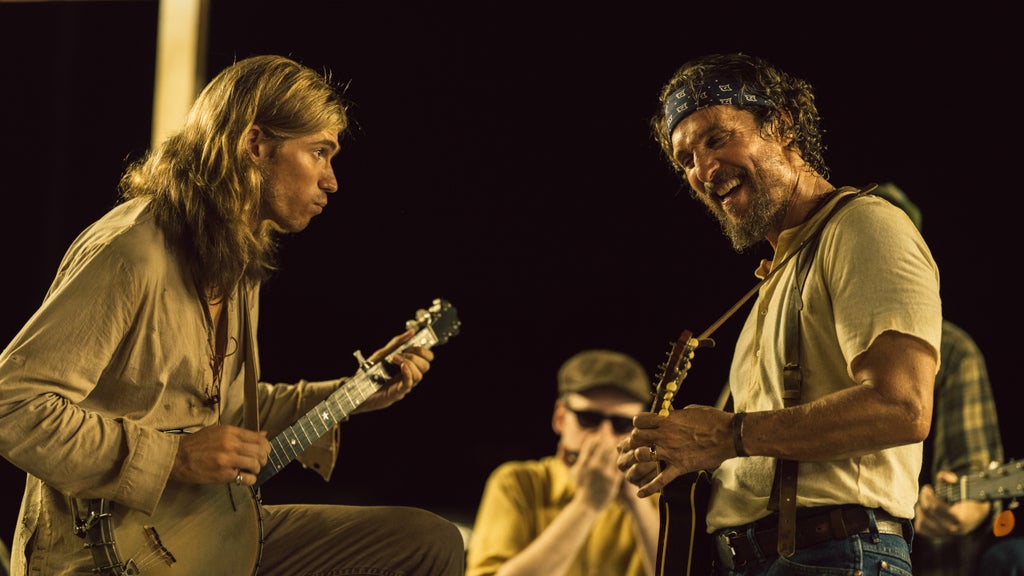
“It was never that I lost my way, and I never doubted what I had created, but I did want the thing that I thought would be 100% my vision, but also the thing that would create the best experience for a viewer one day when they sat us up,” Patterson said.
Now that he’s done, he said that he has “a number of scripts on standby.” Some are more international-leaning, requiring a global shoot. Some of his ideas are nearly as small as “The Vast of Night.” There’s one that is a “misshapen” (in an “interesting” way) true-crime movie, set in the 1960s and ‘70s, that Patterson likens to David Fincher’s “Zodiac.” Much of it depends, he said, on how “The Rivals of Amziah King” goes over – and how “everything comes together after this one.”
But he also keeps circling back to having a “patron” – a partnership, either with a studio or a powerful producer, that can allow him to flourish artistically and commercially. He spoke lovingly of the relationship between Paul Thomas Anderson, then a young auteur, and Michael De Luca, who at the time was a hotshot New Line executive. There were things that allowed that partnership, which produced “Boogie Nights” and “Magnolia,” to flourish, like DVD sales offsetting the box office numbers. Patterson longs for that kind of connection.
“There are other things that I wrote that I want to make that I need the right circumstances, the creative control, and the right partnership to do,” Patterson said. “You need the kind of place that gives you room to try things. Maybe fall on your face. Maybe have an edit that’s too long. Maybe figure it out that way. And also wants you to make it the way you like to make movies. I’m still a scrappy filmmaker in a lot of ways.”
Still, he would love to accelerate his output. The analogy he uses – “And I don’t smoke,” he’s quick to point out – is to take the cigarette he’s smoking and use that cigarette to light the next one “with the last ember of the one in my lips and just start into the next one.” “Then continue it so that it goes production after production after production. That would require me to be a little less precious about post and things like that, so that I’m not needing so much time,” Patterson explained.
And while he might have been flirting with IP before “The Rivals of Amziah King,” he admitted that he’s not “running towards a novel or a video game or a theme park ride” to adapt.
“Not everything is a great shape for a movie,” Patterson said.
And what would an Andrew Patterson movie be, without those sharp bits?
