
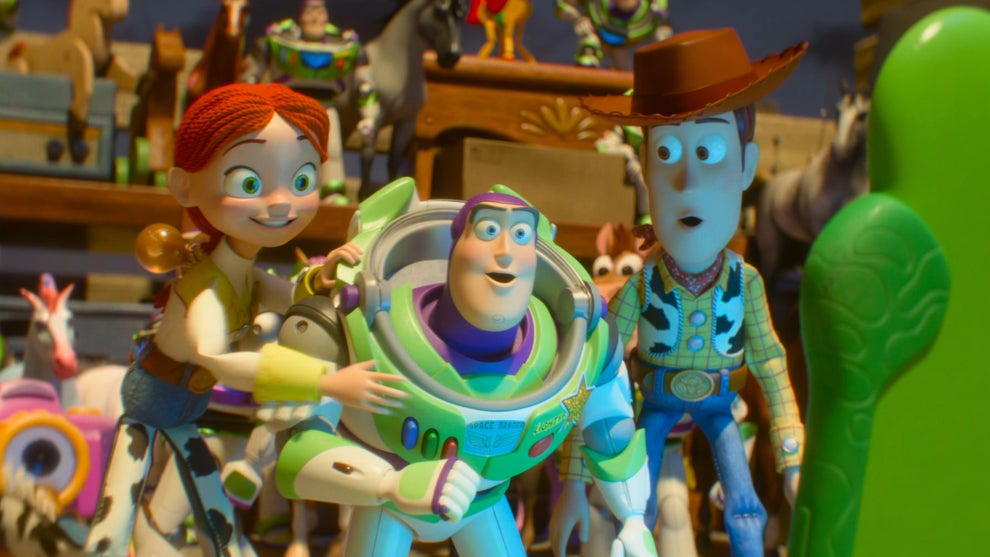
Thirty-one years and five movies ago, “Toy Story” introduced audiences to a world where toys come to life when children aren’t around. What a concept.
The original told a tale about a child’s favorite toy who feels threatened after a new, high-tech toy arrives and tries to replace them. Over the course of three sequels, the toys process the depressing fact that children grow up and stop loving them, confront the horrors of their own mortality and at least one of them overcomes the extremely unhealthy codependency problem which, apparently, all toys have.
We sure have come a long way. Now, with “Toy Story 5,” it’s finally time to a tell another new story. This one is about [checks notes] a child’s favorite toy who feels threatened after a new, high-tech toy arrives and tries to replace them. What a concept.
There’s nothing particularly wrong with “Toy Story 5.” It’s likable and entertaining, in a distractingly familiar way. It’s just hard to shake the idea that “Toy Story 3” was the natural ending to this series. “Toy Story 3” brought the life of a toy to a meaningful conclusion, then closed with a stirring and well-earned moment of rebirth. The cycle continues, “Toy Story 3” argues, but it just kept continuing, in one sequel after another. “Toy Story 4” felt pretty forced, and now “Toy Story 5” is merely repetitive. Enjoyable, but repetitive. Repetitive, yet fun. Repetitive, repetitive, repetitive. And let’s be honest: Repetition can be useful when making a point, but it’s hardly brilliant writing. (Ahem.)

In “Toy Story 5,” Bonnie (Scarlett Spears) loves all her toys, especially the cowgirl Jessie (Joan Cusack). The problem is, she can’t make real friends. All the other kids in Bonnie’s neighborhood abandoned their toys. Now they just zone out with their tablets. Bonnie’s parents think she’s too young for a smart device but you can’t sit out a zeitgeist forever, especially when you’re a kid, so they buy Bonnie a LilyPad (Greta Lee), a tablet which is also kind of a toy, because otherwise it couldn’t come to life and talk to Bonnie’s other playthings.
LilyPad helps Bonnie make new friends, but they bully her online. Jessie vows to find Bonnie a friend who doesn’t stink out loud and has at least some of the same interests. What a concept. The rivalry between these two favorite toys comes to a head after one of them gets lost outside the house and in the home of another child. And yes, this is still a lot like the original “Toy Story.”
And just like “Toy Story,” there’s a group of identical sci-fi toys with a cult-like, delusional belief that they belong on a higher plane. This time it’s an army of Buzz Lightyear action figures which fell off a boat and washed up on a beach and awakened themselves, and go searching for “Star Command.” If you were confused about the logic of sentient toys after the “Forky” subplot in “Toy Story 4,” these Buzz Lightyears somehow make the rules more confusing.
The thing about the “Toy Story” movies, and a lot of other Pixar films, is they don’t operate on pure logic. Anthropomorphic toys, cars and fish spring from a childlike imagination, so all that matters is that they’re in exciting, emotionally involving stories. Problems only arise if Pixar repeatedly revisits the same fantasy for decades and develops new storylines based on an internal logic that was never clearly defined. There’s no reason to question why toys don’t tell the world they’re sentient if the story is just about one toy who’s jealous of another. But after we find out toys are so emotionally dependent on their owners they become despondent, hateful and/or willing to accept the sweet release of death, the answer seems relevant.

So a platoon of living toys that don’t know they’re toys, on the loose, with no knowledge of their place in the universe or the rules they’re supposed to obey, raises interesting questions about what might happen if those toys finally, accidentally, revealed the great big secret. But instead of going somewhere exciting — or anywhere, really — all the frequent cutaways to these Buzz Lightyears accomplish heavily telegraphing a deus ex machina. (Or, since they’re toys, a deus ex ludicrum, which sounds more fitting and more fun.)
Again, this is what an adult thinks about while watching a movie for children. It would be dishonest to claim that adults aren’t in the target audience for the “Toy Story” movies — Woody and Buzz hardly need to show up this time, except for the nostalgia factor — but these films are still designed for kids, and kids will appreciate the love Jessie has for Bonnie and the lengths she goes to just to make a little girl happy. Even LilyPad has Bonnie’s best interests at heart, although she eventually realizes the Internet is a lousy toy and Bonnie is far too young for the stresses of social media. It’s not a nuanced message about the dangers of modern tech, and kids will be forgiven for crossing their arms and snarking “OK Boomer,” but it’s not an awful message either.
“Toy Story 5” is an easy movie to like. It’s just too redundant to completely respect. Pixar is playing the old “Toy Story” hits and hoping you won’t notice they all sound alike. We’ve noticed, and we reserve the right to criticize. But hey… it doesn’t sound bad.
