
After decades of hit-or-miss success at best, video game adaptations are red hot thanks to the billion-dollar box office of films like “Minecraft” and “The Super Mario Bros. Movie.” Now two of the biggest video game franchises around are poised to have their own feature film adaptations around the same time.
The rivalry between “Call of Duty” and “Battlefield” that’s been playing out with video game publishers Activision and Electronic Arts, respectively, over the last two decades is now making the jump to the big screen. And the potential upside for Hollywood jumping on these military shooters is huge.
Last month at CinemaCon, Paramount planted a flag on a June 30, 2028 release date for its “Call of Duty” movie, with Taylor Sheridan and Peter Berg writing and Berg directing an adaptation of the popular first-person shooter that finds gamers playing soldiers across different decades and in different wars.
Just a week later, Electronic Arts (EA) sent its “Battlefield” package — with “Mission: Impossible” filmmaker Christopher McQuarrie attached to write and direct, and Michael B. Jordan producing and potentially starring — out to buyers in what is shaping up to be the biggest bidding war of the year.
As TheWrap exclusively reported, Warner Bros., Amazon MGM Studios, Universal, Sony and Netflix put in bids for the uber hot “Battlefield” property, also a military-themed first-person shooter. And now the race is on.

The silver screen will soon pit the “Call of Duty” and “Battlefield” franchises against each other after the two have duking it out on consoles and PCs since practically the turn of the century — selling hundreds of millions of units in the process. The escalation to a feature film rivalry was the logical next step, and it sets up a Marvel vs. DC-like battle of the brands that underlines the rise of video game adaptations as superheroes fall out of favor at the box office.
And if the last decade has taught Hollywood anything, it’s that rivalries sell tickets, and the disparate audiences of these two franchises could signal a win-win scenario for all, despite their similarities.
“The adaptations of ‘Call of Duty’ and ‘Battlefield’ represent part of a developing trend in which existing fanbases of franchises serve as guaranteed audiences for transmedia adaptations,” Ricardo Parsons, analyst at Ampere Analysis, tells TheWrap. “Video game adaptations have been on the rise since the second half of 2023, with no fewer than 25 being announced in each half-year since.”
The numbers tell the story. Since 2003, “Call of Duty” has been the 800-pound gorilla, selling more than half a billion units. “Battlefield,” on the other hand, has moved roughly 91 million units since 2002. “Call of Duty” has always dominated the sales charts, but a flash bang grenade detonated last year that changed everything.
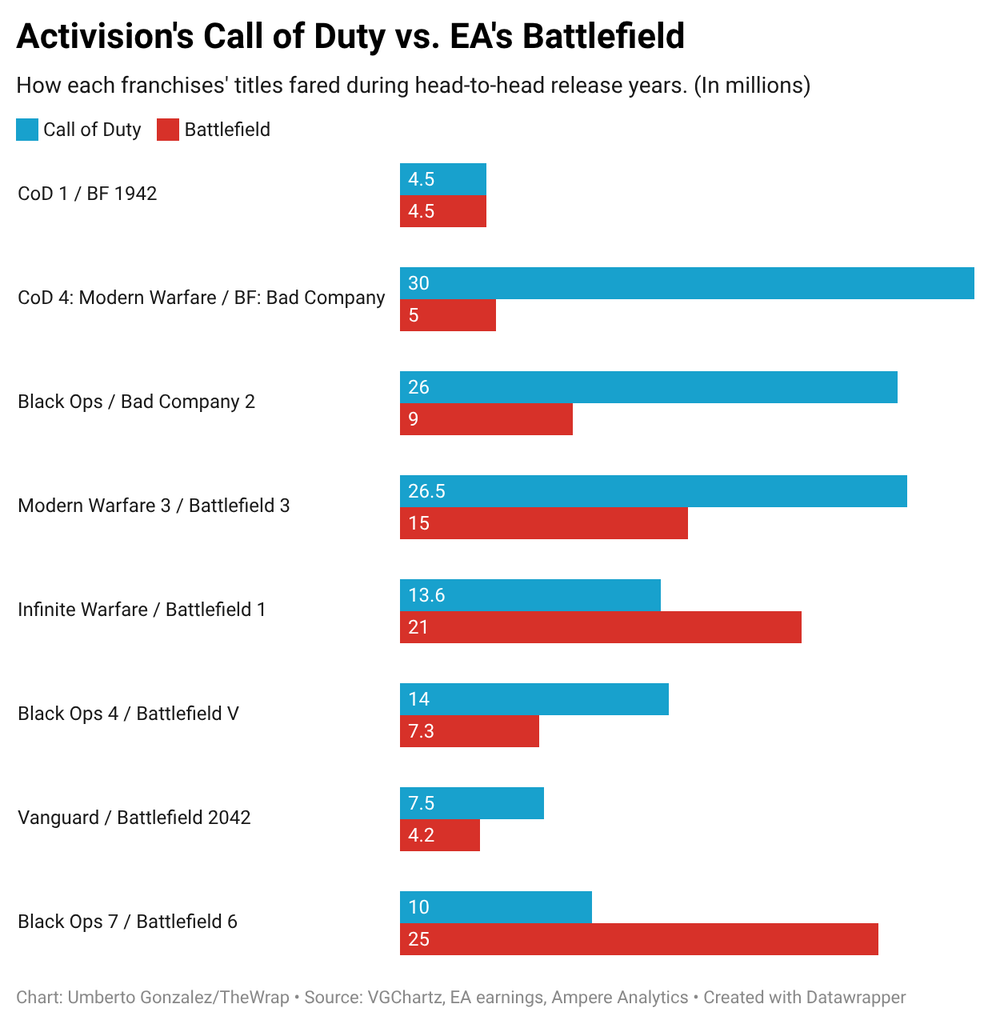
In 2025, “Battlefield 6” outsold “Call of Duty: Black Ops 7” — the first time EA’s shooter beat Activision’s shooter in domestic sales in nearly a decade (2016’s “Battlefield 1” was the only other title that beat out a “Call of Duty” game, “Infinite Warfare”). That huge commercial win gave EA the momentum it needed to finally make a Hollywood push. Within months, the company had McQuarrie, Jordan fresh off an Oscar win and a massive package ready for buyers.
“Call of Duty”: Paramount’s tentpole bet
A “Call of Duty” movie has been a long time coming, given that it’s the best-selling first-person shooter video game franchise of all time. Over two decades, its online multiplayer gameplay has played host to millions of fans, playing soldiers wading through various conflicts and time periods.
Activision President Rob Kostich, who is also a producer on the film, said in a video at CinemaCon that the team was only interested in making a “Call of Duty” movie with “the right leadership, someone who cares about the IP as much as we do.” Berg, who appeared alongside Kostich and directed several military-themed films like “Battleship” and “Lone Survivor,” said he feels “deeply connected to the special operations community” and wants to bring that same authenticity to the screen.
The film’s June 2028 release date will coincide with the 25th anniversary of the original “Call of Duty,” which was released as a PC game in 2003. Originally conceived in a World War II setting, “Call of Duty” changed gaming history forever with its fourth installment in 2007, “Modern Warfare.” A critically acclaimed and influential title that, as its title suggests, brought “CoD” into the modern age, it influenced several generations of war shooters that came afterward.

For Sheridan, who is co-writing the film with Berg, “Call of Duty” will mark the last major project at Paramount, his longtime home where he developed smash hit shows like “Yellowstone,” “1923” and “Landman.” When his contract expires in 2028, Sheridan will move to NBCUniversal, where he will develop film and TV projects as part of a landmark $1 billion production deal with the company.
Both Sheridan and Berg are drawn to grounded, working-class American heroism. Their “Call of Duty” is expected to be gritty, boots-on-the-ground and emotionally hard-hitting. “Call of Duty” built its brand on tight, cinematic single-player campaigns and an addictive multiplayer component that turned online gaming into a lifestyle.
Paramount is banking on “Call of Duty” as one of its centerpiece franchise launches, and even Paramount CEO David Ellison has said he is personally a fan of the game and has “spent countless hours playing this franchise that I absolutely love.”

“Battlefield”: The package in play
The “Battlefield” adaptation has a decidedly different filmmaking team at the helm.
McQuarrie spent the last dozen years creatively quarterbacking the “Mission: Impossible” franchise for Tom Cruise, directing “Rogue Nation,” the critically acclaimed “Fallout” and the back-to-back installments “Dead Reckoning” and “The Final Reckoning” — and steering several high-flying practical stunts in the process.
Jordan is producing “Battlefield” through his Outlier Society banner and remains in early talks to potentially star as an original character that McQuarrie will develop, according to a person familiar with the talks.
McQuarrie is a specialist in large-scale spectacle. His “Mission: Impossible” films are the gold standard for sustained tension and practical action, and he also produced and co-wrote smash hit “Top Gun: Maverick” and directed Cruise in 2012’s “Jack Reacher.” He specializes in adrenaline-fueled thrill-rides that take a straightforward yet effective approach to their action. A “Battlefield” movie in his hands would likely play bigger, broader and faster than Paramount’s take on “Call of Duty.”
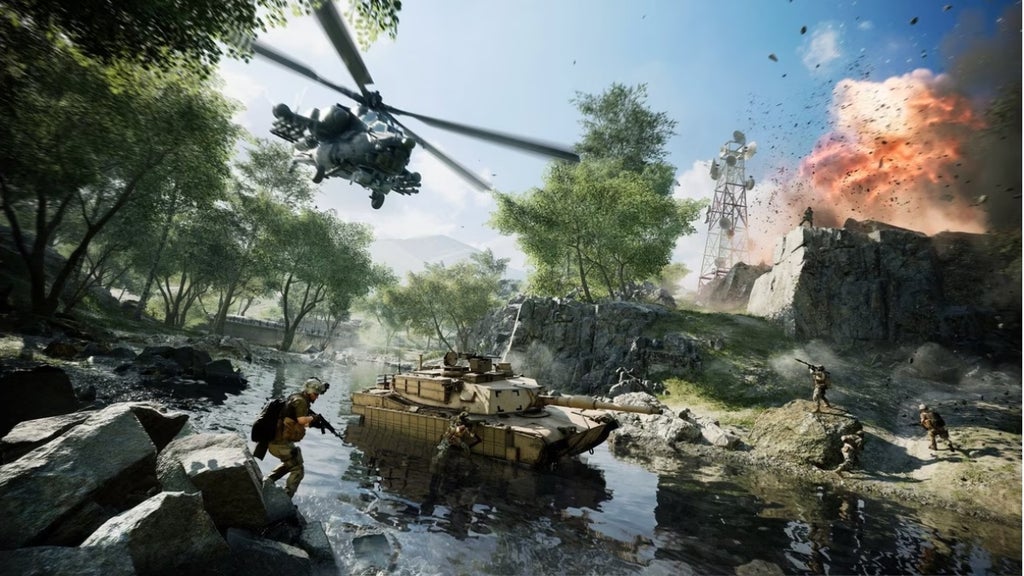
“Battlefield” made its name on large-scale sandbox chaos where tanks and jets collide across maps the size of small countries. Fitting that into a two-hour movie is a completely different problem than adapting the tighter campaign structure of “Call of Duty.”
The first video game in the series, “Battlefield 1942,” launched for PC and Mac in 2002. Since then, the series went from computer platforms to video game consoles and has covered everything from Vietnam to the far future. Last year’s “Battlefield 6” was rumored to be one of the most expensive video games ever created and became the bestselling game of last year (and of the entire franchise). The base game has sold 20 million units and has amassed 26 million players, according to Alinea Analytics.
For EA, landing the right studio partner is equally important. “Battlefield 6” was a back-to-basics identity reset that generated the kind of pre-release buzz the franchise hadn’t seen in years. The shooter’s commercial revival arrived at exactly the right time, and now it’ll be up to one of the major studios to see this adaptation through.
Gaming’s Hollywood gold rush
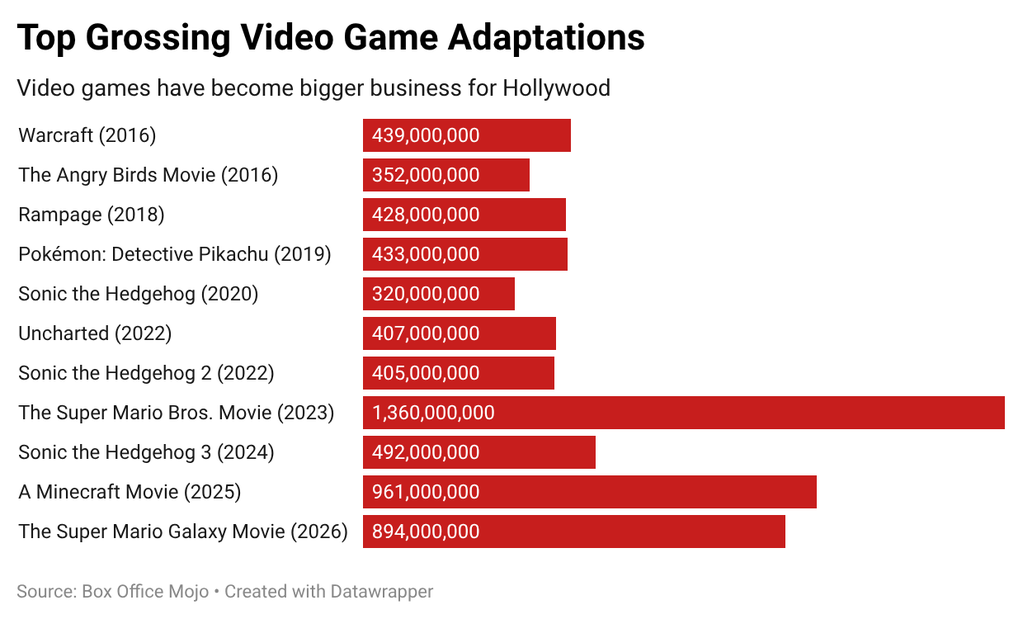
Video games are having a moment, with a number of high-profile projects in the works at every studio and “The Super Mario Galaxy Movie,” from Illumination, Nintendo and Universal, a certifiable blockbuster and the biggest movie of 2026 so far, with $764 million worldwide.
Previously, “The Super Mario Bros. Movie” grossed $1.36 billion worldwide in 2023. “Sonic the Hedgehog 3” crossed $422 million globally in 2024, and last year “A Minecraft Movie” grossed $960 million worldwide (a sequel is coming in 2027).
Other video game-based movies set for release this year include New Line Cinema’s “Mortal Kombat II,” Sony’s “Resident Evil” and Paramount’s “Street Fighter,” along with a new “Angry Birds” movie (also from Paramount). And next year will see the highly anticipated release of “The Legend of Zelda” from Nintendo and Sony.
The boom comes after decades of video game adaptations sputtering out — there was even something called the “Video Game Movie Curse” as every title was destined to be critically maligned and few made a sizable dent at the box office. The trifecta of “Mario,” “Minecraft” and “Sonic” changed that, and now a whole generation of moviegoers are eager to see more video games get adapted for the big screen.
Ampere’s research found that movie adaptations of games boost video games player numbers by an average of 48%. For Electonic Arts and Activision, the upside is huge as both franchises have combined player bases in the hundreds of millions. If the films deliver and break out at the box office, it’s a massive revenue generator for both publishers, which is why they are partnering with A-list talent and pushing hard to get these adaptations made right.
Two audiences, one opportunity
Here’s what the data from Ampere shows. In December 2025, the vast majority of the 33 million combined players across PlayStation, Xbox and Steam chose one franchise or the other — with just 8% continuing to play both.
“‘Battlefield 6’ and ‘Call of Duty: Black Ops 7’ attracted fairly distinct audiences,” Ronald Santa-Cruz, analyst at Ampere, told TheWrap. “Call of Duty” draws a predominantly U.S.-centric player base, with 46% of its December 2025 players coming from the United States, compared to 41% for “Battlefield 6.”
But that divide might actually work in Hollywood’s favor. Rather than cannibalizing each other, the two films could function as complementary events.
“These audience differences suggest that film adaptations of the two franchises may complement rather than compete,” Santa-Cruz added, “potentially setting up another ‘Dunesday’ or ‘Barbenheimer’ moment.” If the release windows align, two massive built-in audiences could show up for entirely different movies.
It’s a scenario Hollywood has seen before. No type of film has seen more repeated success this millennium than the comic book movie. Big-screen adaptations of Batman, Spider-Man, The Avengers and more are met with success time and time again.
The difference here is scale: “Call of Duty” and “Battlefield” aren’t just rival brands. They’re the two biggest military shooter franchises in gaming history.
If both films deliver, studios could be looking at a box office arms race unlike anything the industry has seen from gaming IP.
