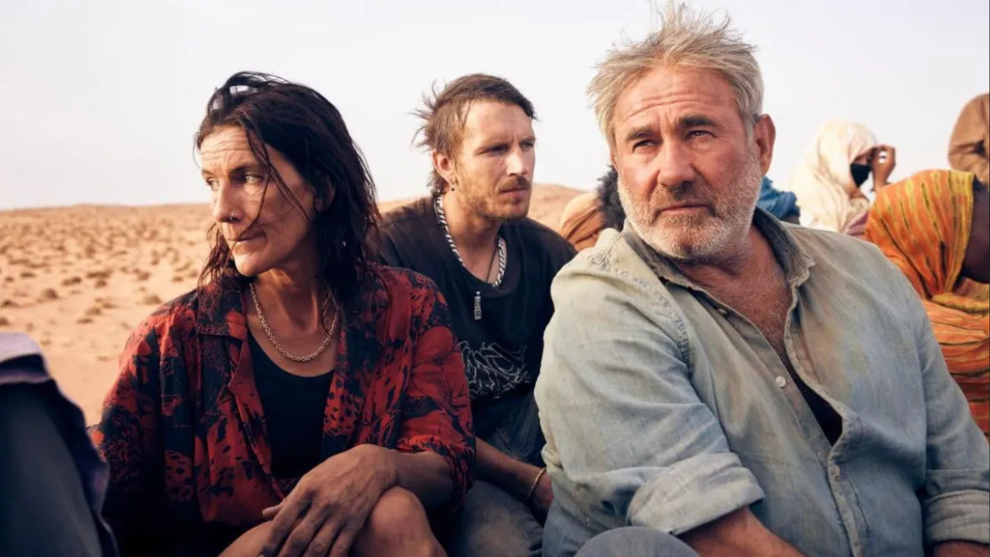
The immersive power of sound is present from the first minute of “Sirāt,” as we watch a bunch of roadies set up massive 15-foot speakers in the barren desert. Then comes the crackling feedback noise, followed by abyss-deep bass beats echoing off nearby cliff walls. The setting is a delirious rave in rural Morocco, which is the starting point for the acclaimed road movie from director Óliver Laxe (pronounced “Lah-shey”).
The film is Oscar-nominated for both Best International Feature, representing Spain, and, in a bold signal that the Academy voters did their homework, Best Sound (Laia Casanovas, Amanda Villavieja and Yasmina Praderas). The nominees made history as the category’s first-ever all-female slate.
Sirāt is a journey film, accompanying a Spanish father (Sergi López) and his young son as they search for his missing daughter among the rave community in rural Morocco. The title refers to the bridge connecting hell and paradise (referenced in Islamic texts), which is as sharp as a sword and thinner than a strand of hair, a treacherous path evoked symbolically in the movie.
And the sound design represented a journey all its own. That opening sequence, for starters, was a tremendous logistical challenge, with all the audio tracks recorded in urban Barcelona months after filming.

“There was a deal with the ravers that the music would not be paused during the filming,” said sound designer Casanovas, whose credits include Pedro Almodóvar’s “Parallel Mothers.”
“So we needed to re-create all the production’s sound, using similar audio equipment in the studio in Barcelona. We also re-created all the voices in the crowd and recorded a lot of actors from all over Europe, so it has that palette of different languages. Some actors just uttered a single sentence and we could control how crowded we wanted the scene to be.” (The film’s score was composed by French musician and DJ Kangding Ray.)
While working on the opening sequence, Casanovas was keenly attuned to another important element in the film: its balance between pure realism and the primal, eerie and obscure. The sound designer is a great admirer of David Lynch, Andrei Tarkovsky and George Miller’s “Mad Max” films.
“There’s something in their films that (seeps) into me,” she said. “We’re not copying David Lynch, but loving his films helps give us the background in creating a sound that’s organic but also expressive. And strange. There’s a suggestion in the audio of something unknown and magical, as if there’s something behind the natural world.”

But the natural world was also an asset to Casanovas, who spent three months in the deserts of Spain and Morocco with her microphones. “I wanted to learn about the specific vibes in blowing wind,” she said. “There’s a point at which the film flips and becomes something else, and there’s a different treatment of the sound. The blowing wind becomes more powerful, with a lot of weird bass frequency inside of it. It matches that feeling of having no place to go in the open desert.”
In a terrifying sequence late in the movie, the characters are stuck in a vast minefield, paralyzed by the danger lurking right beneath their feet. Casanovas and her team worked extensively on the scene, subtly emphasizing the anxiety of the situation through acoustics that indicated distance and perspective.
“It seems like it’s silent, but it’s not silent at all,” she said. “There are a lot of layers of sound to create the isolated place that the characters are in. There are explosions in that scene, and we worked a lot on the sound mix to play with the point of view, so that we hear the explosions as the characters do — further away from us but very near to us as well.”

Casanovas is thrilled about her team’s Oscar milestone as the first all-female sound crew to be nominated. “It’s very cool, but working as a team is pretty natural for us,” she said. “I’ve worked with Yasmina and Amanda several times, and we’re here because we really enjoy our jobs.”
“Sirāt” premiered at last year’s Cannes Film Festival, winning the Jury Prize, and opened in Spain two weeks later. Casanovas has been invigorated by the enthusiasm that the film has generated and the debates it has provoked.
“That’s all we wanted,” she said, noting that she has observed differing reactions among parents. “It was like an event at the box office in Spain, and it’s been beautiful to talk about the movie since it opened. It’s a film that evokes emotion without explaining everything, and every person who talks to me feels it in a different way. I love that everyone went to the cinema because they wanted to be part of this experience — to feel the movie with your body in a theater.”
A version of this story first appeared in the Down to the Wire issue of TheWrap’s awards magazine. Read more from the issue here.