
Horror comedies present a unique challenge for any creator. How do you serve the humor without undercutting the horror, and vice versa? When he began composing the score for Apple TV’s Emmy-nominated hit “Widow’s Bay,” composer David Fleming found himself and creator Katie Dippold thinking more about the show’s characters than its competing genres.
“My initial conversation with Katie was more centered around a feeling that she was after, more than anything sonically specific. She loves it when horror feels like a ride. It’s really not separate from the laughs,” Fleming told TheWrap in a new installment of How I Did It, presented by Apple. “For me, that meant not really focusing on either the horror or the comedy as separate genres, but this feeling of curiosity and mystery surrounding the town and the characters.”
“I don’t think we ever explicitly talked about the horror or the comedy independent of each other,” editor Isaac Hagy said, echoing Fleming. “In fact, I don’t even think we approached the show as being a genre-specific show. It was all about honing in on who the people and the inhabitants of the island were. Then, once they’re put into these extreme situations, whether it’s comedic or horror, how do they react to them?”

“Widow’s Bay” splashed onto the scene when it premiered on Apple TV in late April, winning viewers over with its blend of genuine supernatural horror and absurd, screwball comedy. Set on an island off the coast of New England, viewers followed Widow’s Bay Mayor Tom Loftis (Matthew Rhys) as his attempts to turn the island into the next Martha’s Vineyard were complicated by the horrors lurking within, which turned out to be far more real than Tom wanted to believe.
The series netted 19 Emmy nominations this year for its first season, the most of any eligible freshman show. Its success is due, in no small part, to the delicate, difficult tonal tightrope it walks across each of its quasi-standalone, quasi-serialized episodes. Speaking with TheWrap, Underkuffler attributed to the show’s unique tonal landscape to the “full license” that he and his collaborators were given to be “completely wrong,” calling it “incredibly liberating.”
“There was a lot of license to try things,” Fleming added. “Because this is such a unique show, sometimes that involves being wrong first.” Hagy noted that the freedom he, Fleming and Underkuffler all felt was the result of the “collaborative, safe space” that Dippold and “Widow’s Bay” executive producer and lead director Hiro Murai created behind the scenes.
Fleming relied a lot on Dippold, whose internal barometer for comedy and horror helped shape each and every scene of “Widow’s Bay.” “If a joke was too broad or maybe too dry, she was very specific in knowing the tonal direction, the bullseye, that we were trying to hit,” he said.
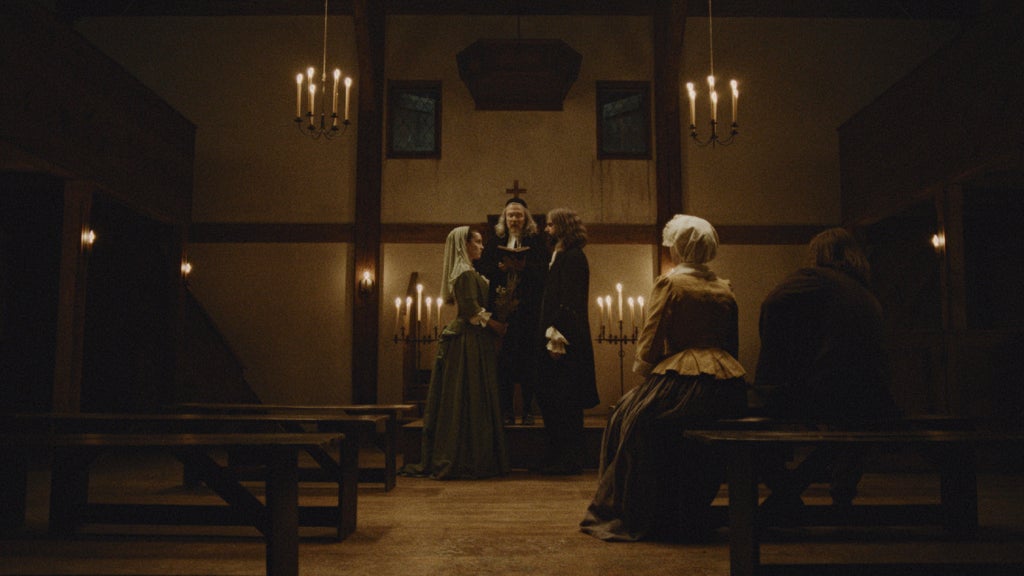
None of the series’ episodes proved to be more informative for Fleming than its sixth chapter, “Our History.” Both Fleming and Hagy earned Emmy nominations for their work on the Ti West-directed episode, which transports viewers back in time to the early 1700s to learn the truth about the founding of the show’s eponymous, haunted island.
Describing the episode as a “mini movie,” Fleming said he leaned into a completely new soundscape for “Our History,” one befitting its colonial setting.
“It’s definitely the most acoustic of all of the episodes,” Fleming said, noting that he recorded music for it with period-accurate instruments, like the viola da gamba and baroque cello. “We also made discoveries. There was an idea of, ‘What else could be on this island?’ And the idea of conch shells came up and it became this danger call in Episode 6 that got us and Katie so excited that we ended up throwing it in the first couple episodes before the ink had dried on those, just to make something that felt cohesive.”

Like Fleming, Hagy ended up settling into a different rhythm for “Our History” than for the show’s other chapters. “We did find ourselves leaning slightly away from the comedy more than we might have in other episodes,” Hagy told TheWrap. “I think a lot of that is because we were doing a lot of world-building and setting up the mythology of the show and the serious specter of generational trauma that had been hanging over the island.”
While Fleming considered making the score for all of “Widow’s Bay” Season 1 feel of a colonial era, he is glad now that he chose to save that turn for “Our History.”
“Ultimately, deciding to save that sound for that episode was a good decision because not only did it create this real, fresh story in the middle of the season, it also ended up informing the music for the rest of the show,” Fleming explained. “There are themes and motifs that start in that episode that end up being developed throughout the rest of the [season].”
“That episode for me and I think the whole music department was the skeleton key to figure out the entire personality of the show,” the composer added.
“Widow’s Bay” Season 1 is streaming now on Apple TV.
Location & Special Thanks: Elemental Recording Studio
