

The Paramount-Warner Bros. Discovery merger could result in the loss of nearly 4,500 film and TV jobs in Los Angeles County over the next three years when the two companies combine their operations, according to a new analysis by CVL Economics and the Department of Economic Opportunity exclusively obtained by TheWrap.
The report also estimates that a total of 10,360 “job years” could be at risk, including 2,661 indirect jobs at small businesses that support production — such as prop houses, printers, transportation companies and other vendors — and
3,204 induced jobs that exist because film and TV workers spend money in the local economy — including restaurants, retailers and service providers.
A “job year” is defined as one job sustained for one year and measures the total volume of work that could disappear over time. For example, one job lasting three years equals three job years.
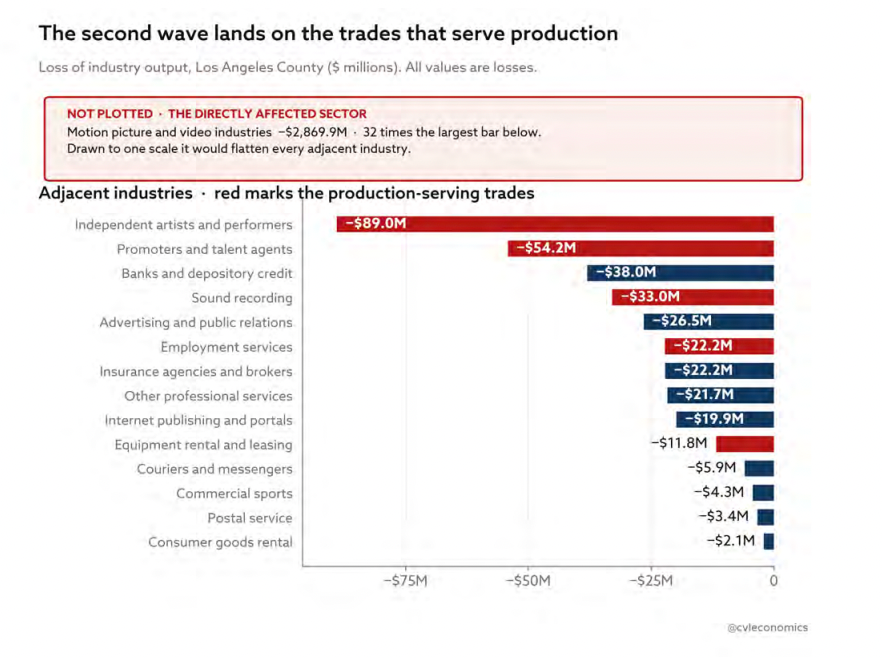
Overall, the economic impact of losing these jobs would be $1.26 billion in wages, $2.78 billion in economic value, $4.06 billion in total business output and $547 million in tax revenue, including $78.6 million in local taxes — most of which (63%) comes from property taxes.

Los Angeles County’s creative economy supports more than 312,000 workers, including approximately 171,155 entertainment sector jobs. The direct jobs at risk account for nearly 9% of the 52,016 film and TV jobs California has already lost since 2022 — and almost all those losses (99.6%) occurred in Los Angeles County.
CVL and DEO said the losses would occur due to slate consolidation that would result in fewer buyers and fewer greenlights and reduce the overall number of unscripted/talk shows and related opportunities for Los Angeles–based crews. They also warned that about 895 creators hold exclusive deals with the two companies and that if development shrinks, these creators and their crews will lose work.
If the two companies merge, the decisions they make about where to
film their shows could dramatically affect how much production stays in California, CVL and DEO said. The high cost of living in L.A. County and California, combined with stronger incentives out of state and abroad, also contribute to work shifting out of the state and country.
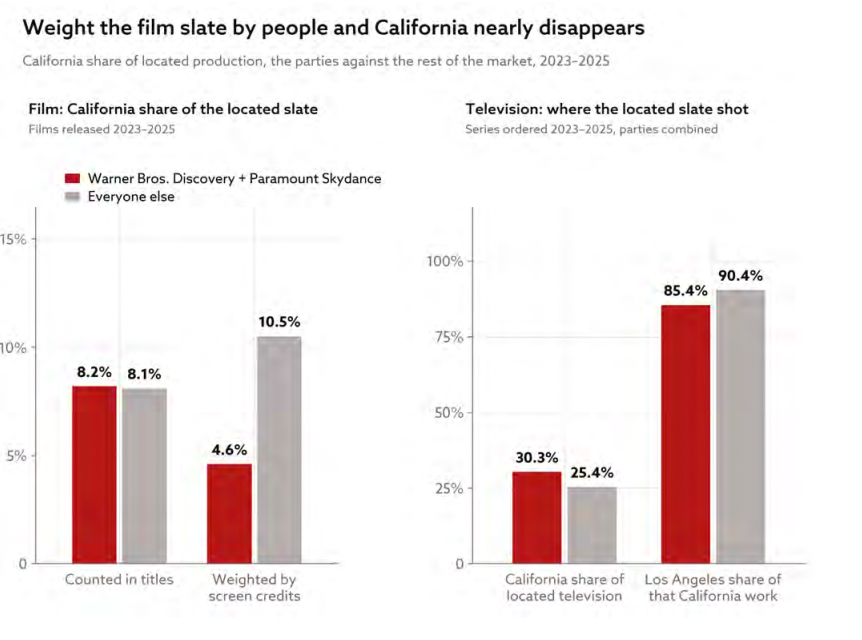
DEO and CVL’s analysis finds that, of the 73 films on Paramount-WBD’s combined 2025 slate with an identified filming location, just four were shot in California and one in Los Angeles County. Between 2023 and 2025, 8.2% of the companies’ films were shot in California, roughly the same as the rest of the market at 8.1%. But their California films supported relatively less work when weighted by screen credits, with the California share falling to 4.6%, compared with 10.5% for the rest of the market.
Meanwhile, California accounted for 30.3% of the two companies’ television series with an identified production location, compared with 25.4% for the rest of the market, per the report. Of their California television production, 85.4% was located in Los Angeles County.
CVL and DEO’s report identifies approximately $6.7 billion in potential annual cost reductions across overlapping operations in order to reach management’s goal of investment-grade leverage metrics within three years.
Those estimated reductions would include $5.3 billion associated with corporate and infrastructure functions and $600 million from content and production support. It noted that the other $800 million would be slower or more difficult to realize due to leases and country-specific requirements.
If revenues underperform or planned savings prove more difficult to achieve, pressure to identify additional cost reductions could increase, CVL and DEO warned.

The latest report, which was ordered by and submitted to L.A. County’s Board of Supervisors on Tuesday, comes after CVL and DEO previously found that the $110 billion deal could put nearly 2,500 local jobs and roughly 6,000 jobs globally at risk due to consolidation. Those 15,567 jobs cover duplicative roles in corporate, tech, real estate and other shared functions across the two companies.
At the time, DEO’s interim report estimated that 17% of Paramount’s total workforce and 13% of WBD’s total workforce are located in L.A. County. When looking by unit, 35% of Paramount and 27% of WBD’s studios unit workforces are based in L.A., while direct-to-consumer/streaming make up 15% and 17% and TV/media and global linear networks make up 10% and 2%, respectively.
The final report was conducted over the course of 120 days, while the interim report was conducted over 60 days.
A Paramount spokesperson told TheWrap that the report underscores that the entertainment industry is “in decline, production is down and jobs are being lost — and lost for good if we don’t act.
“Our plan to invest $30 billion annually in production and release at least 30 films a year is how we regain that ground: more production that supports more jobs over time, and ultimately, a stronger, more durable entertainment industry for generations to come,” the company added.
A spokesperson for California Attorney General Rob Bonta told TheWrap that the DEO’s report provides “one snapshot of the potential impact of the proposed merger” and reiterated that it would result in “higher costs, less competition, lower wages, job cuts, and fewer movies and TV shows” if approved.
The economic analysis of the merger comes as it is on hold due to litigation from 12 state attorneys general and The Writers’ Guild of America, which is headed to trial in March.
Paramount has agreed to delay the closing of the merger until five days after the outcome of a trial, or June 1, 2027, whichever comes earliest. Per the terms of the merger, the final closing deadline is June 4, 2027. However, Paramount CEO David Ellison and Chief Legal Officer Makan Delrahim have also urgedBonta to come to the negotiating table to reach a settlement before then.
Ellison has also threatened to move Paramount’s operations out of the Golden State if Bonta doesn’t come to the table by Oct. 1, when its 25 cent per share ticking fee kicks in. The payout translates to $7 million per day or $650 million per quarter until the deal closes.
Bonta has called the threat of a move “blackmail” and noted that while he’s open to a potential settlement, Paramount would have to offer structural remedies, such as divestments, instead of behavioral remedies, such as its pledge for 30 theatrical film releases per year under the combined company.

In addition to the economic analysis, DEO previously said it planned to submit formal comments to the U.S. Department of Justice regarding antitrust concerns and that it would continue to monitor the state attorneys general investigation into the deal and its potential anticompetitive impacts.
It is also coordinating with state agencies including the Employment Development Department and the California Film Commission to create an action plan to provide job training, placement and other workforce programs, as well as access to unemployment insurance, public benefits and health and mental health services to any displaced workers for those impacted by the merger.
In October, DEO launched a new High Road Training Partnership (HRTP) with the Worldwide Starship Foundation for $1.1 million. The Rain Man 2.0 Initiative will create a talent pipeline for autistic and neurodivergent adults, leveraging strengths aligned with animation and digital media while reconnecting local talent to mentorship, paid experience and portfolio development. It will release applications for additional HRTPs in fiscal year 2026-27, which will include opportunities for training providers and partners in the creative sector to apply for funds for training programs that can serve workers impacted by the merger.
DEO also plans to set up Rapid Response orientations with expedited access to unemployment benefits, social services and health and mental health resources. DEO will coordinate with EDD to seek additional assistance grants that expand training and supportive services. Additionally, it will launch targeted job fairs organized with Rapid Response teams, AJCCs and regional employers to help displaced workers secure new roles. The events will also offer job readiness support and may include financial incentives for employers, such as tax credits or wage subsidies.
Lastly, DEO will collaborate with the California Film Commission to explore ways to link laid-off workers with employers benefiting from California production tax credits.