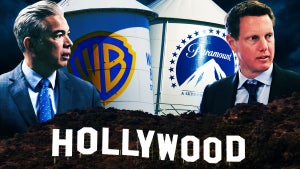
U.S. District Judge Araceli Martínez-Olguín granted a temporary restraining order on Monday pausing Paramount’s $110 billion acquisition of Warner Bros. Discovery for 14 days.
The deal, cleared by the Justice Department in June, could have closed as early as July 21. Instead, 12 state attorneys general, led by California’s Rob Bonta, persuaded a federal court that folding two major studios, the CBS network and its stations, CNN, a roster of cable channels and two streaming platforms under a single owner deserved a closer look before it became irreversible.
Fourteen days is not much time, but it is the first genuine pause this transaction has received, and that fact should concern the industry more than the pause itself.
I have spent much of my career inside the rooms where these questions get decided, serving in four presidential administrations on a bipartisan basis. At the National Telecommunications and Information Administration (NTIA), where I was chief of staff, the hardest question we faced sounded abstract but shaped everything: Should the company carrying the picture also be allowed to own it? Vertical combinations were already forming — Westinghouse owned Showtime; HBO was tied to one of the nation’s largest cable operators — and the movie studios lobbied hard to force programming apart from distribution.
We did not answer by instinct or by clock. NTIA commissioned a four-volume study, held the competing arguments up to the light, and recommended preserving the integrated model, a conclusion I defended then and would defend now, because a record supported it. Note the sequence: a question identified, a record built, alternatives weighed, a decision explained in public. That is what deliberation looked like.
Today, the question returns in a new architecture. The cable operator that owned programming has become the streaming platform, programmer and distributor fused into a single app. The Paramount combination would gather HBO Max and Paramount+, two major studios, along with CBS and its stations under one owner, just as the FCC prepares to vote on Aug. 6 to repeal the 39% national ownership cap that once kept any single broadcaster from reaching too many American homes.

It is not the deal we studied at NTIA; the industry it would reshape barely resembles the one we knew. But it belongs to the same family of questions: Who may own both the picture and the path to the viewer, and at what reach?
This time, the federal antitrust record closed with remarkable speed. The searching examination the deal will now receive comes from state attorneys general in a courtroom, joined last week by the Writers Guild of America, with its own lawsuit, because it was never built into the process. Deliberation is arriving as litigation, after the fact.
Judge Martínez-Olguín’s order suggests the courtroom may take the assignment seriously. The states, she wrote, “present compelling evidence that the combined firm resulting from the transaction will possess substantial market share in the wide-release theatrical distribution market.” That is not a ruling on the merits. It is something more basic: an insistence that somebody, somewhere, build the record.
Here is what the earlier rounds of this fight teach:
- First, scale is not the sin; unexamined scale is. I defended integration when a record supported it. No comparable record preceded this deal’s DOJ clearance; the states are now trying to assemble one by subpoena.
- Second, categories are choices. Cable became “more like television” because one lawyer, my mentor Henry Geller, decided to argue it that way before the Supreme Court, and streaming’s legal identity is no more fated than cable’s was.
- Third, the public gets a seat only when someone insists on it. Constituent fury over rising bills produced the 1992 Cable Act. Today, the insisting is being done by a dozen state attorneys general and a federal judge.
The deal may still close. Fourteen days from now, or after a preliminary injunction hearing, Paramount may well get its merger, and the industry will adapt, as it always has. That is not the point. The point is whether we decide with a full enough record or without one.
The picture on the screen has never been a natural fact. It is the product of decisions made by identifiable people at identifiable moments: licenses granted and denied, categories chosen, limits set and lifted. We have decided questions like this before, and we decided them better when we treated the picture as something worth deliberating about.
Stuart N. Brotman is digital media laureate and distinguished senior fellow at The Media Institute, and the author of “Free Expression Under Fire: Defending Free Speech and Free Press Across the Political Spectrum” (2025). He was the inaugural Visiting Professor of Entertainment and Media Law at Harvard Law School.