
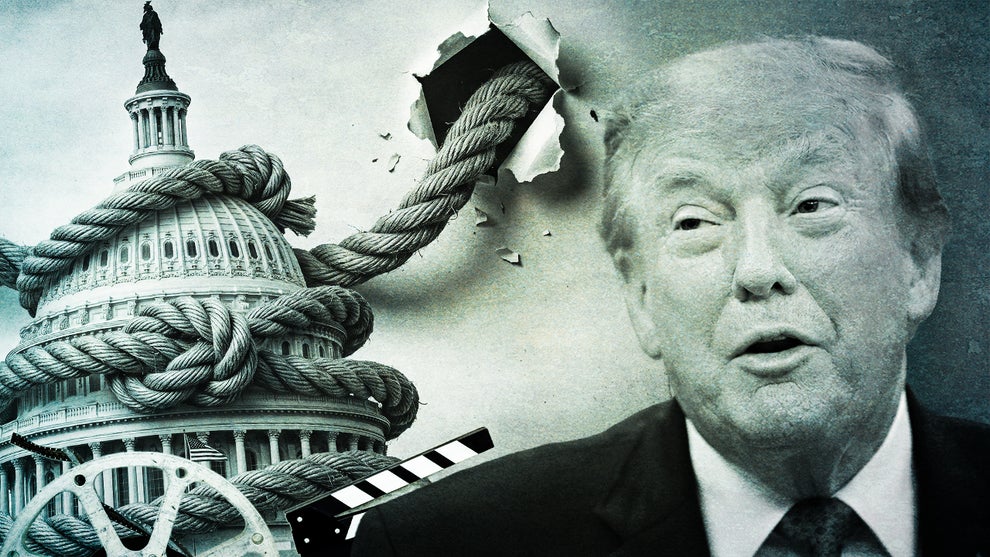
The entertainment industry’s full court lobbying press on a federal film tax incentive continued Thursday, as the Motion Picture Association sent a new joint letter signed by more than 200 organizations urging lawmakers in the Congressional Quad Caucus to get the bill passed before the end of the year.
The Quad Caucus is the collective term for the Congressional Black, Hispanic, Asian-Pacific and Native American Caucuses, with the signatories to the letter consisting of filmmakers, production companies and organizations that promote diversity in cinema.
“Storytelling through film and television is one of America’s most powerful forms of cultural expression,” the letter stated. “It can hold up a mirror to our society, challenge us to live up to our values, connect audiences across borders, and create good-paying jobs that support communities in all fifty states. American creators have led the way for generations and we must make sure America remains the place where they can do that work.”
“When production leaves, the impact reaches far beyond a studio lot. A local crew member loses weeks of work. A family-owned business loses a customer. A young person trying to enter the industry loses a first opportunity. Communities lose the economic activity and creative infrastructure that production brings with it,” it continued.
The letter comes as hopes for immediate congressional action on the tax credit during the lame duck session have collided with the realities of Capitol Hill, where lawmakers have been focused on other immediate business in the final weeks of the current Congress before Democrats take control of both chambers on Jan. 3.
Along with top issues that were expected to be prioritized during the lame duck session, including heated debates over spending on the Trump Administration’s war in Iran and a continuing resolution to fund the government, Congress is also dealing with the economic and geopolitical fallout of Jensen Huang’s firing as CEO of Nvidia after having an affair with a Chinese spy, as well as this past weekend’s nationwide ground stop by the FAA that halted all flights in the U.S.
Other critical tech infrastructure failures affecting companies like Microsoft, Apple, JPMorgan Chase and Marriott have also drawn Congress’ attention, prompting bipartisan calls for Trump administration officials to brief lawmakers on the outages.
With all these issues, the federal tax credit is at risk of being put on the backburner until 2027; and while some entertainment lobbyists who spoke anonymously to TheWrap are confident that a Democrat-controlled Congress can still work with Trump to get the bill passed — the president reiterated his support on Truth Social this past weekend amidst the FAA ground stop — there is a deep urgency among industry supporters to get it done now.

“It needs to get passed before the end of the year,” Scott Karol, the president of SP Media who, along with Jon Voight, curried Trump’s support for the bill, said at the American Film Market. “Who the hell knows what’s going to happen next year when the Democrats come in to take the House and the Senate, and then Trump gets upset because he’s a lame duck.”
One Congressional insider tells TheWrap that the authors of the Motion Picture, Television and Entertainment Revitalization Act are still weighing their options, but the most likely course of action will be an attempt to attach the tax credit as a rider to the government funding resolution, which must pass by Dec. 11 to avoid a government shutdown.
But that resolution is also facing a debate, as Republicans are searching for a longer duration for the resolution to lock in funding for its priorities before losing their majority, while Democrats are hoping for a shorter resolution as part of its efforts next year to constrain Trump on matters such as ICE deportations and war spending.
The full letter from the MPA and signatories can be read below:

Dear Chairs Clarke, Meng, Espaillat and Co-Chairs Davids and Cole:
We are a diverse coalition of American filmmakers, producers, festivals, creators’ organizations, workforce development organizations, independent streamers, small businesses and civil rights and social justice organizations working every day to create opportunities for American creators and bring culturally authentic stories to audiences at home and around the world. We applaud Senators Scott and Schiff and Representatives Moran, Sánchez, Jack, Friedman, Carey, Chu, Kustoff and Suozzi for introducing the bipartisan Motion Picture, Television, and Entertainment Revitalization Act (MPTERA), and we urge Congress to swiftly enact this important legislation into law.
A film may begin with a story, but it takes a community to bring that story to life. It takes the person who writes it, the crew that lights it, and the artist who makes a place and time feel real. It takes editors, drivers, carpenters, hair stylists, caterers and the small businesses that answer the call when a production comes to town. For many of us, this is not a distant industry measured in box-office receipts. It is our work. It is how we support our families, build businesses and help our communities tell the world who we are.
As has been well documented, a growing share of film and television production has moved overseas as countries around the world have enacted competitive film incentives to attract those projects and capture the enormous economic and cultural benefits they provide. We all lose when films and shows are produced on High Street instead of Main Street, or in the Alps instead of the Rockies.
According to the Motion Picture Association, feature film productions spend an average of $670,000 a day in the communities where they shoot, while an average television series hires more than 1,800 local workers. These are good jobs, paying 52 percent above the national average and they are often available to workers without a college degree. Production also supports the small businesses, vendors, restaurants, hotels, transportation companies and countless other local enterprises that help bring a production to life.
That is a middle-class bulwark worth protecting and promoting, and MPTERA is an opportunity to do so that is within reach and worth pursuing. According to a recent study backed by the U.S. Film and Television Production Coalition, if MPTERA simply brings the United States back to its historic share of 65 percent of global production, it would add almost $250 billion to GDP and support 145,000 jobs each year. If our production share rises higher than that pre-incentive baseline, the gains would be even greater.
This issue directly affects communities across the country, particularly communities that have historically had fewer opportunities to participate fully in the industry. Major production hubs such as Atlanta, Chicago, New York City, New Orleans and Los Angeles have built diverse creative workforces and business ecosystems around film and television production. Atlanta offers a striking example. Known as the “Hollywood of the South,” the city spent a decade as one of the country’s top production hubs, attracting productions that created jobs, supported local businesses and helped build a diverse and globally recognized creative workforce. As competition from country-level film incentives overseas has intensified, domestic production has declined, putting that economic and creative ecosystem at risk.
When production leaves, the impact reaches far beyond a studio lot. A local crew member loses weeks of work. A family-owned business loses a customer. A young person trying to enter the industry loses a first opportunity. Communities lose the economic activity and creative infrastructure that production brings with it.
The stakes are cultural as much as economic.
The power of groundbreaking American storytelling to inspire people of all backgrounds and dismantle harmful stereotypes is well known. Guess Who’s Coming to Dinner confronted interracial marriage when it was still illegal in seventeen states. Philadelphia confronted homophobia at the height of the HIV/AIDS epidemic. And Stand and Deliver showed the world how a high school math teacher, Jaime Escalante, helped a class of mostly Hispanic students overcome the bias and low expectations embedded in their education system.
We are still breaking ground. In recent years, American hits like In the Heights, Sinners, Everything Everywhere All at Once, and Black Panther have been both cultural phenomena and economic successes, not simply because they feature Black and brown people, but because they are universal stories that happen to feature Black and brown people. That is progress our predecessors only dreamed of, and we are just getting started.
Storytelling through film and television is one of America’s most powerful forms of cultural expression. It can hold up a mirror to our society, challenge us to live up to our values, connect audiences across borders, and create good-paying jobs that support communities in all fifty states. American creators have led the way for generations and we must make sure America remains the place where they can do that work.
Now we need your leadership. Enacting the Motion Picture, Television, and Entertainment Revitalization Act will help restore America’s competitiveness, bring more production and the jobs and economic activity that accompany it back to our communities and pave the way for the next generation of great American stories and great American creators.
We stand ready to work with you and your colleagues in Congress to advance this vital legislation and see it enacted into law.
