
On the eve of Fox News Channel’s 30th anniversary, the network faces an unusual challenge: figuring out what comes after cable while its core business is still working remarkably well.
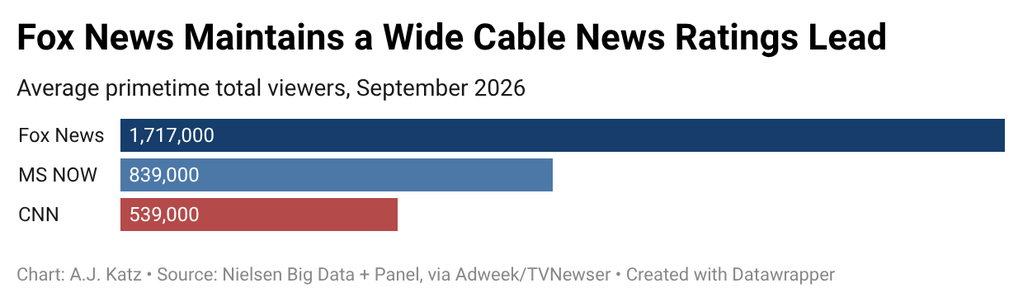
As Fox News prepares to enter its fourth decade, it remains the dominant cable news network, averaging more than 1.7 million primetime viewers in September, more than double MS NOW’s audience and more than triple CNN’s, according to Nielsen. At the same time, Fox has spent years building beyond the channel, from subscription service Fox Nation and streaming outlet Fox Weather to digital, social, podcasts and Fox One, the company’s direct-to-consumer service aimed at consumers outside the traditional pay-TV bundle.
That gives Fox an unusually strong hand in the fight for audiences beyond cable: a powerful linear business, an established brand and a loyal audience from which to build new products. The question now is whether Fox can turn that advantage into lasting power beyond cable — without weakening the business that still gives it that advantage.
“Fox has the luxury of managing linear television’s decline from a position of extraordinary strength,” Tim Hanlon, founder and CEO of media consultancy Vertere Group, told TheWrap. “Whatever you think of Fox News — and I have plenty of issues with it — very few media brands enter this transition with that much habitual viewing, audience loyalty and cash flow already in place.”
That viewing habit extends across the political spectrum: Fox News had the highest monthly length of tune among adults 18+ across Democrats, Independents and Republicans from January through July 2026, according to Nielsen panel data provided by the network.
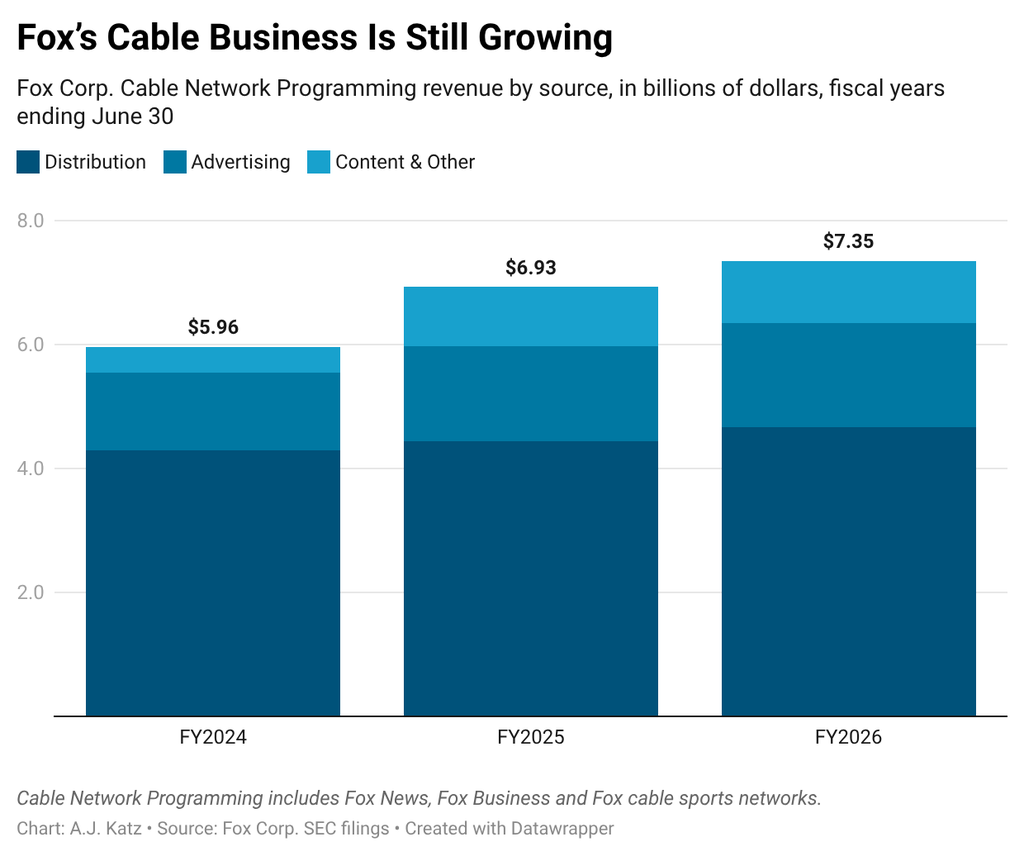
Those economics help explain why Fox is building around linear television rather than rushing to replace it. Fox does not disclose Fox News’ revenue or profit separately, but its Cable Network Programming segment — which includes Fox News and Fox Business alongside its cable sports networks — generated $7.35 billion in revenue in the fiscal year ended June 30, up 6% from the previous year, and $3.1 billion in segment earnings before interest, taxes, depreciation and amortization. Distribution revenue rose 5% to $4.66 billion as higher average rates per subscriber more than offset a decline in subscribers.
For Fox, then, the strategy is not to build a replacement for Fox News Channel. It is to make the channel — and the reporting infrastructure built around it — the engine of a larger business.
“I do think Fox News Channel will still be the centerpiece of what Fox News Media is,” Fox News Media president and executive editor Jay Wallace, who has been with the network since its 1996 launch, told TheWrap.
The opportunity, Wallace said, is in how far the reporting, talent and resources assembled for that channel can now travel.
“I may deeply distrust much of the editorial product, but from a business standpoint Fox understands something many legacy media companies are still struggling with: a passionate audience is an extraordinarily valuable asset if you can keep following it from platform to platform,” Hanlon said.

The linear engine
Bill Hemmer has watched that evolution from inside Fox for more than two decades. The “America’s Newsroom” anchor joined the network in 2005, when online video was in its infancy and consuming news on a phone was hardly the norm.
What hasn’t changed, Hemmer said, is the basic mandate: get the story right, move quickly and keep viewers interested. What has changed is nearly everything surrounding it.
“Our business will never be consistent again,” Hemmer told TheWrap. “It will always be moving and changing and developing in ways that we can sometimes predict and sometimes not predict. And that’s because of technology.”
Hemmer recalled Fox experimenting years ago with “Fox Online,” when the network was still figuring out the relationship between television and what viewers were doing on their computers.
But Hemmer still sees television as the foundation.
“What we do between 9 a.m. and 11 a.m. … that’s the baseline for what we are about,” he said of “America’s Newsroom.” “Without that, by the way, we would not have all the other bells and whistles that you see on social media.”

Sharri Berg, a member of Fox News’ original launch team who now serves as president of Fox Weather, sees a similar evolution behind the scenes. Fox’s early disadvantage against larger, established competitors, she said, forced the network to experiment with ways to gather and produce news more quickly and efficiently.
“We always would push technology before it was ready,” Berg told TheWrap. The goal was “being there fast, being there first and getting on the air with as few people as possible. You know, you’re lean, you’re agile, and we really wore that as a badge of honor.”
That infrastructure no longer serves just one television network.
“Everything we built at Fox News — the newsgathering muscle, the tech innovation, the live breaking news DNA — it’s not locked inside a cable channel anymore,” Berg said.
Wallace described the editorial version of the same model. A decision by Fox’s assignment desk to send chief foreign correspondent Trey Yingst to cover a story, for example, is no longer merely a decision about television. His reporting can produce material for the channel, social platforms, podcasts or a Fox Nation documentary.
“There is this cascading effect” from the newsgathering operation, Wallace said.
Can loyalty travel?
But the model ultimately depends on something less certain: whether viewers will follow Fox’s talent from one platform to another.
Yingst offers one example. The 33-year-old correspondent said he has built an audience of more than 3 million followers across social platforms, including more than 1 million on TikTok. For him, those platforms don’t replace television. They extend his reporting and can steer audiences toward it.
“Social media is a tool for journalists to connect with a wider audience,” Yingst told TheWrap. “In my mind, it’s a tool to bring an audience that may be on a platform like TikTok or Facebook or Instagram back to the channel to learn more.”
During a recent reporting trip to the USS George Washington, Yingst said his team used vertical video to show followers his journey aboard an Osprey and take them behind the scenes on the aircraft carrier. His live reporting from the flight deck remained the centerpiece.
“Social media can’t replace that live TV coverage, but it can let our audience know that we’re there, and it can keep their interest,” he said.

Wallace said Fox has deliberately avoided forcing every established television personality onto every new platform. Instead, younger reporters increasingly arrive at the network already comfortable building audiences in those spaces.
“We’re finding people who are multiplatform people,” Wallace said, while “not trying to just chase these audiences inauthentically.”
The bigger question is whether Fox’s relationship with its audience belongs to the television channel itself or can travel wherever those consumers go next.
Reece Peck, an associate professor at the College of Staten Island and author of “Fox Populism: Branding Conservatism as Working Class,” argued that Fox has an advantage because its connection with viewers goes beyond distribution.
“The loyalty it built on cable was never really just loyalty to a television channel,” Peck told TheWrap. “It was social and cultural identification, and that identity can travel across platforms.”
Digital media has also lowered the barriers for political personalities, podcasters and creators to build direct relationships with audiences without going through a television network. Fox has the resources and brand recognition to compete in that environment, Peck said, “but the risk is institutional inertia.”
Building beyond the channel
Wallace said Fox Nation initially leaned toward additional programming resembling Fox’s primetime lineup, before the company realized subscribers were already getting much of that experience on cable.
Fox Nation subsequently expanded into documentaries, lifestyle, faith-based programming, sports and entertainment — an effort to make the subscription product distinct from the cable network rather than simply an extension of it.
Fox Weather took another path. Launched in 2021 as a free, ad-supported streaming service, it began outside the traditional cable model and has since expanded onto a wide range of streaming and television distributors.
Berg said the idea grew partly from examining what Fox News viewers did when severe weather struck and the channel wasn’t providing the coverage they wanted. They went elsewhere.
“We looked at the entire fractured, but very busy … ecosystem of weather,” Berg said.
Instead of choosing one platform, Fox built the service around that fragmentation.

Hanlon sees Fox Weather and Fox Nation as useful contrasts: one began as a free streaming product, while the other asks Fox’s most engaged consumers to pay for additional programming.
“Those are very different businesses, but together they show that Fox understands the brand doesn’t have to mean one channel delivered one way,” he said.
Fox One pushed that strategy further when it launched in August 2025. The direct-to-consumer service gives consumers access to Fox’s portfolio of news, sports and entertainment programming without requiring a traditional cable subscription.
The shift is also changing how programming gets made. Berg pointed to “Fox Weather at Night,” a three-hour live program that can be run by two people: an on-air meteorologist and a producer who also directs the show using technology built into the studio.
“Our need for efficiency really goes hand in hand with our drive to innovate for speed,” she said.
A different scoreboard
Reaching audiences in more places also makes determining success more complicated.
Nielsen remains important to Fox, particularly for advertisers, Wallace said. But television ratings now sit alongside an array of other measurements, including reach, digital page views, YouTube consumption and social engagement.
“There’s obviously some failings when you’re just relying on Nielsen,” Wallace said. “I don’t think there’s one overall number anymore that you can use.”

Fox’s scale outside television is already substantial. Fox News Digital drew roughly 76 million desktop and mobile unique visitors in August, according to Comscore, while the network generated 287 million YouTube views during the month, according to Emplifi data cited by Fox.
“The meaningful scoreboard now has to include total reach, time spent, digital engagement, streaming usage, subscriber retention and ultimately how well all of that attention can be monetized,” Hanlon said.
Those metrics measure different forms of consumption, however, and they don’t by themselves answer the longer-term question: whether Fox is creating meaningful relationships with new consumers or largely following its existing audience from one screen to another.
Peck sees that challenge as cultural as much as technological.
“The challenge isn’t simply moving Fox onto the next platform,” he said. “It’s whether Fox can remain the place where a new generation of conservatives comes to understand itself.”
Fox, meanwhile, is betting that the asset at the center of its first 30 years can remain at the center of whatever comes next.
Wallace expects Fox News Channel to remain the “centerpiece” of Fox News Media a decade from now, even as platforms emerge that the company hasn’t yet imagined. But the channel’s role is already broader than the television feed itself: the reporting, talent and newsgathering decisions made for Fox News can now ripple across streaming, social, podcasts and other products.
That leaves Fox with a very different challenge than the one it faced at its launch in 1996. Then, it had to persuade viewers to find a new cable news channel. Thirty years later, Fox already has the audience. Its next test is whether it can keep that relationship intact no matter where the audience goes.
