When Caroline Collins sits down to anchor a livestream at Fox 26 Houston these days, reading the news is only part of her job.
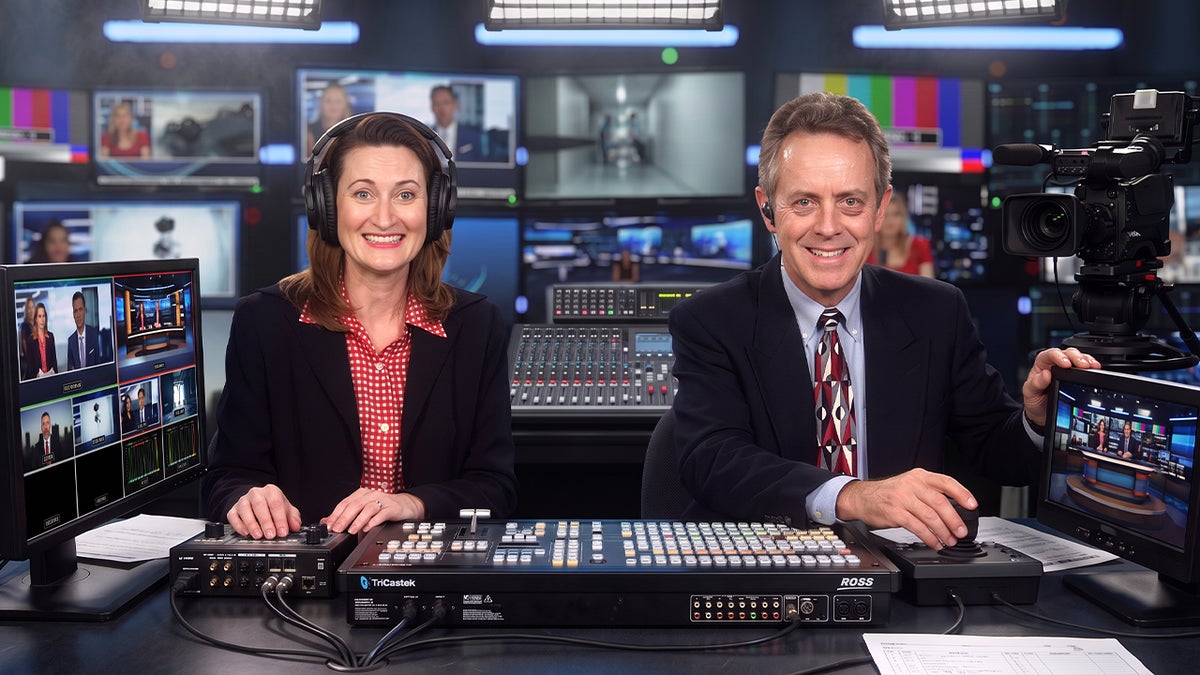
Collins can also find herself switching cameras, bringing up graphics and video and controlling audio while appearing on screen — effectively producing and directing the broadcast she is anchoring. In a social media post showing viewers the setup, Collins described simultaneously anchoring and “punching” her own show as “incredibly stressful.”
“This is what you are going to have to do,” Collins told aspiring broadcast journalists in the video. “You’re gonna have to be your own producer, pretty much your own director, your own host on your show.”
Collins, who noted that she had a support team while learning the system, is part of a broader evolution playing out in local television. As stations expand programming across streaming, digital and traditional television, some anchors are taking on production and technical responsibilities traditionally handled behind the scenes. The practice isn’t entirely new, but its growing visibility comes as broadcasters face pressure to produce more programming with leaner operations.
Executives say the model gives anchors greater editorial freedom and allows newsrooms to make more efficient use of their staffs. But asking journalists to operate cameras, manage audio and direct live broadcasts while reporting the news raises questions about burnout, editorial accuracy and whether technical responsibilities are crowding out journalism. It also raises a broader question for an industry increasingly embracing automation and centralized production: What happens to the jobs traditionally performed behind the scenes?
“The multi-tasking is really next level,” Troy Lynch, an anchor and reporter at Tegna-owned 12 News in Phoenix, told TheWrap.
This isn’t entirely new
Keren Henderson, an associate professor of broadcast and digital journalism at Syracuse University’s Newhouse School and director of the annual RTDNA/Newhouse School newsroom survey, cautioned against treating the self-producing anchor as a completely new phenomenon. Anchors in smaller markets have been producing their own shows, running teleprompters and reporting for years, Henderson said, recalling similar multitasking during her producing days in the mid-2000s. What may be changing is the visibility of those responsibilities.
“What changed is that anchors active on social media … in markets that were traditionally shielded from aggressive cost-saving measures, are showing audiences how hard their jobs really are,” she said.
Raquel Amparo, Tegna’s senior vice president of content, disagrees that this kind of multitasking has been largely confined to smaller markets.
“I would say it’s actually been happening across the board,” Amparo told TheWrap, adding that multitasking extends beyond anchors to producers, reporters and other newsroom employees.

More content, more control
As local broadcasters expand beyond traditional television into streaming and digital platforms, Tegna is pushing to produce more content.
“We’re gonna amplify and really double down on the amount of content we produce, especially in the streaming space,” Amparo said.
She said anchors themselves are also driving some of the change, with some wanting greater ownership over which stories they cover, how they’re treated and how long they spend on them.
Melissa Medalie, senior vice president and regional general manager of Fox Television Stations’ Florida properties, said some anchors are operating parts of the production board themselves. Fox has used versions of the model for some time, she said, but its stations are increasingly aligning around the same systems and tools.
“They’re not confined to a rigid two-minute segment or something that’s on tape,” Medalie told TheWrap. “We want them to explain. We want them to pull back the curtain.”
Rather than waiting for instructions from a producer, Medalie added, anchors can decide when to extend a compelling interview or stay with breaking news. “I think now they get to have some of that control.”
Marla Tellez, an anchor at Fox 11 Los Angeles, has experienced that autonomy firsthand. “It’s liberating,” she told TheWrap.
Tellez said the format emphasizes what is happening in real time. If compelling live pictures develop, she can act on them herself rather than waiting for instructions from a control room. That gives her the ability to shift the broadcast’s focus as a story unfolds, rather than following a predetermined rundown.
Lynch sees a similar upside at 12 News, where he is among a small group of journalists rotating through a daily 30-minute streaming newscast without commercials or a teleprompter. The anchor also produces and directs, controlling cameras, microphones, video and the show’s timing.
“I think there’s a small part of every journalist that loves total creative control,” Lynch said. “I get to choose how long I want each segment to be and to decide what I’m going to talk about during each show.”
The arrangement can also allow colleagues to concentrate on other work. “The major advantage is that other people can focus on finding and reporting new stories while we’re running a live show,” Lynch said.

Efficiency — but what kind?
The same changes that give anchors more control also raise an economic question: How much of the shift is about improving journalism, and how much is about producing more content with fewer people?
Henderson sees economics as central to understanding changing newsroom workflows.
“Companies that own local TV news stations save money by having the most content produced by the fewest people,” Henderson said. “The short-term financial gains are obvious.”
The broader shift toward leaner production is already affecting local newsrooms. E.W. Scripps eliminated 268 jobs across the company in August as part of a restructuring involving automation and centralized production, including cuts to producer and director positions at local stations. The cuts have not been directly linked to the self-producing anchor formats examined in this story.
At Tegna, Amparo framed the pursuit of efficiency around reducing labor-intensive tasks so journalists can spend more of their workday reporting and creating content. She offered the example of meteorologists who can spend hours assembling a relatively short forecast. Making that process more efficient, she said, can give them additional time to report weather stories and deepen their expertise.
Whether those efficiencies ultimately translate into more journalism, fewer production positions or some combination of the two remains an open question.

The cost of doing it all
For anchors operating these shows, the most immediate challenge is keeping the broadcast running while remaining focused on the news.
“It is completely different,” Lynch said. “Everything is on you, and you have to figure your way out of any mistakes or errors that happen during the show.”
The demands go well beyond switching cameras or making sure a microphone is turned on. During an interview, an anchor must listen closely, assess a guest’s claims, identify the next question and maintain journalistic accuracy — all while tracking the technical demands of a live production.
“I have to use parts of my brain that I didn’t know existed,” Lynch said. “I’ve gotten better the more I do it, but it can be difficult to think of everything while trying to interview a guest and focus on reporting the truth and being as professional as I can.”
The concern isn’t whether anchors can learn the equipment, but whether dividing their attention risks compromising the judgment and concentration journalism requires. Traditional control rooms distribute those responsibilities among producers, directors and technical operators.
For Henderson, the concern extends beyond any individual station or anchor to the cumulative demands of an industry asking journalists to perform more functions. “People can always learn to spin more plates. Of course they can,” she said. “But people do not become journalists to put on a plate-spinning show. Every new plate takes time away from doing journalism.”
“You can only lean on a journalist’s sense of public responsibility for so long before they drop the plates and walk away from the newsroom,” she added.
Lynch sees room to improve the format as the station gains experience with it. “There are also advantages and things that would be better about the show if we had more people working on it,” he said. “We’re learning how to make it better.”
The one-person model also has limits. Lynch said a team helps run the broadcast during major breaking-news situations, when the demands of coverage can intensify. That support highlights a central question as the format spreads: How much can reasonably be expected of one anchor, and when does doing more begin to compromise the work that matters most?

A different kind of anchor
Those changing responsibilities may ultimately matter most in defining what stations expect an anchor to be.
Medalie said technical and production abilities are part of what Fox considers, although she cautioned against confusing proficiency with the tools for the journalism itself.
“I think it’s part of it,” she said. “I don’t think it’s all of it. Those are just tools.”
More important, she said, are flexibility, curiosity and the ability to respond thoughtfully to a guest’s answers rather than simply follow a script. “You’ve got to really know your stuff.”
Tellez is already seeing the implications for the next generation. College students have shadowed her to understand how the anchor’s responsibilities are changing.
“Journalists have to be able to do more than they have in the past, especially when it comes to work happening behind-the-scenes,” Lynch said. “There’s some pushback on it, but I do think it will be the new norm.”
Henderson doesn’t see much reason to talk about the change in the future tense.
“I don’t need to make a prediction about the future of anchoring because the future is here,” she said.
Collins, Tellez and Lynch have already demonstrated that anchors can handle much of a newscast themselves. As broadcasters expand programming across more platforms, the question is how much of the newsroom the anchor of the future will be expected to carry with them.
