
It’s usually a red flag when someone says a movie, or a TV series, or a video game, or whatever, is “for the fans.” That’s partly because it deflects criticism, accusing anyone who doesn’t like a thing of not being part of your super cool club. But it’s also because many films confuse “for the fans” with “fan service,” and fan service isn’t enough on its own. If a film thinks so little of the fans that it offers a pile of shameless cameos and in-jokes instead of quality storytelling, then the filmmakers probably don’t think much of their fans, whether the films make a billion dollars (“Deadpool & Wolverine”) or tank a whole franchise (“The Flash”).
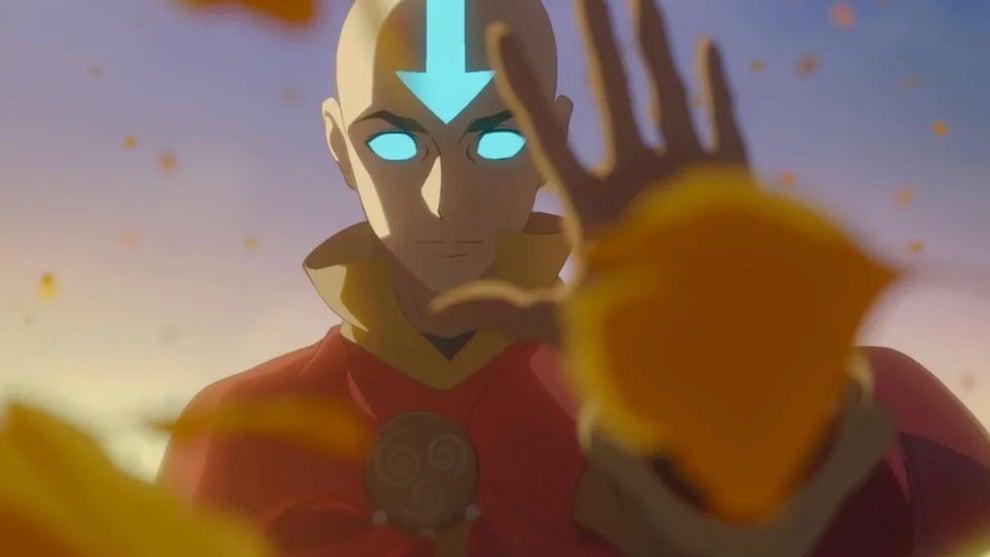
“Avatar Aang: The Last Airbender” has fan service. People who love the classic animated series will probably enjoy seeing the cabbage guy again. And the foaming mouth guy. And a Kyoshi warrior just kind of hanging out in the street, doing whatever it is Kyoshi warriors do when they have the day off. But “Avatar Aang” is for the fans on a more meaningful level, since the fans will understand this film’s story in a powerful way, and everyone else will probably just get the gist of it.
After three epic seasons of television, “Avatar: The Last Airbender” spawned an equally impressive sequel series, excellent comic books and live-action adaptations which haven’t had the same cultural impact or universal acclaim as the original. (The less said about the 2010 film “The Last Airbender,” the better.) “Avatar Aang” takes place between the original “Avatar” and “Avatar: The Legend of Korra,” and it tells a story that’s impressive if you’re familiar with what these characters have gone through and where they’re destined to go. But the dramatic resolution to Aang’s ongoing inner turmoil won’t hit as hard if you’re just learning about it for the first time.
It’s been years since “Avatar: The Last Airbender’s” story ended and Aang (Eric Nam) is now a young man, a little wiser but still a huge dork. He lives in a fictional world where some people are born with the ability to bend one of the four elements to their will — air, water, earth and fire — and Aang is the legendary Avatar, the only person who can bend all four elements, who gets reincarnated every generation to unite the people. As a child, Aang saved the world from a colonialist Fire Nation and has, in the time that followed, founded Republic City, a political, economic and cultural center where the previously separate societies can come together and live, in theory, in harmony.

One of the recurring motifs in “Avatar” is that every Avatar tries to do the right thing, but every Avatar also makes mistakes which their next reincarnation has to fix. Fans of “The Legend of Korra,” a series about Aang’s successor, already know that Aang’s utopian city has a massive flaw: Building a society around the four bending cultures created a class divide where the non-benders — i.e. the rest of us — are sidelined, leading to civil unrest.
In “Avatar Aang,” we meet the first non-bender uprising, a group called “The Denied.” They’re searching for a magic staff they think will balance the scales. It doesn’t sound too bad when you put it that way, but they’re violent jerks about it, so Aang has to find the artifact first. He reunites with Team Avatar — the group of kids who helped save the world, who have also grown up a bit (some more than others) — and embarks on a quest of his own.
Aang is (no spoilers, it’s the title) the last Airbender. The Fire Nation slaughtered all the others in an unthinkable genocide. Aang was a child at the time, and was only spared because he had literally run away from his responsibilities. Aang’s survivor’s guilt and overwhelming shame have driven the character since the beginning — even when he was in total denial — but while “Avatar: The Last Airbender” concluded with Aang defeating the Fire Lord, effectively righting the wrongs, he never fully processed the trauma.
In Aang’s new quest, he discovers the second-to-the-last Airbender, a man out of time named Tagah (Dave Bautista), and Aang thinks that, at long last, there may be hope for his people’s survival. Perhaps, with Tagah’s tutelage and the magic staff, Aang can bring airbending back to the world and ease his guilty conscience. Of course it doesn’t go as planned and eventually Aang has to make impossible choices, all of which have serious, life-altering consequences.

“Avatar Aang: The Last Airbender” is a 99-minute movie. That’s not a lot of real estate. Director Lauren Montgomery jams a lot of action and spectacle into that short running time, and the animation is as stunning and fluid as you could hope for, with fight scenes and elaborate disasters which put most live-action movies — and a lot of animated movies — to shame. The scale of “Avatar Aang” was clearly designed for the theatrical experience, so let’s all give a big round of applause to Paramount for dumping the film on Paramount+ instead. Good job, Paramount. You’re really killing it lately — and by “it” I mean everyone’s opinion of your studio.
But at its core, “Avatar Aang” isn’t an action movie, it’s a film about reckoning with genocide, and while that’s a gigantic subject that would be difficult for any movie to explore properly, in any genre and at any length, the film does an admirable job of making its points. Over the course of the conflict, Aang has to decide what’s really important, and although the antagonists have understandable points of view, Montgomery’s film ultimately comes down to a matter of principle: The cycle of violence must not continue, at any cost. And there’s a big cost.
It’s powerful stuff, and fans of the series will take away additional nuance, since we know what Aang’s decisions lead to, for better and worse. I suspect everyone else will find the film dazzling visually but undercooked in other ways. Aang is the only member of Team Avatar with an arc this time around. The rest of his friends have to settle for small roles, mostly doing what they usually do, in the midst of a familiar episodic formula where they meet a mysterious and powerful new bender and debate whether or not to trust them. Without any character development to wrap around that familiar structure most of the ensemble is stuck cracking jokes and kicking butt. It’s nice to see them, joke-wise and kick-wise, it’s just a shame we never got to hang out.
“Avatar Aang: The Last Airbender” is a noble endeavor, and a largely successful one. That its greatest depths are difficult to see if you’re not familiar with the series is a problem, but it’s also clearly an intentional decision that allows this sprawling story to fit within a limited time frame. After all, this one is “for the fans.” Not because it has cute little in-jokes and cameos, but because it’s the latest chapter in a ongoing, epic tale. And what a moving and exciting chapter it is.

The Best Movies of 2026 So Far