
Kane Parsons’ “Backrooms” is a horror movie about an unknowable, liminal space called “The Backrooms.” There’s nothing wrong with that title, but the rest of the film has serious problems. It’s a masterpiece of production design, no one can argue otherwise, but the ingenious sets are undermined by a wispy storyline and characters who’ve heard about psychology but don’t know much about it, and don’t have in-depth psyches of their own.
Lots of movies have a limited grasp on psychology, that’s not unique to “Backroms,” but Parsons’ film revolves around a psychologist and her patient and they talk about psychology all the time, so here it’s more like an albatross. “Backrooms” has a terrifying aesthetic, but it never assembles a coherent, meaningful narrative. The sad thing is it didn’t need one. If this movie was nothing but a sightseeing tour of disquieting office buildings Parsons probably could have gotten away with it. But the more “Backrooms” tries to have a point, the more pointless it feels.
Renate Reinsve stars as Dr. Mary Kline, a psychologist whose patient, Clark, is in a pretty standard rut. Clark is played by Chiwetel Ejiofor, and he’s a divorced alcoholic who wanted to be an architect but now runs a crappy discount furniture store. He hates his job and resents his ex-wife, and there’s not a lot more to him, even though the whole movie is allegedly about figuring him out.

Dr. Kline has a traumatic backstory, about a mother with severe mental health issues, and sometimes we see her past in short flashbacks. But there’s not a lot to Dr. Kline either. She’s got lingering issues, but mostly she just sits at home, looking bored, staring at a piece of concrete that reminds her of her childhood, because symbolism is a thing in movies sometimes.
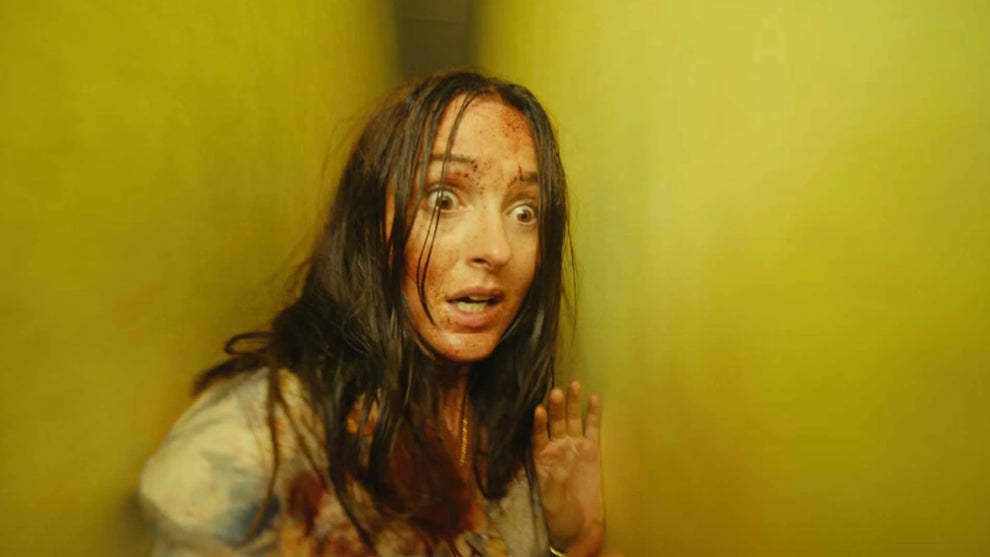
Clark’s store has its own issues. There are no customers, that’s a big one, but there are also weird electrical surges and inexplicable switches in the circuit breaker that aren’t connected to anything. Clark flips them anyway, which allows him to walk through a wall and into the Backrooms, a series of infinite hallways with impossible geometry, illuminated by urine-yellow fluorescent lights. These rooms are full of mysteries and, like any proper labyrinth, there’s some kind of minotaur stalking around it, always just around the corner, terrifying but rarely glimpsed.
Like a lot of horror stories, the concept is scarier than the explanations. “Backrooms” is strongest when the protagonists explore inexplicable, ominous spaces, a gigantic practical set which would, in any rational universe, win a plethora of year-end awards. There are details and clues in these nightmarish halls that excite the audience’s imagination, and make us complicit in the film’s terror and paranoia.
Every theory you’ll come up with, however, is probably more unsettling than what “Backrooms” reveals. Kane Parsons built a large mythology around this popular creepypasta, and good for him, but screenwriter Will Soodik struggles to find a place for it all. There are lengthy exposition dumps which make the scariest parts less scary, and when “Backrooms” finally answers one of the biggest questions, and puts it on camera for all the world to see, you’ll be forgiven for laughing out loud. It’s an absurd image which, in a cleverer film, might have been a welcome tonal shift. Instead, “Backrooms” doubles down on how terrified we’re supposed to be, by an image that’s hard to take seriously. There’s no coming back from this cognitive disconnect. The damage is done.

Chiwetel Ejiofor and Renate Reinsve are both brilliant performers, but Reinsve is held back by a screenplay which asks frustratingly little of her. Ejiofor gets more to do, but eventually it becomes clear his behavior doesn’t track with what we know about his character. Clark goes on a journey, certainly, but he teleports randomly forward in his development, evolving in ways that could be frightening but are, instead, difficult to justify. Clark does what this movie needs him to do whether it makes sense for him to do it or not, and since very little actually happens, we have lots of time to think about how his character wasn’t thought through very well. Not even Ejiofor’s sad, plaintive intensity can make up for that.
And then, of course, there’s the mythology, which is jammed into “Backrooms” whenever Parsons and Soodik don’t know what to cut to. Mark Duplass plays a researcher, never mind what kind, who probably knows more about the Backrooms than anybody else. But this film never figures out how to incorporate his character or his knowledge without stopping the narrative dead in its tracks. It’s like an episode of “Lost” that keeps referencing the Dharma Initiative experiments without ever actually going anywhere with them — which is to say, it’s like too many episodes of “Lost.”
There are long segments of “Backrooms” where Parsons lets the eerie art direction take center stage, and stops trying to sell the audience on unconvincing characters and half-baked lore. Whenever he lets go, “Backrooms” is a mesmerizing, horrifying experience. Whenever Parsons steers back in the direction of the wonky plot and underdeveloped themes, he loses control and the film fights back.
With that said, this movie doesn’t seem to want to be a major motion picture. I think it just wants to be a Halloween Haunt. I’d pay good money to get lost in these sets for a day, just so long as I don’t have to hang out with the protagonists or think about the mythology anymore.
“Backrooms” finds itself in theaters on Friday.
