There’s a facetious double meaning to writer-director Jordan Firstman’s “Club Kid,” which tells the story of a washed-up party promoter who suddenly realizes that he has a son.
On the surface, it’s a tidy shorthand for summarizing the film. Still, it also captures the central tension its protagonist faces: He’s forced to choose between the pleasures of a thrill-seeking life and the unsexy toil and responsibilities of adulting. Our finitude and limits are the things that make us human and simultaneously the most frustrating part of existence. Firstman’s film is an exploration of a man who has to come to terms with the fact that if he can’t have it all, he has to be judicious about what he will commit his one “wild and precious life” to.
It’s an earnest, heartwarming, and vivacious look at the realities of parenting and a celebration of the warmth and love in unconventional lifestyles. At the same time, Firstman often gets in his own way, commandeering the film to act as PR (or damage control) for himself, rather than following the natural path of this unvarnished story.
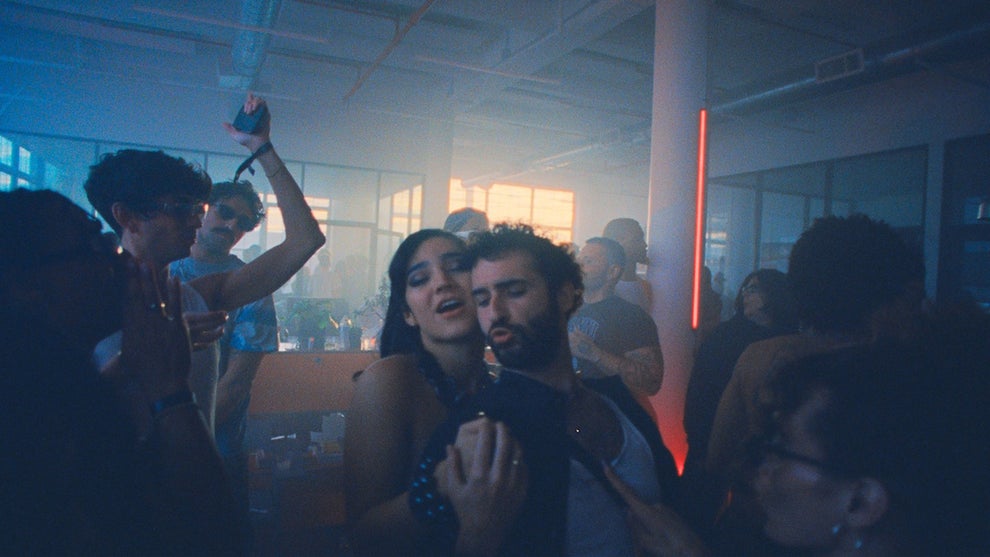
Firstman may be wearing multiple hats in the film, but he’s anchored by a solid crew that is in synergy with his creative provocations. The chief MVP, I’d argue, is cinematographer Adam Newport-Berra, who, with Olivia Wilde’s “The Invite,” managed to make just one floor of an apartment feel like a whole world. He has more real estate to play with here as he captures the nightlife escapades of Firstman’s Peter, a party promoter whose idea of a good time is deeply tied to taking all flavors of heavy drugs with his coterie of comrades. Newport-Berra doesn’t shoot these scenes the way most club sequences have been depicted in film, which mostly favor wide shots that capture the sheer breadth of the contorting mass of bodies in a given space. The camera is kept up close and personal, almost invasive in nature, as it homes in on the character’s visage.
We see this in the film’s opening, where Peter and his friends get into a cab, and the camera spins in a 360-degree fashion, capturing the changing expressions of the cab driver and the rowdy crew in the back. It’s immersive, intoxicating and immediately gives a grounded sense of place, which carries forward when the action moves from the car to the dance floor to the dark rooms where hookups abound.

Yet for all its depiction of the carnal, “Club Kid” doesn’t fasten its stories in the vociferous; it’s all about the moment after, when the hangover is so intense that an iPhone alarm feels like a sledgehammer to the cranium, where you’re wiping the drug dust off your furniture before the whole cycle starts anew. It’s evident that Peter feels stuck and hollowed out. He wrestles with an insecurity and dissatisfaction that brews under his skin, even if he is very much the life of the party whenever he’s out.
“You ever just like, lose 10 years?” he offhandedly asks his neighbor the morning after a night out, before he shrugs it off and keeps going up the stairs.
It’s when Peter is at his most mopey and sardonic that Firstman thrives as a performer, but the film moves to deeper narrative territory that requires more from him in ways he can’t always deliver on. One day, a friend of the woman he unknowingly slept with, Edison (Kirby Howell-Baptiste), knocks at his New York apartment door and tells him that he has to care for a son he didn’t know he had, Arlo (Reggie Absolom).
Once it’s clear that Arlo is here to stay, Peter, to his credit, accepts the responsibility, and his results at parenting are humorous in their sincerity and imperfection. From seeing Arlo pick up his profanity habits to unintentionally throwing up on him, it’s touching to see Peter try his best under these new circumstances.
Credit is also due to Absolom for not playing Arlo as a naive youth in need of coddling. His music taste is eclectic and sophisticated (he name-drops Cocteau Twins as an example of an artist he likes), and he’s well-versed in queer culture due to his mum. While Peter is unsure about introducing Arlo to his night club life – what with the drugs and sex of it all – he learns to embrace a new model of parenting through Arlo’s openness and inquisitiveness that goes beyond just protection. Being a good parent, Peter realizes, doesn’t mean shielding kids from all the things that are scary and uncomfortable, but making sure to be present while they encounter things they might not understand.
It’s easy to be won over by Peter and Arlo’s chemistry, but this is where the faultlines in the script begin to show. Little exists in the way of problems between them that can’t be resolved through Peter’s can-do attitude, which doesn’t make their intimacy feel earned. Then, when it gets threatened later in the film by child services, who don’t seem to think Peter is a worthy guardian, it’s sad, but it doesn’t carry the weight that it could have. There’s no paucity of shots of Firstman crying, and the frequency and framing of these scenes can’t help but feel performative, as if Firstman himself is asking to be taken as a good guy at heart.
If there’s a familiarity to these pleasures, it’s a mix of the carnal and unsettling, that’s thanks to the producing work of Alex Coco (“Anora”) and Galen Core (“Lurker”). You’re subjected to blinding lights, rowdy music, and conversations that are overplayed on top of each other. NYC’s gay night club scene, at least the types of establishments Firstman most likely has intimate experience with firsthand, is rendered with pristine detail that serves as a way to bring to life this community that’s formed in spite of the oppression and scrutiny it faces.
At one point in the film, while fighting for custody of Arlo, the judge comments that due to the unconventional nature of Peter’s community, it raises concern from the court. The film is in rebuttal against such suspicions. This is a film that celebrates those found families and imperfect spaces and showcases that they’re just as worthy and capable of love.
