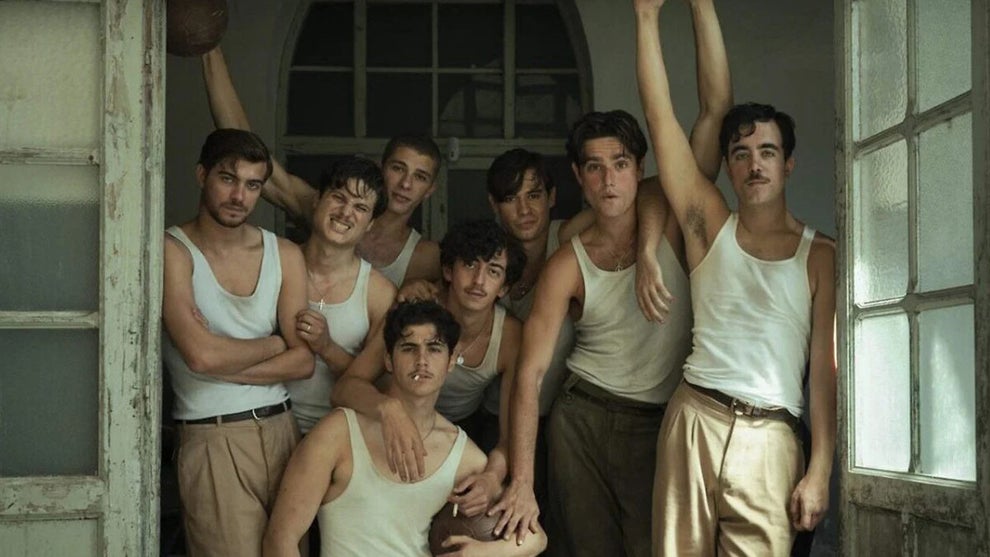
It’s only in the cinema where the impossible can be made possible, and with filmmakers Javier Calvo and Javier Ambrossi’s “La Bola Negra (The Black Ball),” the past and present break free from the constraints of linearity, transforming into lovers who flirt and fight with each other. From the directing duo known as Los Javis’ rattling opening to its devastating coda, it’s one of those rare films that feels both old and new.
It’s rife with ingenious and technical marvels and sequences that rank among cinema’s best while also telling a very classical story about honoring those who’ve come before us, making space for the stories of those we may never meet, and acting as a celebration of those who never gave up on their love even when it was punishable by death.
Take the opening sequence, set in 1937, where a village housing musician Sebastián (Guitarricadelafuente) sees his entire family and community get slaughtered by aerial gunfire. His escape sequence immediately tips viewers off that the epic that unfolds for the next two and a half hours is in the hands of filmmakers who know how to imbue their spectacle with heart.
Sebastián climbs through the bodies of the dead before coming face to face with a felled sculpture that’s been pierced with arrows. He uses the arrows the way some might use rocks when bouldering, as a way to give his hands a grip to climb out of the hell around him. That the sculpture, porcelain white and shaped in the way the idols to the Greek gods might be, is a clever touch; Sebastián, with his dark skin, Adonis features, and bloodied body, is eschewing that worldview in exchange for telling a new story we haven’t seen before. What we see is nothing short of witnessing a new mythology being created before your very eyes.

Sebastián was loyal to Nationalist Italian rebels, hence their punishment from the government, and against his will, he’s forced to join the fascist army that caused his village’s massacre. While there, he meets leftist prisoner, Rafael (Miguel Bernardeau), whom he’s to befriend so that Rafael might give up sensitive information. It’s evident, though, that Rafael has a role in Sebastián’s own queer awakening. This adds another layer to Sebastián’s deception, as he’s trying to hide his own blossoming feelings, his marching orders, and his own hatred for the regime he’s serving under.
Two other stories form the triptych that is “La Bola Negra (The Black Ball),” the second being about Carlos (Milo Quife), whose inciting action for his own spiral is being denied access to his father’s casino amidst rumors about his homosexuality.
The film’s title comes from the voting process that the casino members undergo to induct new members: a white ball shows support, while a black ball is negative. The black ball imagery manifests in a clever, surreal and snow-chilled sequence that’s too fascinating to spoil. The idea of Sisyphus and his boulder comes to mind, as well as the ways internalized rejection can take on a gargantuan and monstrous form.
The third story focuses on historian Alberto (Carlos González), who learns that his mother’s father, whom he knew very little about, left him behind something that becomes the key to connecting these other stories. While the other two stories tell of homosexual desire under siege, Alberto’s story is touchingly one of reverence for the sacrifices of the past. It’s not that those of marginalized identities don’t face discrimination today, but that each generation has split its own share of blood to make the next one better.
Alberto’s story is a moment of giving the elders their much-deserved flowers, and what gorgeous flora they are. Of note also are the roles of Nené (Penélope Cruz) and Isabelle (Glenn Close), who have brief yet substantial roles as a nightclub performer and historian, respectively, but whose vibrant performances anchor the film emotionally within the three time periods.

Indeed, above all else, the directors find ways to show how the past and present should not be viewed as separate but intimately and achingly connected. They achieve a lot of this through clever cross-cutting — their editor, Alberto Gutiérrez, deserves praise for cutting across so many time periods cleverly without making it all feel too montage-esque. It’s not perfect though, as sometimes Gutiérrez can be a bit too zealous in showing the connections from one story to another that he halts the narrative momentum of what’s going on just to make a broader point on the whole. Personally, I found Sebastián and Alberto’s stories to be more fleshed out than Carlos’, which can make the dedication of screen-time feel a bit uneven.
One key example though of Gutiérrez’s editing shining is through Alberto’s tense relationship with his mother. His mother holds anathema towards her father (Sebastián from the film’s opening), who left her when she was young and supported the fascist regime. She wryly notes about his violent disapproval if he ever found out Alberto was gay. Of course, in reality, circumstances were much more complicated. Yes, Sebastián was a part of the regime, but tried to resist in his own way, and was queer himself. This isn’t known to his present relatives, but by cutting his scenes together with those of what happens with Alberto and his mother, the film acts as a beautiful rebuttal of easy judgment. It reveals that while we may never know the fullness of those who have passed, it doesn’t mean they didn’t live lives of nuance, pain, sorrow and love like the rest of us. As Close’s Isabelle (paraphrased) says, “The work to remember is a way to avenge death.” History, she says, is not about facts but the people who made those facts.
“This country has too many love stories buried in the fields,” says one character near the film’s end. If cinema can be anything, the two Javiers seem to say, it can be both a shovel to unearth and new soil for those stories to take place.
There are terrains out there to explore, those that need the compassionate and vivacious eye of people like Ambrossi and Calvo to put them to screen. The harvest is plenty, but the workers are few, and “La Bola Negra (The Black Ball)” might just invite you to start digging. You never know what treasures you’ll find.
