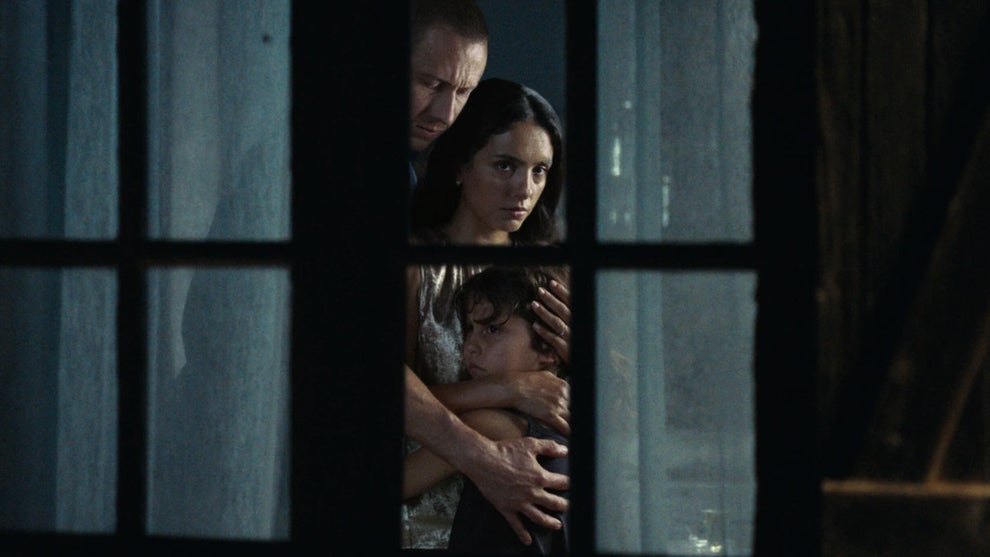
It’s an encouragement to see that director Léa Mysius’ “Histoires De La Nuit (The Birthday Party)” has its premiere in the Main Competition at Cannes, proving that there’s room in the line-up for proficiently made home invasion thrillers whose craft elevates ingredients that will likely be familiar to those of the genre.
There’s easily another version of this story that could have been the movie of the week on Netflix, but Mysius and her team are too talented, too adroitly adept at merging the universal emotions of their characters with the cultural specificity of this story, to deliver anything less than compelling. Its length ends up being its biggest hindrance as it isn’t always able to sustain the momentum of its shotgun blast of a story across its 114 minutes, even though those minutes go by thanks to Monica Bellucci serving face. Even then, I can’t fully fault it because its restraint allows the horror inherent in its premise to lodge itself in ways that a faster-paced version of this film might not allow. Mysius slides the blade in slowly, reveling in the kind of terror you’re choking for air from only after you’ve realized you’re standing in a pool of your own blood.
While Mysius’ direction is to be praised, “Histoires De La Nuit (The Birthday Party)” wouldn’t work if the rest of her collaborators weren’t taking its B-movie material seriously — and across all departments, that synergy of minds shows. Take Florencia Di Concilio’s score, which feels like it takes Volker Bertelmann’s “Conclave” score – with its imposing strings and thunderous crescendos – and transports them into the marshlands of France. It makes every moment feel instantly more tense than it is, which is a testament to how cinematographer Paul Guilhaume makes the isolated farm where Nora (Hafsia Herzi), her husband, Thomas (Bastien Bouillon) and their daughter Ida (Tawba El Gharchi) reside, feel serene. It is the dissonance between the beautiful scenery and operatic soundtrack that keeps you on edge from the first frame. Something will go wrong; it’s just a matter of when.
Guilhaume frequently uses a handheld camera, and his stationary blocking always keeps us at a chilling distance from the characters. We never feel like we’re with them but rather that we’re watching them. Take a moment where we see Nora have to change a flat tire; as she gets out of the car, rather than have the lens follow her out, we see her leave from the perspective of the backseat. We’re trapped, made to feel like voyeurs, or most poignantly, a predator stalking its prey.

Mysius adapts the novel of the same name by author Laurent Mauvignier, and her work shines best when she’s economical with getting viewers up to speed on the characters, often using one incident as a way to paint a complete picture of interiority. After school one day, Ida shows her mother a video she posted to TikTok of the three of them doing one of the dance trends. After revealing the video has over 60,000 views, Nora immediately tells her to delete it, not budging until she’s seen Ida do it. It’s clear from the beginning that she doesn’t want to be seen, and it reframes the farm that the family is situated on as a bunker for evasion rather than just a preference for the bucolic.
Even the occasion to celebrate Nora’s birthday is structured in a nerve-shredding way. When she turns the corner of the office where she works, she’s startled by her co-workers, who have prepared a surprise celebration. Thanks to sound editor Alexis Meynet, when they all pop confetti, it feels violent rather than celebratory. It’s merely a foretaste of things to come, when three brothers, Franck (Benoît Magimel), Flo (Paul Hamy) and Stutt (Alane Delhaye), take the family’s next-door neighbor, Cristina (Monica Bellucci), hostage and also intercept Ida when she comes back from school. Stutt is assigned to watch over Cristina at her home while Flo and Franck keep Ida in the other house, waiting for Thomas and Nora to get back home.

For these types of stories, you think you know who the heroes and villains are, but Mysius’ and Mauvignier’s script isn’t trying to make anyone easy to root for. Yes, the brothers are threatening and brutish, but they’re also driven by a sense of empathy and honor, particularly Stutt, who begins to bond with Cristina over being an outcast and, quite literally, being left out of the room where things happen. Alternatively, when Nora and Thomas arrive, the film is all too eager to poke holes in the idyllic portrait of a family we’ve seen prior to the home invasion. They all have secrets that they thought they could bury with a new start on life, but the brothers’ presence acts as a form of judgment; they are the living embodiments of when you don’t properly exorcise your demons.
The action remains split between these two houses, which means we get two chamber pieces for the price of one. Naturally, the house with more characters (i.e., more unpredictable variables) makes for a more compelling watch, even though Bellucci on her end delivers an essentially one-woman show whenever the camera turns to her. She’s a master at feigning the frightened damsel, but her eyes reveal a steely resolve. We’re treated to multiple scenes that underscore the brutality of the three brothers, but they don’t unlock any new layer of insight for them; we understand the gravity of the situation the first two times Flo threatens the family at knifepoint. By instance 13, it has become rote.
There’s a familiar comfort to watching “Histoires De La Nuit (The Birthday Party)” unfold, not necessarily because its sanguine outcome is expected to differ from what you might expect, but because there’s a thrill in seeing a familiar story be told with a sharp personality. In many ways, watching it is like getting a gift you didn’t ask for on your birthday: Its unexpected nature may surprise you, but when you consider the thought and intention that went into its purchase, you can’t help but be enamored.
