
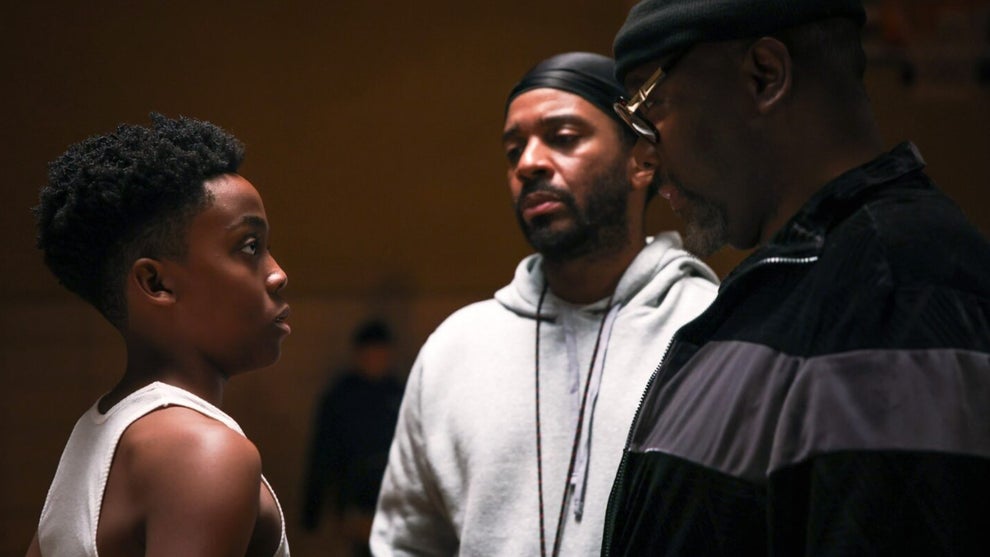
Sheldon Canis’ new boxing drama “They Fight” is about children fighting in a boxing tournament. It’s about adults fighting their own demons. It’s about a recreational center fighting city budget cuts. But the most dramatic fight is between the story and its storytellers. So, as the anonymous poet who wrote the tagline for “AVP: Alien vs. Predator” once said: “Whoever wins … we lose.”
André Holland, perfectly cast as literally anyone (he is just always reliably that good), stars as Walt Manigan, an ex-boxing coach on parole after three-and-a-half years in prison. He’s determined to get a job, stay clean, and earn his way back into the life of the woman he loves, Ketta (Samira Wiley), and their very young son.
Walt has nowhere to go, nowhere to sleep, and nowhere to work, so he spends a lot of time at a local rec center, using their computer to apply for jobs. Slim (Wendell Pierce) runs the place. He recognizes Walt and he nudges him back into coaching local kids, especially Peanut (Anthony B. Jenkins) and Quincey (Toussaint Francois Battiste). Hopefully the children will grow into disciplined go-getters. Walt may even find himself along the way.
“They Fight” frames itself as Walt’s personal journey to redemption, and Holland can play that. He wears regrets like they’re goosebumps, which can only go away with warmth and comfort, neither of which he currently has. Walt says he lost his love for boxing, although “They Fight” is vague about why he turned his back on the sport. He resists his own urge to be a mentor and instead tries to work in construction, before sciatic nerve pain overwhelms him. He can manage that with medication but he’s afraid of falling back into addiction, so every time he takes a pill, “They Fight” pauses to watch him closely, as though he might relapse.

The filmmakers do this kind of thing a lot, using familiar, clear cinematic language to tell a story with tension and melodrama. But “They Fight” has no interest in playing along. No matter how many times we see Walt taking his meds, he never abuses them or seeks out stronger stuff. That’s not a subplot, it’s the threat of a subplot. And it’s an empty threat.
Not that we want anything bad to happen to Walt. He’s a decent guy, whatever mistakes he’s made, and he’s determined to redeem himself. So determined that he successfully redeems himself about two-thirds of the way through the film, so “They Fight” needs to scramble to put together a third act. The focus shifts from Walt to his boxers, Peanut and Quincey, who seem destined to fight each other at the climactic tournament. That’s a promising development. Or it would be if it was developed.
Peanut and Quincey, played by impressive young actors, have no beef with each other. They’re good friends. There’s no indication that fighting each other means something to them. They’ll both try to win, only one of them can, and they’ll probably hug it out afterwards. Neither boxer has a stronger motivation to compete, neither has anything seriously on the line. Sheldon Canis’ film tries, by employing high intensity montages, to imply Quincey is working out his aggression after a terrible personal loss, but it never seems like he’s losing his way or has to be stopped. No matter how hard the cinematography and editing insists that the big fight means something, it’s never convincing.

The Best Movies of 2026 So Far
The thing is, “They Fight” is full of convincing moments. Whenever the characters stop and talk, about their crushes on girls, about their family drama, it’s a captivating film. Whenever Pierce spouts wise words about life, or hard work, or honesty, or any other important subject, “They Fight” feels forced. When he’s talking about how he thinks noodles taste better when you eat them with chopsticks, that feels real.
The most powerful moment in “They Fight” isn’t when Holland stands before his students and gives a big speech about his past and their future, inspiring them to compete. The movie wants that to be the most powerful moment, so the dramatic music drowns the actor’s dialogue, as if the bigness of the moment was more important than anything he actually says. That doesn’t amplify the scene. It just makes the scene hard to follow.
No, the most powerful moment is when Quincey, at the worst moment of his life, while Walt is trying to keep him interested in boxing, tells his coach “I give zero f–ks about your pep talk.”
It’s as though Quincey was finally speaking for all of “They Fight’s” characters, trying to convince the storytellers that even though this film has boxing in it, it shouldn’t conform to the usual boxing movie rules. “They Fight” is better whenever it ignores the standard sports clichés and focuses on real people and their emotions, not its barebones plot.
“They Fight” is based on a documentary, and it shows. When it’s about something real it’s about something beautiful, but we already have the real version, so this remake never makes a convincing case for its own existence. Why watch the self-conflicted, contrived version of the story when you can watch the actual people, living actual lives, with actual consequences? A great movie about these characters already exists. Why fight it?
