
Note: This story contains spoilers from “American Horror Story: 13” Episode 6.
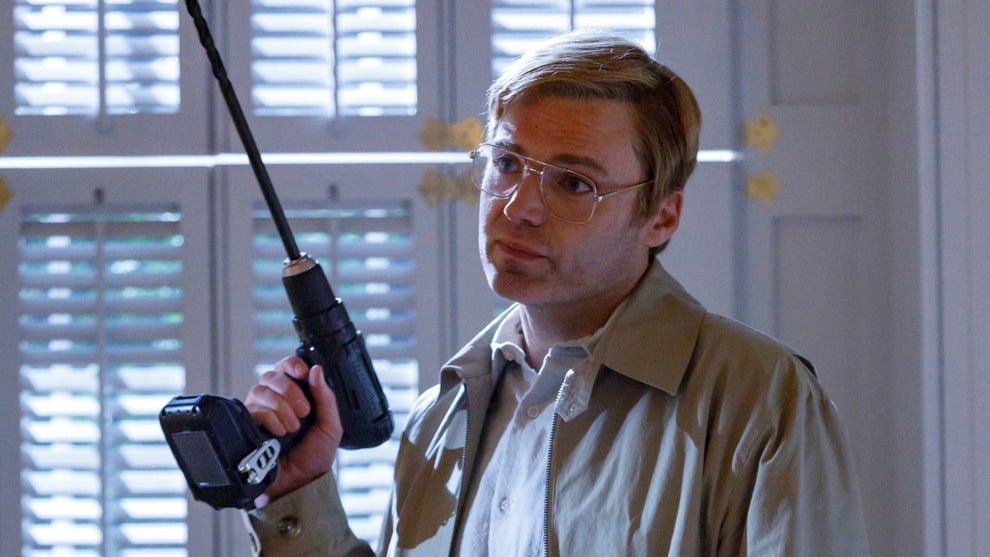
You never know who Ryan Murphy is going to bring back for “American Horror Story,” and the sixth episode of Season 13 brought back a face fans haven’t seen in a decade: Seth Gabel’s Jeffrey Dahmer.
Inspired by the infamous real-life serial killer, the character first debuted in the “Devil’s Night” episode of “American Horror Story: Hotel,” which saw Evan Peters’ murderous Hotel Cortez designer James March welcome his fellow serial killer ghosts for a ceremonial Halloween dinner — and kill — on the one night of the year ghosts are allowed to walk free.
Of course, the undead are now roaming the streets of New York freely in “AHS 13,” thanks to whatever hellish scheme is being brewed up by Constance (Jessica Lange), her cohorts and the mysterious Mr. Nas (Fedor Steer). That scheme brings Dahmer, Mr. March and a couple more of their fellow killers to the coven’s doorstep in a confrontation with Cordelia Goode (Sarah Paulson).
Ahead of the episode’s debut, Gabel told TheWrap about filming that violent confrontation with the “Coven” supreme in “The Return of Devil’s Night.” The actor also discussed why a call from Ryan Murphy is always a “hell yes” and the surreal experience of returning to the character of Jeffrey Dahmer alongside Evan Peters – who has himself since earned an Emmy nomination for playing Dahmer in the first season of Netflix’s “Monster” series. This conversation was edited for length and clarity.
TheWrap: I read that when you were on “AHS: Hotel,” it was sort of a call-out-of-the-blue offer, 10 years after you last worked with Ryan on “Nip/Tuck.” Did you have an idea that you might return to this world one day, or was this a similar situation?
With Ryan, you learn to expect the unexpected. So getting a call to play Jeffrey again fit the norm in terms of, it came out of nowhere, and I had no idea what I was going to do, and I was immediately a “hell yes” in wanting to do it. Similarly to “The Watcher,” usually when I get a call from Ryan, I agree to do it without having any idea what’s going to happen. And this time, like every other time, I was beyond pleasantly surprised and so thrilled to get to do all the fun things that we get to do on the show. To get to play with Evan Peters, who also played Dahmer, was surreal and a dream and so much fun.

Yeah, I was going to ask about that. That’s got to be a little strange. Was that what was that experience like for you guys? Was it a situation where you addressed the surreal elephant in the room on set?
Yeah, that’s the big thing I was nervous about. Was he going to be territorial about this part? And the first day we had rehearsal together, it was clear that this was not going to be a measuring contest. He was very clearly already embedded in the March role, and he behaved the whole time like he never even touched Dahmer, so he was incredibly generous and just letting me own that part. He never had anything to do with it. It felt like if you shared an ex-girlfriend with someone, and he didn’t bring it up at all.
So it was fun, but he was so much fun to play with. He’s such an incredible actor, and to just simply be present with someone not knowing what’s going to happen next, even though you both have the script to memorize, that’s one of the most thrilling things that I love to do.
Absolutely, it’s very gracious. But I will say, he maybe has enough roles this season.
[Laughs] Yeah, seriously, I was happy I could take one off of his plate.
What is it like to be a guest star on “American Horror Story?” What’s it like to come to the set in the middle of these always wild and ambitious stories? Do you try to understand where you are in the bigger picture, or do you just walk in and focus on the scene?
It’s a bit of both. You definitely want to know enough context that you’re serving the material and helping drive the story forward. But at the same time, you know you don’t need to know everything, and you can just fully commit to your part.
“American Horror Story” is such a surreal show, and it’s such a satire that is fully aware of itself that you get to play at the same time, fully committing to the most extraordinary circumstances and making fun of it at the same time while you’re doing it wholeheartedly. So it’s this surreal combination where you’re aware of the irony and at the same time, you’re doing it earnestly, and so the more information you have about what’s happening in the series on the whole, the better. But at the same time, if you’re someone like Jeffrey Dahmer, you’re just committed to what Jeffrey’s into, which is sex and eating people.

Right, speaking of which, this is already an interesting character to step into, but you had about 10 years between coming to this character, and two different ways and two very different contexts. So, how did you approach your return to him?
I was able to play the surreality of coming back to the show for Jeffrey. It’s a similar sensation because he’s dead, he’s a ghost, but at the same time he’s been resurrected, and kind of doesn’t fully have a sense of what was happening in between that time. And and so any anything I felt in terms of how strange it was to suddenly be back on the show, Jeffrey was able to feel, in terms of suddenly being back in the real world outside of the hotel, riding in a Waymo, dealing with cell phones and iPhone apps and Grindr. And enjoying how strange the world is that we live in, but at the same time, having a sense that something’s even more fucked up about the world now than it was when he was in his heyday.
I’m not a forensic psychologist, but there’s been plenty said about the role that repressed sexuality played in Dahmer’s life. So, tell me a little bit about your interpretation of Jeffrey Dahmer, Grindr user.
[Laughs] Yeah, I mean, the first time I did “Hotel,” I really dove into the research of Jeffrey Dahmer and really wanted to dig into every single detail of what happened and tried to figure out for myself a way to do that safely without kind of infecting my mind with too much darkness. But I knew I had to find a way to speak to the truth of what his mindset was with his repressed sexuality, and at the same time find a way to make it funny, which is a very interesting thing to do on this show.
I had a rehearsal early on with Ryan Murphy, and he came up to me, and he just said two words. He said, “Poor Jeffrey,” and I just understood that what makes Jeffrey funny is he’s so self-indulgent and so worried about his own feelings of despair that he’s willing to kill people, turn them into zombies, make them slaves for his own dark, repressed reasons, and at the end of the day, feels bad about himself. And so, pointing to that irony is what is funny on the show.
So, the whole time on this series, I’ve just had Jeffrey be someone who is so self-indulgent with his feelings, and so depressed about being in the world and not being able to fully get what he wants all the time, and how unfair that is.
But yeah, to speak to the repressed sexuality, that was definitely I think a driving factor for the real person. I think he comorbidized his feelings, and kind of everything that was repressed in him became a sexual stimulant of some kind. Incredibly dark and and creepy, but yeah, I think I think he he was a reflection of homophobia around him, but someone who didn’t intervene in the process and stand up for what’s right. Instead, he made things worse.
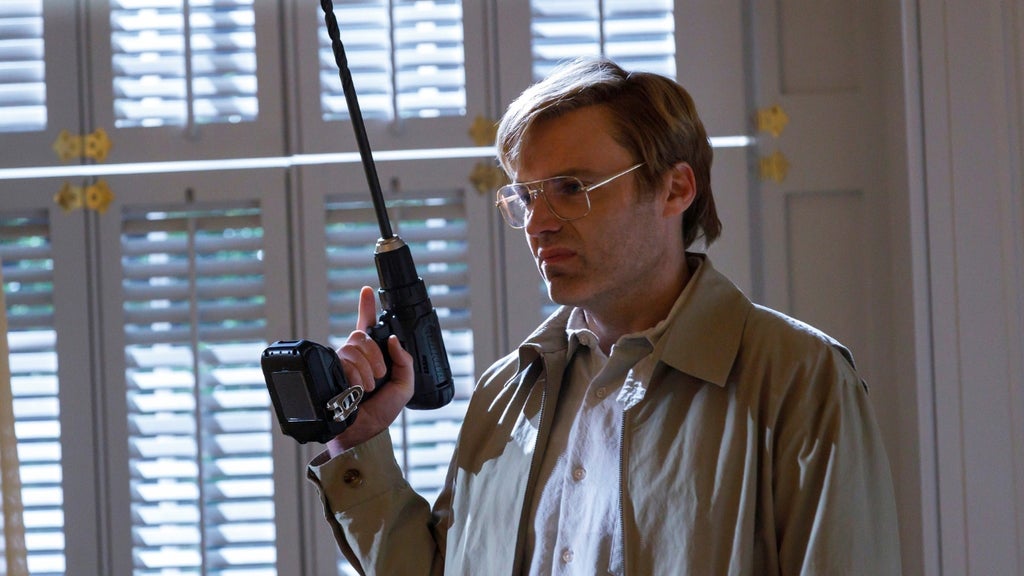
Certainly worse. The “Poor Jeffrey” mindset is interesting to me because something that jumped out in that scene was that March is quite mean to him this time around. Did you give different versions of reacting to that in different takes?
Yeah, yeah. He calls Jeffrey dumb essentially, and that was a tricky one to react to because I didn’t necessarily want to play that he is fully dumb and not processing what he’s saying, but I think I think Jeffrey is so repressed that he comes across as dumb because he just doesn’t want to engage in the fun way that March wants to.
He’s not as free as March. March revels in being able to kill, and do whatever he wants, and run rampant on the world, whereas Jeffrey has such a hard time coming out of his shell. I think they ended up using that reaction as well when he kind of says that Jeffrey isn’t a good dinner guest, Jeffrey’s feelings are mostly hurt. I remember thinking in the character, “What’s wrong with me that like, even other murderers don’t think I’m cool? I’m such a piece of shit.”
[Laughs] Poor Jeffrey, indeed.
Poor Jeffrey.
Okay, let’s talk a little bit about the ending, and the attack scene with Cordelia and the coven. What was that day on set like?
It’s so much fun. I mean, it’s such chaos. But anytime you get to work with Sarah Paulson and Evan Peters and everyone else on the show … what I love about working in the Ryan Murphy world is that acting is treated as sacred, even if you’re doing the most ridiculous things. And so it was just a wild romp of “Okay, we’ve got a bunch of stunts to do, learning what is going to be CGI and what’s practical.”

Fortunately, a lot of it was practical, but it was just a crazy time of being strange, and letting your darker impulses fly and just kind of going for it. Interestingly, I wanted to always have an option where we were giving some comedy because the show’s aware of itself. But Crystle [Roberson Dorsey], our director, she did a really great job of keeping things as grounded as possible and allowed some comedy to come in where it made sense. But she really kept us grounded in the real world so that the stakes felt real and we didn’t get too crazy about it.
You even got a shitty little kick in on Cordelia. Was that something in the script? Was that a direction on the day?
I just let my impulses fly. Fortunately, they had switched Sarah with a stunt person at that point, so I felt OK kicking her in the leg. I kicked, and I don’t know if you noticed, but I also got a few air humps in. To which, Sarah, when she was watching from the side, went, “Hey, Seth … nice.” [Nodding head in approval].
[Laughs] Fantastic. OK, so you’re also currently the terrifying Liam Glasser on “The Rookie.” I think the first thing I ever interviewed you for was your terrifying character on “Salem.” And every time I’ve spoken to you, you’re just the loveliest person. At a certain point, did you have to just like, lean in and go, “I guess it’s what I’m booking?”
Yeah, I keep getting called for these dark, creepy parts. I think I have fun with it, and I think I don’t take it too seriously, and I think hopefully that makes it refreshing to watch in some way. So the phone keeps ringing for these kinds of parts.
I’m starting to want to not take these kinds of roles just to show that I am capable of other things, but at the same time, it’s really hard to say no to getting to express all of the insane, creepy, strange parts of ourselves that we hide from the world. It’s incredibly cathartic as a husband and father to get to do whatever the hell you want and get paid for it.
That’s true, and I hope that taking them on in these somewhat lighter projects helps you avoid the “this stuck with me for months” mindspace I’ve heard sometimes actors can get stuck in.
I recently did an Amazon show called “Scarpetta,” where things did get pretty dark on that one, and it didn’t have the relief of comedy, and I did feel that affected me a bit on the inside. So it’s nice to have a balance in a world like “Horror Story,” where we’re taking the piss out of it rather than fully going to that dark place.
“American Horror Story” releases new episodes Thursdays on FX and Hulu.
