
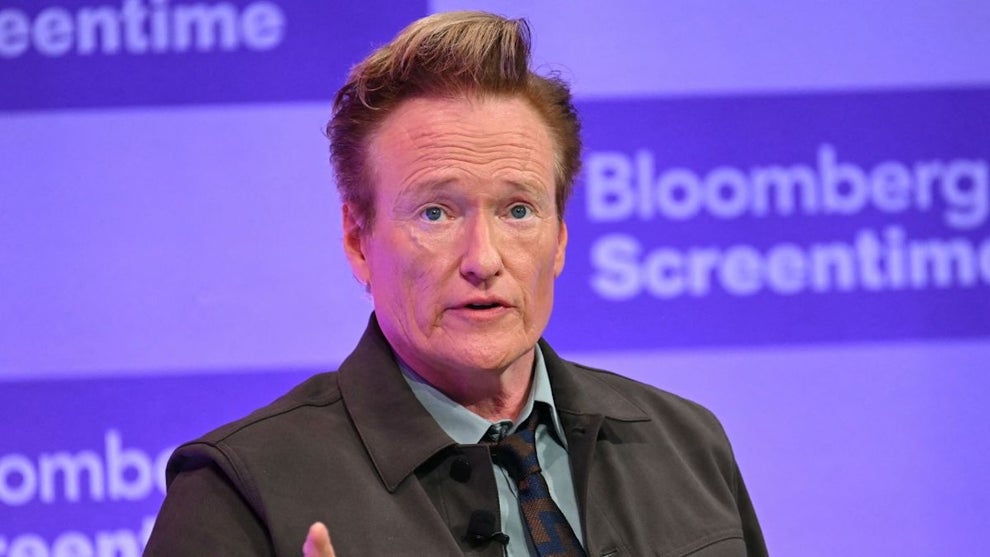
Conan O’Brien reflected on his departure from late night television Wednesday evening, saying he chose to leave before reaching the 30-year milestone as the late-night landscape began to change.
The comedian addressed his move from late night to podcasting during his Wednesday appearance at Bloomberg’s Screentime, where he confessed that he could “see which way things were going” before he decided to end his TBS show, “Conan,” in 2021.
“I knew I wanted to wrap up my late night gig soon,” O’Brien recalled. “I had done about 28 years between NBC, Turner, and I decided [to leave]. Some people were kind of thinking, ‘Well, if you can go to an even 30…’ And I thought, ‘I’ve loved it, but you can kind of see which way things [are] going.’”
He added: “And so, in true sort of Irish tradition, I wanted to leave the party before I was asked to leave. So I said, ‘I know you want me to stay, but I better go.’”

Elsewhere in the conversation, O’Brien weighed in on the state of late night, which saw the departure of Stephen Colbert’s “The Late Show” in May. When asked to comment on networks claiming that late night TV doesn’t “make sense economically,” O’Brien highlighted how the landscape is “really changing” from its prior heyday.
“When people talk about late night, they often don’t think about the bigger issue, [which] is why did it exist in the first place?” he said. “Network TV comes along in the late 1940s. And then, in the very late ’40s, someone realizes we all go off the air at 10:30, and then an American flag comes up and music plays, which is what happened. And I don’t know if anyone here is old enough to remember that, but stations would go off the air.”
“My analogy has always been: you own a nice house, kind of like, ‘It’s a Wonderful Life’ house. You fix it up. Your kids live there. It’s a nice old drafty Victorian. And then you realize, ‘Hey, there’s an attic,’” he continued. “And, what you do is, you go up there and you just put down some basic flooring and put some beds in there, and suddenly you have all this room you didn’t know you had. That’s what networks did. They found room that was not being used.”
As O’Brien went on, he explained how this revelation led to the rise of Steve Allen, Jack Paar and Johnny Carson.

“And you’re off and running, and it’s a monopoly,” he further explained. “And then more and more people stay up late. It becomes a thing, and it’s a giant machine that fires out cash. I got to be in [it]. I got in in ’93, and that’s still happening. And then I saw over my 17, [18] years with NBC … I started to see, ‘Oh, this is really changing. They’re asking us to be much more cost conscious.’”
O’Brien defended that the cost-cutting measures had merit, as late night was battling the rise of HBO, Cinemax and other networks.
“There’s more networks. Instead of one late night show, the ‘Tonight Show,’ there’s now ‘Tonight Show,’ and there’s the ‘David Letterman Show,’” he said. “Then there are other shows, and so you know, it’s a little like Detroit and automobiles. Like, things just started to change.”
O’Brien said that he could’ve gotten “really upset about it,” but that it was just the cycle of the industry – highlighting how streamers and the internet came along to further disrupt.
“Now you’re competing with how many people in America posting videos every day?” he said. “Hundreds and hundreds and hundreds of millions of people are making funny videos. If you do the math, nine of them are going to be one of the funniest things you’ve ever seen. Those come out every day. That’s what you’re competing against. And so, it just became very different.”
While acknowledging how “the economics have changed,” O’Brien defended he is “much more comfortable in my situation now.”
“Everybody works very hard, but there’s not a ton of us, and we make something,” he commented. “The margins are fantastic, so it feels like everyone has got a crucial role. Everyone’s making something.”
