
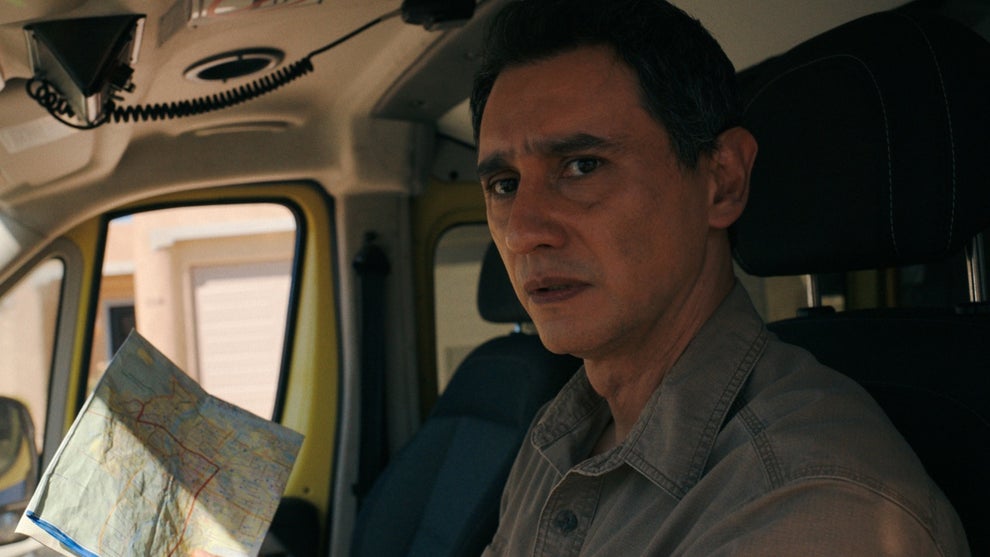
The supporting-actress and supporting-actor nominations for Karolina Wydra and Carlos-Manuel Vesga aren’t just two of the most deserved honors of this Emmy season; they’re also plaudits for two performances that embody how gloriously odd and thought-provoking “Pluribus” is. While Wydra may be the first person nominated for playing 8 billion people at once, Vesga is one of only a handful of actors to be nominated for playing a nearly silent role.
“The show fulfills every role that you would expect from a TV series,” Vesga said. “But also it really goes beyond entertainment and starts to walk the territory of art, which is a different thing from entertainment. Art is about presenting the audiences with different angles on human existence. Hopefully, those new angles and perspectives are going to invite audiences to question their own existence and maybe better that existence.”
Wydra’s Zosia and Vesga’s Manousos sit on opposite sides of the moral dilemma that plays across Vince Gilligan’s Apple TV drama. “Pluribus” starts with a virus that quickly spreads across Earth, infecting all of humanity in hours and turning most of the world into a connected hive mind. The only people not controlled by
“the Joining” are a handful of survivors who are immune to this virus as well as to the Others’ control. Rhea Seehorn’s Carol is a rare survivor, a romance author who resents her fans, is mourning the death of her wife and is now one of the last remaining defenders of what’s left of human free will.
Most of the conversations about the importance of that autonomy happen between Carol and Zosia, a member of the Others who serves as Carol’s chaperone and eventually her love interest. As Zosia argues that the Joining has eliminated racism, mass pollution and poverty from the world, Carol argues that everything worthwhile about being a person — aspects like love, passion, art, family and friendship — relies on people having their own thoughts and opinions.
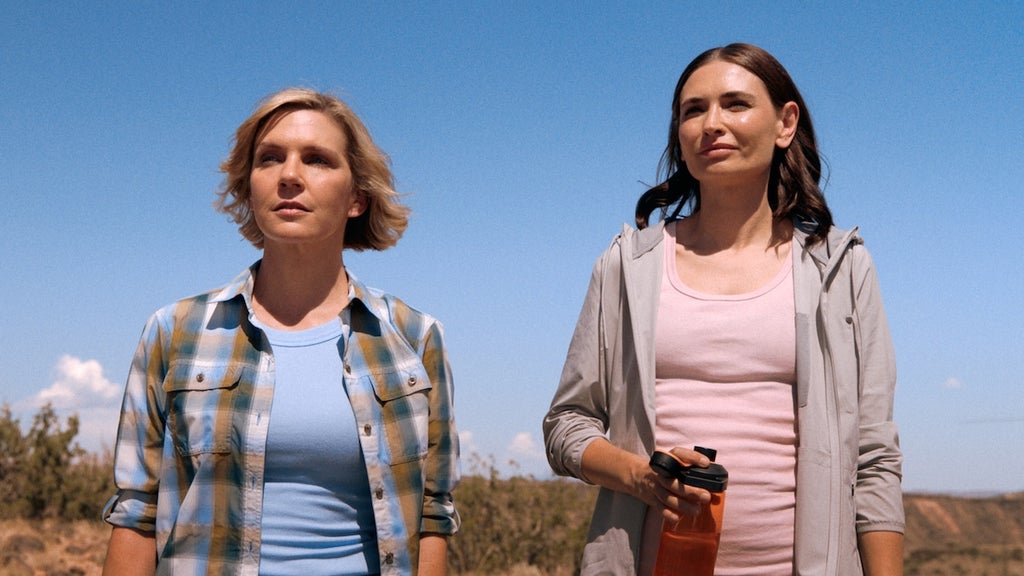
“I feel so incredibly grateful to be part of something that makes people talk and makes people sit and actually be present,” Wydra said. “[The show] pressures you to have the conversations about what it means or what resonates with you.”
To construct the role of Zosia, Wydra worked closely with Gilligan and the rest of the “Pluribus” team to determine how exactly a hive mind of 8 billion connected people works. While Zosia does experience emotions like happiness, anger and grief, they’re all felt as if they’re a faded memory. That distant politeness is crucial to how Wydra portrays Zosia.
“You can compare it on some level — and I’m not saying that that’s what Vince had in mind — but definitely to AI,” Wydra said. “They don’t have the same emotional consciousness on some level that a normal human being does, but they can perform everything and anything to the best of their ability — actually at the best of all humanity.”
In contrast, Vesga’s Manousos, another of the few immune survivors, spends most of Season 1 refusing help from the Others and cutting himself off from the rest of the world.

Heading into “Pluribus,” Vesga knew only that Manousos was an immigrant who had moved from Colombia to Paraguay. That detail was all he needed to conceive a deeply complicated character.
“It does inform the way he approaches the Joining,” he said. “The fact is that this guy had to leave his home country and lose his roots, his identity, his loved ones, probably, to try to build a new world for himself in a different country. That’s why he’s so black and white about [the Joining]. He knows what loss is, and he knows what losing one’s identity is.”
As the season progresses, Manousos’ role becomes a far more physical one, especially once he decides to find Carol without relying on the Others. But for Vesga, it wasn’t traversing the notoriously dangerous Darién Gap on the border of Colombia and Panama that was most difficult. Far more challenging were Manousos’ quieter scenes in his office, moments when Vesga had to construct and communicate his character’s entire personality while barely saying a word.
“His inner world and his inner tensions, for me, were the most important part,” he said. When Manousos did talk, Vesga worked closely with the directors and producers to ensure that the meaning of his words transcended his short lines. “How do you express through a line like ‘Today is Monday’ the stress, anguish, pain and physical pain — everything that this guy is going through?” he said. “Though those lines seem disconnected from the emotion and state he’s in, I would have to use them to complete the whole picture.”
This story first ran in the Down to the Wire Drama issue of TheWrap’s awards magazine. Read more from the issue here.