
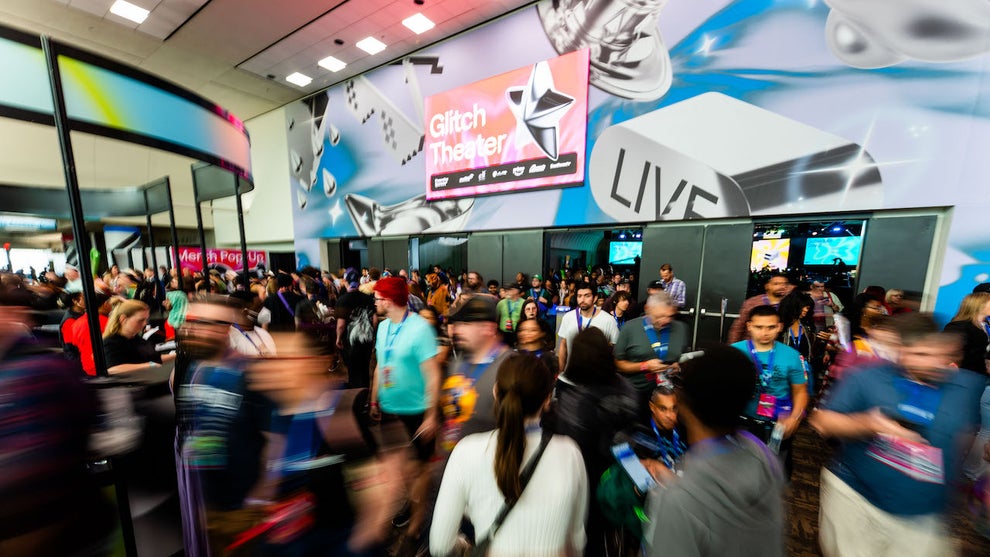
TwitchCon 2026 took place earlier this month from Nov. 13-15, the same weekend the FAA grounded flights nationwide amid similar outages that further impacted emails, banking and other technical services across the country.
However, if you asked the 20,000 Twitch users who gathered at the San Diego Convention Center, everything seemed fine both physically and digitally — and that’s thanks in large part to Chief Technology Officer/Head of Global Trust and Safety Christine Weber and Head of Community Trust Kristen Murdock.
“Our cybersecurity team is small but mighty, and they have the backing of the entire Amazon cybersecurity infrastructure, all of whom are very passionate. We don’t really take the approach of waiting for something to occur. They are really good threat hunters and they search out vulnerabilities,” Weber told TheWrap. “They’re so good about explaining why something has to be done, why this has to be changed, and what the threat is to either our customers’ data or our community’s experience. They don’t make those requests lightly. It’s separate and distinct from Trust and Safety, but it’s amazing how often the organizations work together because we often find that something we might find is a vulnerability internally we may want to make sure the community is aware of.”
“For trust and safety, how we define it is everything from setting policy through the administration of community guidelines, as well as tools that help both our streamers and moderators. Moderation is really about the personal nature of safety — what might be safe for you on your channel might be different for someone else’s channel — so what we consider the community guidelines to be is really the floor,” she further explained. “You have to comply with those because those are our rules, but a lot of streamers have additional rules: They don’t want to talk about certain topics, they don’t want to use certain words. We’re really focused on creating solutions that help them do that and tailor how they want their community to grow, not just based on our rules.”
“It’s incredible to see how streamers interact with their communities, who may have never met [IRL] before,” Murdock agreed. “Similarly to how we want to foster a safe and secure environment online, we want to do the same here; we want people to feel safe and to be able to show up as they are, who they are, just as they would in their chat or on stream.”

But when your platform base consists of millions of daily users and billions of nonstop comments, how exactly do you keep track of every single bit?
“We combine a couple of different methods as well as tooling solutions to help us do that at scale, but our communities are the most active. They want to protect their own communities, so user reporting is a very valuable tool for us,” Weber shared. “User reports come in; the vast majority of them, we are able to make a decision in under 10 minutes and we triage those. But it’s also about education. If there’s a violation, we really focus on trying to give the person another chance. We try to let them know what they did wrong, and just this year we came out with the ability to have the accountability match the violation.”
“Up to that point, for instance, if you would make a somewhat minor offense in chat, you would get suspended the same amount of time as somebody perhaps doing a hate raid — one size fits all. Two years ago, we rolled out the concept of escalating consequences,” she continued. “You might have a first offense that might not be too severe, but if you keep re-offending in the same way, it’ll start to make more of a difference … what worked 11, 12 years ago doesn’t really work anymore because the Internet continually changes what is acceptable and what isn’t. Something like high 90s percentage of users on Twitch have never received it, and of those who have received an offense, just 2% of them re-offend.”
“The other thing that I love that we’ve done are the requests for reinforcements, where we recognize that maybe you did do a whole bunch of things because you weren’t in a great mentality,” Murdock also noted. “Maybe you thought the way to build your community on Twitch was to have a negative impact on other people. But we recognize that people change, so our requests for reinstatement occur six months after. You can apply for it and say, I understand what I did was wrong. I commit to having a safe channel. I understand the community guidelines. I want to be a productive member of Twitch. It’s fantastic that people are able to take accountability and recognize that maybe the way they were isn’t the way they want to be moving forward.”
This self-policing of their own communities echoes other Twitch executives’ takes on why Gen Z and younger have a unique approach to the Internet in 2026.
“There is a huge focus on wanting that raw, unedited, un-curated life experience that you can only get with livestreaming. I’ll make a bold statement: Twitch is the safest place to live stream on the Internet, and we’re very proud of that,” Weber said. “And the only way that we can do that is to continue to adapt the solutions that we offer; the advice, the education that we provide to streamers as well as viewers. We want people to understand what those rules are because we want them here. So if they make a mistake, let’s tell you what you did wrong and invite you back; help you correct those errors.”

“COVID really, really changed how people engage with each other. Admittedly, I’m a Bravo girly, but reality shows are very much a scripted reality, a produced reality. That is not the same when you’re watching your favorite streamer,” Murdock added. “You have an entire generation that had to go through a lot of their social development while in COVID, also at a time where there are a lot of rules and legislation coming down that maybe inhibit who they feel like they can be online and in person … but people on Twitch are creating communities and safe spaces. It is truly the safest place for you to be and for you to be yourself.”
So what’s next for Twitch, 15 years after launch?
“There’s a really interesting evolution that I think is happening on Twitch. You’re seeing so many different pieces of how people authentically and genuinely live their life, where now they’re not just behind a PC living it, they’re living it on mobile out and about and being able to actually bring totally different cultural experiences to people who may not have been able to see it in any other way,” Murdock said. “All of these different experiences are really, truly actually bringing people together on a global scale. That is just going to increase and that is going to bring more people in and more people together, and maybe foster a little bit more of a global culture in how we think.”
“The younger generation is realizing that social media isn’t so social anymore; it can be pretty toxic on a lot of services. We take great pride in making sure that we are as accurate as possible when our human moderators are reviewing cases and complex issues,” Weber continued. “That is really important to the younger generation as they want to see something authentic. They don’t necessarily want to see AI-generated content. They have plenty of choices if they do, but they want that You never know what’s going to happen moment and they want to be a part of it. When you go into a chat and the creator recognizes you or other chatters do by your handle. It’s that sense of community, even though you may not even know who this person is in real life unless you come to an event like this.”
“I think young people are really looking for that connection,” she concluded. “That’s not to say that the older generation is not, but I think growing up in the era that they are growing up in, it’s something that they really crave.”
