
For years, there has been a steady shift away from the binge-release model on streaming. As platforms try to minimize subscriber churn and get more mileage out of their content investments, the all-at-once release model pioneered by Netflix has been increasingly sidelined in favor of a return to more traditional release strategies that parcel content out over a longer period.
In the chart below, it’s clear that 2021 marked a major turning point. For the first time, weekly-released originals made up a larger share of the top 100 most in-demand streaming originals shows than binge-released series. Since then, the supply of weekly rollouts has only grown.
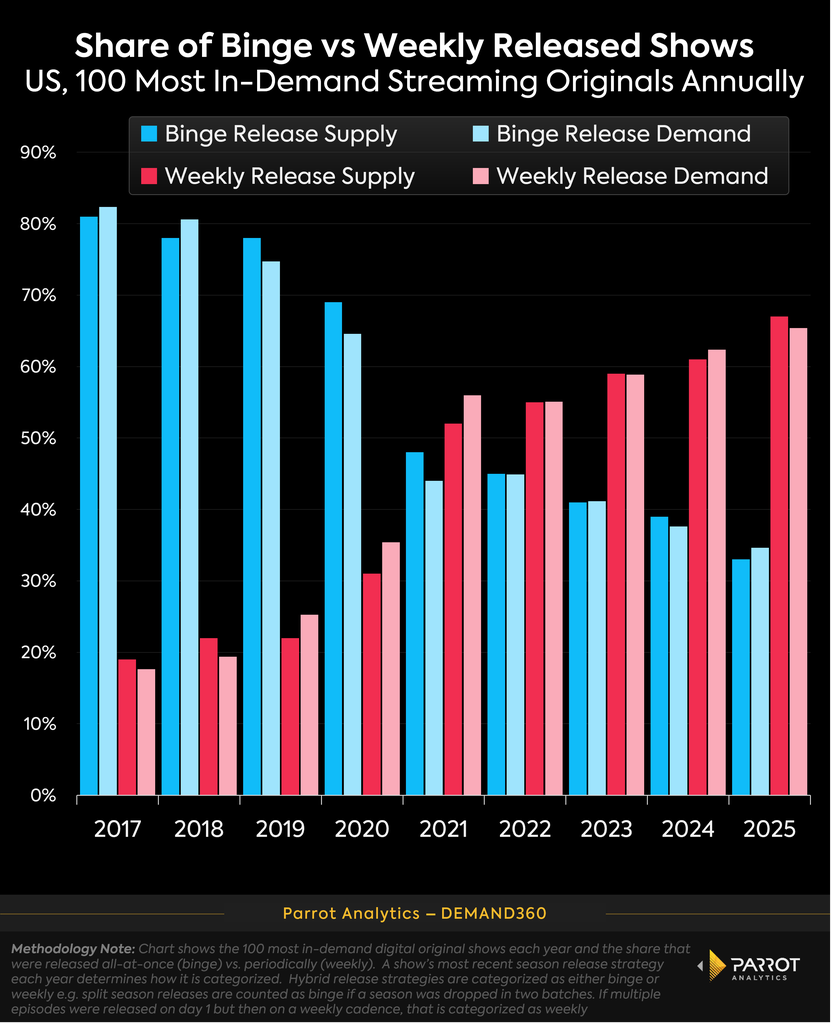
But supply is only half the equation. When we layer in audience demand, 2025 looks like it may mark another shift in the balance between how platforms choose to release shows. From 2019 through 2024, weekly-released series consistently overperformed, capturing a larger share of total audience demand than their share of supply.
2025 was the first year since 2018 in which binge-released shows accounted for a larger share of demand than of supply. Last year, a third of the 100 most in-demand streaming releases were binge-released, yet they accounted for 35% of the total demand.

To understand why the appeal of the binge drop remains so potent and why the industry hasn’t landed on a single “best practice” way of releasing series, it helps to visualize the different approaches and how they distribute audience attention across a season. This makes the operational trade-offs between all-at-once, weekly and hybrid release strategies clearer.
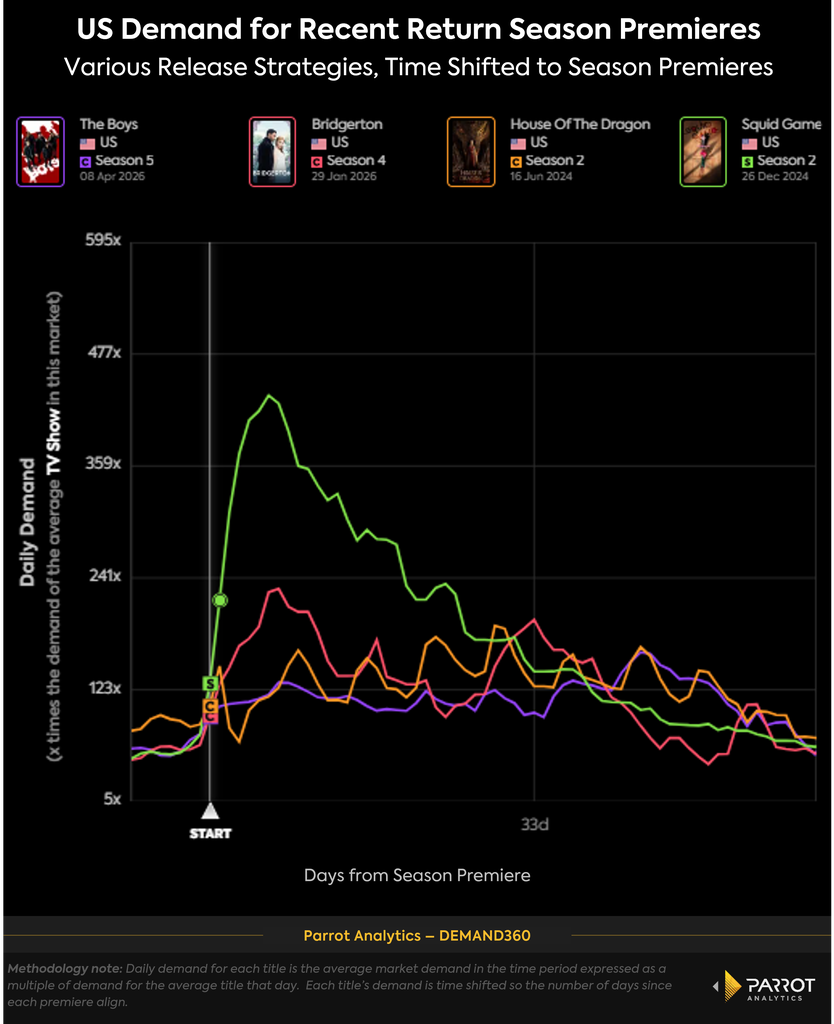
A pure binge release like “Squid Game” has the best chance of creating a massive spike in attention that can command total cultural focus. The downside is that it decays faster from that initial peak. To counteract this, platforms have turned to the “split season” model. As seen with “Bridgerton,” splitting a season into two distinct drops allows a show to catch a powerful “second wind,” extending the length of time it can engage audiences.
In contrast, traditional weekly releases like “House of the Dragon” and hybrid weekly models like that of “The Boys” can sustain steady audience demand over a span of two months. While they might not reach the massive level of attention that a concentrated binge drop achieves on day one, they keep subscribers hooked week after week and outperform binge releases in the one to two-month window.
The most revealing takeaway from this cross-strategy comparison may be where things land beyond the initial two-month window. While audience attention is distributed entirely differently during the first two months of a season premiere, these flagship shows largely ended up at a similar baseline level of demand beyond the 60-day mark.
Ultimately, this suggests that while a weekly release schedule is excellent for maintaining a steady buzz and protecting against immediate churn, it does not inherently create more long-tail demand than a binge release. As streamers head deeper into an era of hyper-optimization, the choice of release model has less impact on a show’s long-term value and more to do with choosing exactly when and how a platform wants to capture its biggest burst of audience attention.
