
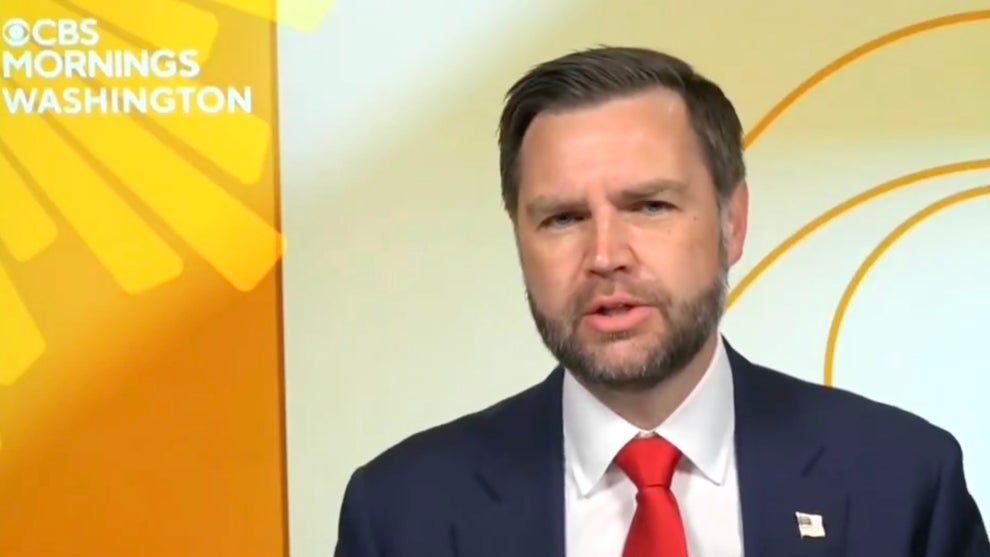
Vice President JD Vance stopped by “CBS Mornings” on Monday, where he gave additional details about President Donald Trump’s deal with Iran before it is officially signed on Friday.
The VP told host Gayle King that there has been both accurate and inaccurate reporting of the deal thus far, but that it will be good for everyone involved — “if the Iranians comply with their end of the bargain,” that is.
“I think the most important thing for the American people to appreciate is that what this agreement does is really twofold: On the one hand, it ensures that Iran will never have a nuclear weapon, while simultaneously opening the Strait of Hormuz,” Vance said. “You already see oil prices from a high of $126 a barrel down to about $80 a barrel today, that’s a lot of progress; but it also, Gayle, fundamentally extends a hand to Iran and says, ‘Look, if you guys are willing to honor your obligations, if you’re allowed, if you’re willing to allow real inspections of your nuclear program, then we will welcome you back into the world economy.’”

“I think what the President of the United States wants to do is turn over a leaf of 47 years of a failed relationship between the United States and Iran, but that requires the Iranians to actually honor their end of the bargain,” he continued. “So, when people say that billions of dollars of assets will be released, that’s not true. What is true is that Iran will have a much better and much more prosperous future if they meet the obligations they make in this agreement.”
Vance then shared his take on the reported $300 billion reconstruction fund, as well as the $24 billion in so-called frozen funds for Iran, with co-host Ed O’Keefe.
“That’s the sort of thing they could have access to, funded by the Gulf Coast Coalition, so long as they honor their entity obligation. I think that one of the things you’re going to see, Ed, and people have to be skeptical of this, is that the hardliners in the Iranian system will overemphasize the benefits that Iran gets, while underemphasizing all the things that they have to concede and all the things they have to provide in order to get these benefits,” he said. “So we absolutely are open to the Gulf Coast countries investing in the reconstruction of Iran, but only if Iran ends their nuclear program, ends their enriched stockpile of material, and it was really open to an inspections and enforcement regime that gives the American people confidence they’re never going to have a nuclear weapon.”
“We’re open to a lot of things that are on the table. That $24 billion just doesn’t appear anywhere in any of the text that we’ve talked about with the Iranians,” Vance added. “What we have said is that we’re willing to talk about unfreezing assets, but a much, much bigger deal is un-sanctioning their economy, so long as they make the long term commitments on the nuclear program.”
The Vice President went on to explain how this new deal will be different from the previous Joint Comprehensive Plan of Action.
“I don’t think that U.S. military forces are going to be necessary. I do think that we have some expertise on the non-military side in the destruction of nuclear material, and again, that’s one of the things the president cares so much about, is ensuring they don’t rebuild that enriched stockpile,” he began. “One final point on this. You know, you hear a lot of comparisons: ‘How is this different? How is this the same from the JCPOA?‘ I think that fundamentally misunderstands where we are. We have comprehensively destroyed their nuclear program and this agreement is about ensuring that they don’t rebuild it. The JCPOA was fundamentally about bribing them to stop the construction or to cease a nuclear program that was already in progress. It’s a very different background, a very different sort of leverage and, I think, really a different outcome for the American people.”
“OK, that is one point of view, Mr. Vice President,” King replied as Vance went on to dodge her question about Israel’s involvement.
“Israel has been a good partner, but we do expect everybody in the region — they’ve been participating in this peace agreement, they’ve been participating in our talks with Iran. They understand where our perspective is, and what the President has said is that we expect everybody to honor this agreement,” he stated. “There are always Gayle these bumpy moments with these cease-fires. Sometimes someone will fire and sometimes somebody responds. We think right now that there are probably people within Iran, because of the Internet blackout, they’re not even aware that this deal has happened. So, we certainly expect the Israelis are going to be a participant in this peace process, but we think it’s going to be good for them, it’s going to be good for us, it’s going to be good for the Gulf Coast Coalition.”
“All right, we’ll see what happens on Friday,” King concluded. “A lot of people are saying, ‘Why don’t we sign it today?‘ But you say Friday’s the day, we’ll all be watching.”
