
Charline Bourgeois-Tacquet’s “A Woman’s Life,” which premiered in the Main Competition of the Cannes Film Festival on Wednesday, begins with an extreme closeup of a woman in the throes of passion, though it’s hard to tell any details other than the shine of her skin in this particular light. It’s up to the rest of the film to fill in those details, which is essentially what “A Woman’s Life” (“La Vie d’une Femme”) sets out to do, one chapter at a time.
Those chapters are quite literal: The film is broken into segments, each with its own title: “Alter Ego,” “Pity,” “Loss of Control,” “The End of a Relationship,” “Letting Go,” “Sentimental Symposium” and several others. It’s a conceit reminiscent of a previous Cannes hit about a woman’s life, Joachim Trier’s “The Worst Person in the World,” which launched Renate Reinsve’s career and which was originally titled “Julie (in 12 Chapters).”
But the confused abandon of twenty-something Julie in that movie is a far cry from Gabrielle in this one. A doctor in her mid-50s, Gabrielle (Léa Drucker) is nothing if not controlled and controlling. Her specialty is microsurgery, painstakingly detailed work to repair damaged faces, and she approaches the rest of her life with similar precision. She rushes from meetings to operating rooms, sometimes canceling meetings in the middle of an operation and always expecting that the team around her will be as driven and as seemingly tireless as she is.

The film itself has a nervous, urgent pace, with solo piano music there not to soothe but to agitate. Gabrielle is wound so tightly that when she goes home and is bothered by her husband Henri’s son and his friends playing loud music, the only options that occur to them are for her to get a separate place or for them to split up.
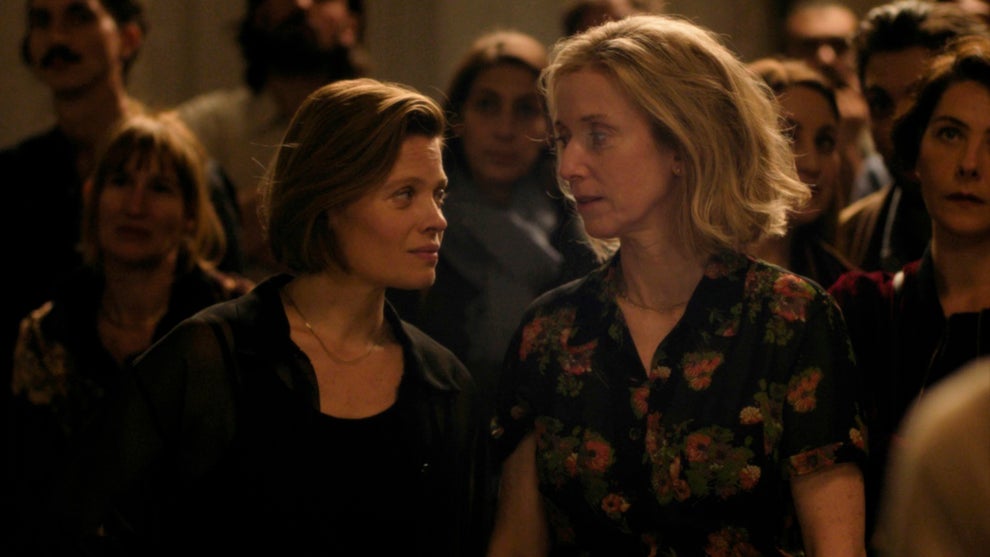
There’s stress on another front as well, as Gabrielle’s mother shows the effects of Alzheimer’s and may need to move into a nursing home. It’s hardly the time or environment for courtship or flirtation – but when a writer, Frida (Mélanie Thierry), tags along with Gabrielle’s daily life as research for a book, the flirtation begins anyway, starting at a dance class where they’re surrounded by movement to Mendelssohn’s “Hebrides” overture.
There’s a sense of languorous beauty in the scene, so different from the insistent urgency of almost everything that has come before – but before long, Gabrielle is back in the hospital, delivering bad news to a cancer patient and having a polite argument when he resists an operation (“I must say that what awaits you is not a peaceful death,” she says evenly).
At one point or another, she seems at odds with almost everybody around her, and the film underlines the unnerving agitation: An argument in which she insists to a co-worker — “I’m not a victim of my choices or my gender!” — plays out against a raucous soundtrack of construction noises.

Bourgeois-Tacquet sets up the burgeoning relationship between Gabrielle and Frida in a frenzied urban setting, then lets it pay off in a quiet mountain cabin where they’ve gone to visit an aging writer. But then they’re back in the city, and you don’t need to have read that list of chapter titles to know that twists and turns await.
The filmmaker is admirable in her insistence on keeping Gabrielle complicated, conflicted and often confounding; just because she’s the lead character doesn’t mean she’s always somebody to root for. This “Woman’s Life” isn’t easy – not easy to live and not easy to watch. There’s a touch of “The Pitt” in the way it lays bare the mental and physical toll on medical professionals, and more than a touch of Bourgeois-Tacquet’s first film, “Anaïs in Love,” which dealt with a woman whose mother is experiencing medical problems and whose rocky relationship with her boyfriend is tested when she has an affair and then becomes obsessed with another woman.
Coming on the first day of screenings in the Cannes competition, “A Woman’s Life” feels pleasurable but perhaps too slight to survive the onslaught of auteur-driven films to come. There’s much to admire in its embrace of a thorny character, its judicious use of music and its control of pace and mood, but it rarely prompts the passion on display in its opening image.
