
When we last spoke to Matt Braly, he was ready to turn the page.
The creator of Disney’s hit fantasy series “Amphibia” had mourned and had moved on. His debut animated feature “Afterworld,” which was written with “Steven Universe” creator Rebecca Sugar and had been in development at Sony Pictures Animation, was shelved. Braly took to social media to share pieces of production art that would never be utilized and to lament the project’s passing (he now calls it a “public trauma dump”).
Instead of wallowing, he shifted his energy to raising money on “Clara and the Below,” his Gothic horror take on “The Nutcracker” that will be produced by his newly formed studio Fantasy Project. (The fundraiser for “Clara and the Below” ultimately generated $443,000; the first installment will be released on YouTube in time for Christmas.)
But a funny thing happened while Braly was making other plans – interest in his movie, about a disabled Thai kid who journeys to the spirit world and ultimately discovers that no magical path will heal him, started gaining momentum on its own. Suddenly a project which was all but dead and buried was showing signs of life.
“In this instance, we actually went viral in Thailand. It was all over Thai social media that Hollywood had passed on a Thai-infused cultural story, which I think is something that you know people over there, when they see films like ‘Moana’ or whatever, everyone’s thinking, Oh, do Thailand next,” Braly explained.
It’s a remarkable reversal of fate for “Afterworld” and an example of when authentic cultural art combines with social media for an explosive reaction. Its potential revival also comes amid a big year for original animation, with films like Pixar’s “Hoppers” and Sony’s “Goat” among the highest grossing of the year so far and “KPop Demon Hunters” a certified phenom last summer. In the case of “Afterworld,” it’s also a rare opportunity for a culturally specific film to be crafted by talent from that country.
Braly said that he was approached by three Thai animation studios “that were interested in either resuscitating the idea, or maybe, let’s make a new thing in collaboration.” At first, Braly wasn’t interested. He wanted to move on. “I’d spend a lot of time developing this idea and these characters, and I just wasn’t willing to dance anymore,” Braly said.

Then a studio, MONK (also known as The Monk Studios), which had flirted with the project even before it had been dropped by Sony, emerged and was “willing to do a little bit of the front-end work,” according to Braly. MONK had been a support studio for big animated features like Sony’s “Wish Dragon,” Paramount’s “The Tiger’s Apprentice” and Chinese blockbuster “Ne-Zha 2,” and were ready to make a splash on its own.
MONK now owns the rights to “Afterworld” and will begin fundraising, starting at the Annecy International Film Festival’s film market late next month, working towards a modest but far from “low budget” sum to get the ball rolling.
A wave of online support
Braly was encouraged by the efforts of “Book of Life” director Jorge Gutierrez, whose canceled Netflix film “I, Chihuahua,” he is now attempting to make independently, and by the success of “Flow,” the tiny animated film that ended up winning the Oscar for Best Animated Feature. (“Flow,” too, cobbled together its budget from foreign investments in France, Belgium and Latvia.)
He also feels buoyed by the success of culturally specific movies like Sony and Netflix’s “KPop Demon Hunters,” which became the biggest Netflix original movie of all time after launching last summer, and DreamWorks Animation’s upcoming “Forgotten Island,” a wonderful film steeped in the culture and heritage of the Philippines.
“It felt very natural for this project to find a home in Thailand. Because the film draws so deeply from Southeast Asian mythology and spirituality, it’s meaningful for a Thai studio to help bring that vision to the world,” said Juck Somsaman, founder of The Monk Studios, who will also serve as executive producer on “Afterworld.”

Somsaman said that, while the “virality” of the “Afterworld” imagery helped in his decision to take on the project, it wasn’t the only thing that moved it forward.
“The response online was incredibly encouraging, but it wasn’t just about the ‘likes.’ What stood out was how quickly people from completely different backgrounds connected emotionally with the tone of the world,” said Somsaman. “It reinforced our belief that there’s a real global appetite for authentic stories inspired by Southeast Asian culture and mythology.”
The trick now, said Somsaman, is to “elevate the project for a global audience.”
“We’re finding that balance — making it feel fresh for the world, while still keeping it honest and authentic for Thai audiences. We don’t want to westernize it; we want to evolve it through a modern lens while respecting the spiritual identity at its core,” said Somsaman. “Between the massive organic interest we’ve seen and the support from the Thai government’s initiatives, we have a real opportunity to grow this internationally while staying culturally rooted.”
And Braly has brought along a familiar face for this new version of “Afterworld” — Alyssa Engelberg, a former development executive at Sony Pictures Animation and a longtime champion of the project, who will now serve as the movie’s producer.
“Right after the project went viral, one of the primary creative executives who was attached to the project at Sony and had shepherded it for three full years recently left Sony and reached out, luckily for us, to lend a hand in seeing the movie through,” Braly said. “We’re all a little bit of like shipwrecked sailors, and we are trying to put together this movie sort of as it was meant to be.”

Authentically Thai
For Engelberg, the excitement came from not only seeing the project through but working with a new studio in MONK.
“I’ve been a big fan of MONK and Juck and what they’re doing there. And I’ve always had a desire to do something like this which is a story that is very specific to the culture and to have the movie made there by the people of that culture, of that country, it feels like an amazing opportunity,” said Engelberg. “It felt like the perfect confluence of events.”
And she’s right – there’s something quietly revolutionary about “Afterworld.” When a big animated feature finds foundational relevance in a specific country or people, that country is never actually responsible for making the movie. Pixar’s “Coco,” for instance, was steeped in Mexican lore and animated in a suburb of Oakland, Calif. “Afterworld” will be very different – steeped in the country’s culture and animated by its people.
Engelberg is energized by the prospects of “Afterworld” and said that she will serve as the movie’s “conductor,” serving to keep the original version of Matt’s vision moving forward and helping MONK transition from a support studio to a bigger player in the feature space.
“It’s about getting all of the pieces together,” she said. “There’s so many moving parts to these smaller independent productions.” Trains need to run on time, after all.
‘Building in plain sight’
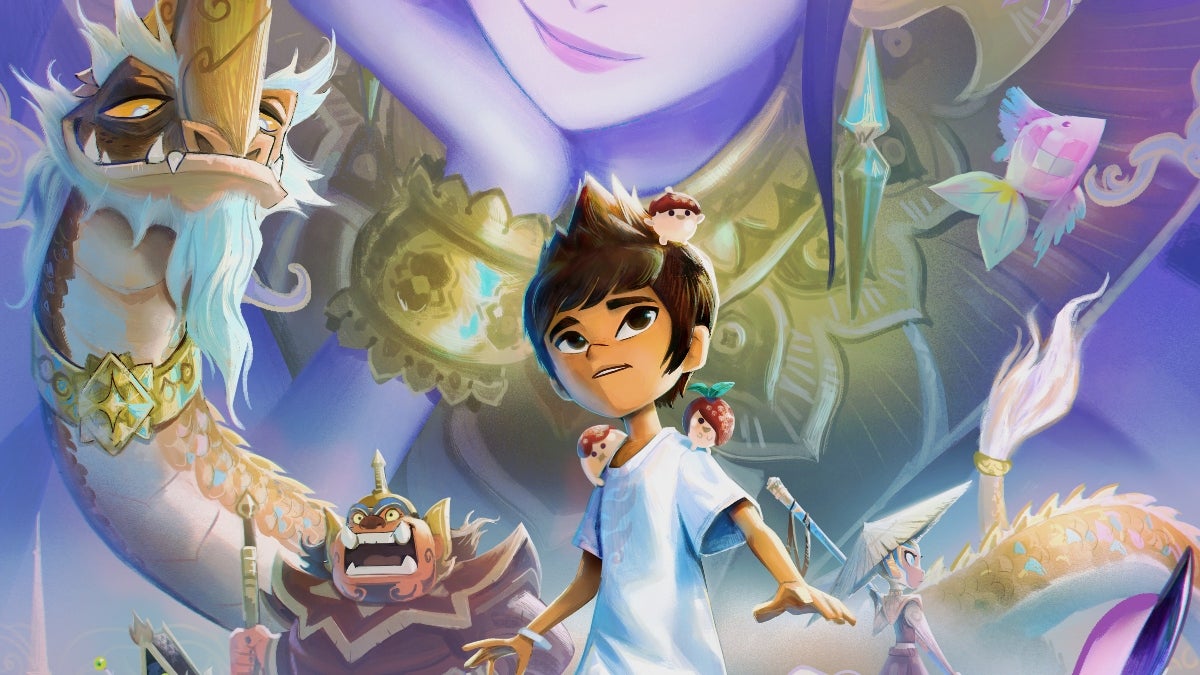
In terms of how the original version of the movie will translate to this new iteration, Braly said that he was so encouraged by the response to the character designs that he shared online that he’s hesitant to change much. He points to a princess character who generated an astounding amount of fan art, both abroad and in America. The team now has a mandate – do not change that design.
“There’s learnings here for the industry, writ large, a little bit where it’s like, if you give people a taste, you are getting free feedback and a little bit of market research,” Braly said. “Our primary characters that we’ve released art from already, we’ve locked them like, they’re going to look like that, because people have already seen them and fallen in love with how they look,” Braly said. “For the poster, for example, we talked about, Oh, should we do anything to the designs and change them and experiment? And I very much was like, No, don’t touch them. Because everybody knows what this project is now, and what these characters look like. I would just leave it for as long as we can. Obviously we’ll tweak them later, but for now, I think they are the ambassadors for the film.”

That level of transparency – of sharing what the team is working on as they are working on it – will continue with “Afterworld.” MONK is embracing what Braly describes as a “building in plain sight” philosophy, based on construction – like driving by an unfinished house or building and watching as the bricks are put in place.
“We are creating social media accounts, Instagram and X for this project, a production diary, so that fans can actually see the film start to get on its feet,” Braly said.
The plan is to share story details and character profiles, along with character models and early sketches. This is in stark contrast to how most animated features are made, with “us going away and hiding and working in secret,” Braly said. They had such success sharing early details off the project online that the team “feels like we should continue with that.”
“Animation usually happens behind closed doors for years, but this one was different because the world was already ‘out there.’ People already knew the characters, so we wanted them to feel part of the journey from the beginning. Social media gave us a chance to share the creative process in a much more open way — not just the artwork, but the passion and collaboration behind it,” said Somsaman. “We still have to respect the business realities and protect the project, but we want fans to feel like they are watching this slowly come to life. Audiences today really respond to that kind of authenticity.”
Along with the movie’s new lease on life, it has a new title – sort of.
Braly was inspired by the fact that some Studio Ghibli movies have completely different titles outside of Japan. Hayao Miyazaki’s Oscar-winning masterpiece “The Boy and the Heron,” for instance, is called “How Do You Live?” in Japan (the title itself is a reference to Genzaburō Yoshino’s 1937 novel). “I think there is some magic in the fact that when a Thai person looks at the logo, they’ll see the Thai title, and an English person might not even notice it,” Braly said.

The Thai title “Glab Baan” (กลับบ้าน) is a “sticky Thai phrase” that means “Go Home,” which people will say, for instance, if they’re at the end of the night and are exhausted.
“The title has a dual meaning, which is one, it’s about the protagonist, where you’ve got this kid who’s got this scary operation, and he’s run away from the hospital, and he’s found himself in this spirit world, he should really go home,” said Braly. “That’s really the meaning there, which is like, come home, dude, don’t run. That’s very much the soul of the movie. And the secondary meaning is, the film is returning to Thai hands. It is going back to the culture that it’s based off of, and they are going to make it their own. It’s a flag in the ground for us, which is like the old Sony project was ‘Afterworld.’ This one is ‘Afterworld Glab Baan.’ It’s the rebirth of the project.”
While nothing is set in stone yet – Braly wants to emphasize that the movie has not been greenlit and is not in production – everyone associated with “Afterworld” is extremely jazzed about its prospects.
“It’s so exciting,” said Engelberg. “It’s such a privilege to be a part of this project and for it to get another shot. I’m so hopeful and confident.”
“Years ago, I created a preschool series called ‘Sea of Love’ for Netflix for my daughter when she was three. Now I have the chance to make a film like this for her generation as they’re entering their teenage years,” said Somsaman. “There’s something really meaningful about growing alongside your audience. It’s incredibly exciting to see our culture and mythology travel the world and connect with people everywhere.”
Braly said that a movie called “Afterworld” getting a second life is very special.
“There is some meta magic to this story. I just hope that people who are looking to invest in animation notice that there was a very special reaction to this project online and that that’s not something that you can take for granted,” Braly said. “I do hope people are interested in really seeing this movie through.”
