
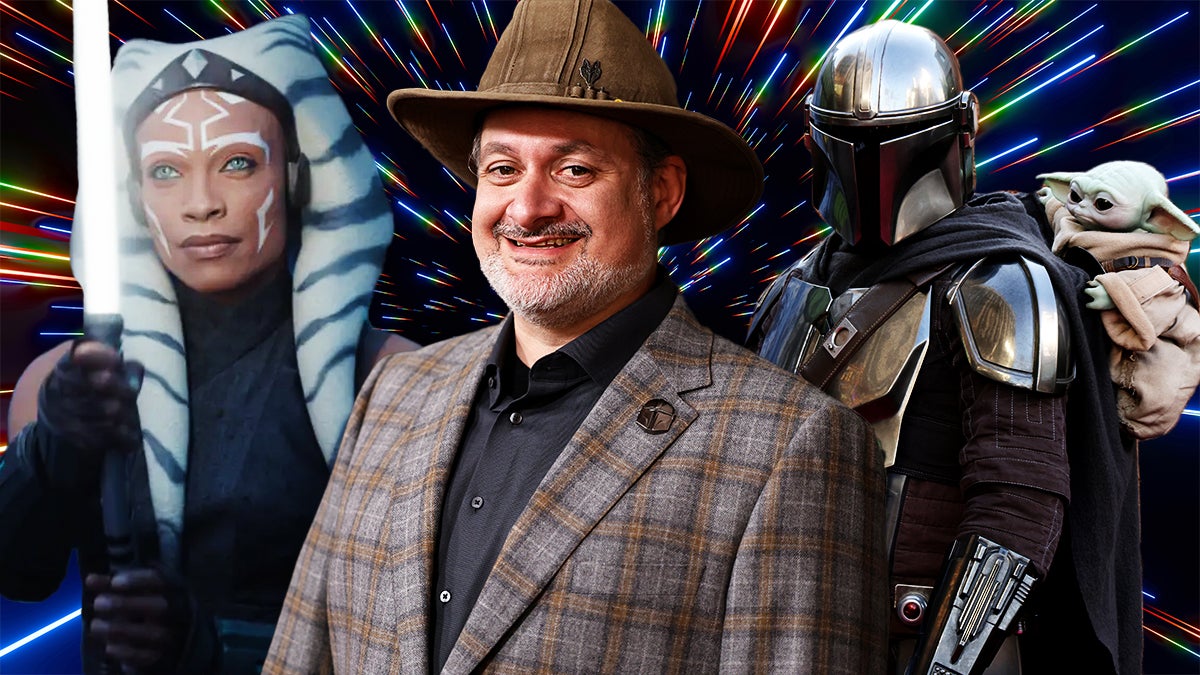
Dave Filoni likes playing with toys.
For more than a decade, Filoni, the new Lucasfilm president and chief creative officer, worked on shows like “Star Wars: The Clone Wars,” “Star Wars: Rebels” and “The Mandalorian,” making a name for himself in the franchise by building stories around characters that lived on the dustiest pages of a “Star Wars” encyclopedia — catnip to the property’s most ardent fans. Playing with toys is a metaphor oft used by Filoni and “The Mandalorian” creator Jon Favreau.
“Jon and I, we get along like we’re playing with our old Kenner toys,” Filoni told StarWars.com for the release of “The Mandalorian” Season 3.
But “The Mandalorian and Grogu” put this narrative style to the test for the first time on the big screen, a culmination of everything Filoni and Favreau built on Disney+. (Favreau directed the feature, which he and Filoni wrote alongside Noah Kloor.) The result was inarguable failure, with “The Mandalorian and Grogu” garnering the lowest opening for a live-action “Star Wars” to date and getting knocked out of the top five at the domestic box office in only its third weekend. It will likely become the lowest-grossing “Star Wars” film of all time (outside of Filoni’s animated “Clone Wars” film from the pre-Disney era, which had a significantly smaller budget).

The fallout of “The Mandalorian and Grogu” represents the new Lucasfilm head’s first challenge amid swirling questions about the viability of the storied franchise. As audiences (particularly younger crowds) pick other options at the multiplex over the latest “Star Wars,” Filoni must ask himself one question: Is it time to put the same old toys away?
“The current state of ‘Star Wars’ is complicated,” Dan Zehr, the host of the “Coffee With Kenobi” podcast and an author who has written books for Lucasfilm, told TheWrap. “On the one hand, we are getting a lot of content in different media (film, streaming, animation, etc.). However, the results have been mixed.”
A representative for Lucasfilm declined to comment on this story.
An unprecedented box office
May 2026 was one of the strangest months in box office history. “The Mandalorian and Grogu” was simply one piece of the puzzle.
The 12th live-action “Star Wars” feature (and first to release since the start of the pandemic) opened to $163 million worldwide and $81 million domestic over the long Memorial Day weekend. This was comparable to the international first weekend haul of “Solo: A Star Wars Story.” It’s not quite the sum one would expect for a “Star Wars” movie, but not bad on its own considering “The Mandalorian and Grogu” is the cheapest film in the franchise since Disney purchased Lucasfilm.

“I think Din Djarin and Grogu are absolutely a logical next step in taking the saga in a new direction (with the Skywalker storyline having wrapped up in 2019 with ‘The Rise of Skywalker’). But ‘The Mandalorian and Grogu,’ as much fun as it was, did not meet the level of storytelling that the Disney+ series exhibited during its three seasons,” Zehr said. “Mando, in particular, is a nuanced character with a lot to say about identity, culture, family dynamics, adaptability and responsibility — but unfortunately, that was not clear in the new film.”
Things took a drastic turn in the second weekend as “The Mandalorian and Grogu” dropped 70% to a $25 million haul. This knocked it down to the No. 3 slot, trailing behind Gen Z phenoms “Backrooms” (which matched the domestic opening for “The Mandalorian and Grogu”) and “Obsession,” then in its third weekend.
By weekend three, “The Mandalorian and Grogu” found itself entirely knocked out of the top five at the domestic box office, taking home only $10 million. It again landed behind “Backrooms” and “Obsession,” as well as newcomers “Scary Movie,” “Masters of the Universe” and “The Amazing Digital Circus: The Last Act.”
This unprecedented box office month puts “The Mandalorian and Grogu” in strange waters for a “Star Wars” film. In the Disney era, Favreau’s feature is the only film from a galaxy far, far away to get knocked out of the No. 1 slot at the box office after only one weekend. It’s also the only Disney “Star Wars” movie to spend just two weekends in the domestic top five.
So what’s the reason for this lackluster box office performance? To start with, “The Mandalorian and Grogu” failed to capture the interest of Gen Z and Gen Alpha in the same way as its competitors. “Backrooms” and “Obsession,” horror films from first-time theatrical filmmakers who cultivated audiences on YouTube, had similar audience makeups; 86% of the opening weekend audience for “Backrooms” was under the age of 35, with 44% younger than 21.
Compare that to “The Mandalorian and Grogu,” which had a nearly identical opening weekend but an under-25 audience share of just 27%. In a time when younger moviegoers are consistently showing the most excitement for the theatrical experience, that’s not enough to maintain good legs. “Masters of the Universe” also hit the same wall, getting solid reviews but failing to ignite audiences outside its Gen X core.
It’s particularly glaring considering Filoni has a history of garnering younger audiences — notably with his animated shows.
The rise of Filoni
It’s that history that is partly why Filoni is living a fanboy’s dream.
When the offer to join a galaxy far, far away first came in, he didn’t believe it himself. Filoni was working on “Avatar: The Last Airbender” when he got a call from Lucasfilm asking if he wanted to talk about working with George Lucas. It took some convincing, as the story goes, for Filoni to believe this wasn’t just some elaborate joke from other Nickelodeon employees looking to crush a “Star Wars” diehard’s dreams.
But Filoni eventually took the meeting, and then the job, directing the 2008 animated feature “Star Wars: The Clone Wars” before later shepherding its TV continuation. There, Filoni gave love to some of the lesser-known characters in the sci-fi/fantasy world. “The Clone Wars” may have been led by fan-favorite characters like Anakin Skywalker and Obi-Wan Kenobi, but it also made space for deeper cuts like Plo Koon and Wot Tambor (remember him?) to take on bigger parts in the saga. The Clone Troopers themselves, once just digital, faceless masses in the prequel trilogy, suddenly had their own personalities, desires, flaws.

One of the show’s leading heroes, Ahsoka Tano, is among the most significant “Star Wars” characters to debut in animation before leaping to live-action.
That leap came in “The Mandalorian,” where Filoni steered his first live-action project by directing the show’s first episode. He continued his quest of dusting off old Kenner action figures with Favreau as a new playmate.
Filoni directed three episodes and wrote four across the three seasons of “The Mandalorian,” bringing characters like Ahsoka and Boba Fett into the fold. He also directed and co-wrote one episode of the sister series “The Book of Boba Fett,” featuring the first on-screen interaction between Ahsoka and Luke Skywalker (rendered as young Mark Hamill through an AI voice tool and deepfake technology).
Filoni was an integral part of the Disney+ era of “Star Wars,” shepherding his own live-action show with “Ahsoka” (a follow-up of his cartoon “Rebels”) and creating a number of animated series before, in January, taking over for Kathleen Kennedy as president and CCO.
“The Clone Wars” appears to have the most staying power out of his animated batch. According to Nielsen, the series that got Filoni his start in the franchise was the 10th most-streamed title on May 4, 2025, despite airing its finale exactly five years earlier on May 4, 2020. Nielsen data from the first quarter also shows that “The Clone Wars” is the most streamed “Star Wars” title for Gen Z, while Gen Alpha and Baby Boomers prefer “The Mandalorian,” and Millennials and Gen X prefer “Andor.”
But that divide between “Andor” and the Filoni/Favreau projects is stark.
A time for new toys
In the wake of “The Mandalorian and Grogu,” a quote has been making its way back into the “Star Wars” conversation. The quote hails from a Backstory Magazine interview with “Andor” Season 2 screenwriter Tom Bissell, invoking a piece of advice showrunner Tony Gilroy gave when he joined the show.
“He said, ‘A lot of times, when you’re working on IP storytelling, your impulse is to open the toy box and start playing with all the toys,’” Bissell recalled. “He said, ‘You should try to resist that, and what you should do is leave more toys in the toy box than were there when you got there — resisting the impulse to be a child and instead think more like a storyteller who’s adding to the world rather than taking from it.”
This strategy worked well for Gilroy, whose two-season show became the most well-received “Star Wars” series and earned 22 Emmy nominations with five wins. TheWrap previously reported that Filoni privately expressed dissatisfaction with “Andor,” one of the few “Star Wars” TV projects to lack his involvement. Lucasfilm denied these events at the time.
“Action and special effects are an essential part of the ‘Star Wars’ universe, but fans want new additions to the lore so we can learn about these wonderful characters. I am not sure why the new film took a safer approach, but my hope is that the powers that be can find a way to create material that is poignant for both old and new fans alike,” Zehr said. “I will always want more ‘Star Wars’ content, but I am much more enamored of stories that need to be told because they teach us more about the world and ourselves.”

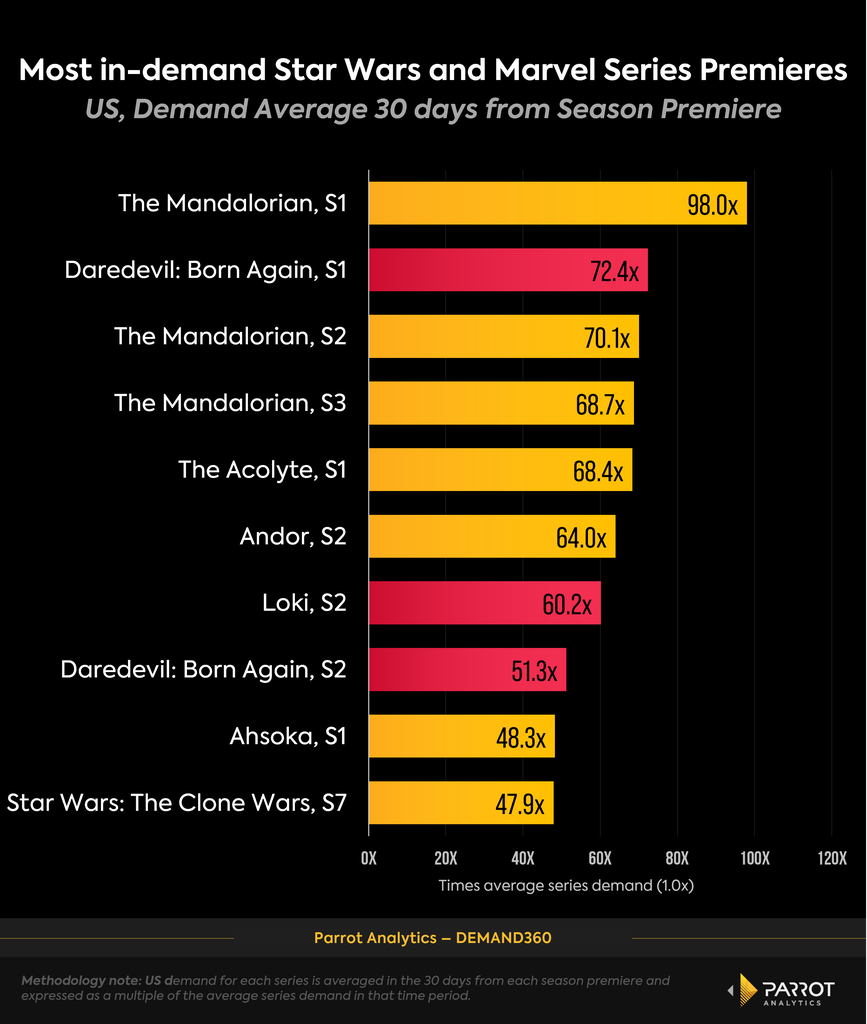
Intentionally or not, Gilroy’s words directly clash with the Kenner-based ethos of Filoni and Favreau. This mentality served them well on Disney+. According to Parrot Analytics, three of the four most in-demand season premieres across “Star Wars” and Marvel series on Disney+ belonged to “The Mandalorian,” with the first season of the show having nearly 100 times greater demand than the average TV series. Subsequent seasons were similarly popular, but faced diminishing returns.
But according to Nielsen, a greater percentage of people watched “Star Wars” live-action movies than live-action series in 2025, despite the lack of new features since 2019. While “The Mandalorian and Grogu” ignited much talk over whether “Star Wars” is a TV franchise now, it seems that the films are still what animate viewers.
“The Mandalorian” was an unambiguous hit, a cultural phenomenon that changed the streaming game. But it also trained fans to expect big-budget, low-stakes “Star Wars” adventures on Disney+. When Filoni and Favreau released their “Mandalorian” movie, filled with unnamed characters and a lack of human faces, audiences decided they could wait to play with their toys at home.

Filoni was not Lucasfilm president when “The Mandalorian and Grogu” went into production — the movie was a Kennedy green light — but it’s a film deeply connected to his work in the “Star Wars” universe. It ties back to his very first days in the franchise, with Rotta the Hutt, son of Jabba, introduced as the MacGuffin in the “Clone Wars” movie. Rotta returns as the MacGuffin again in “The Mandalorian and Grogu,” now old, buff and voiced by Jeremy Allen White.
As “The Mandalorian and Grogu” struggles in theaters, it’s hard to imagine a previously announced Filoni-directed “MandoVerse” feature (starring characters like The Mandalorian, Ahsoka and Grand Admiral Thrawn, first introduced in a series of pre-Disney “Star Wars” novels before being canonized by Filoni in “Rebels” and “Ahsoka”) animating a younger fanbase. The status of that project is unknown.
Next year will see the release of the Ryan Gosling-led “Star Wars: Starfighter,” an original idea directed by Shawn Levy and also greenlit by Kennedy, with plot details under wraps.
Aside from that, the future of “Star Wars” remains murky. Kennedy implied upon her exit that a trilogy of films from Simon Kinberg seems the closest to materializing out of a long list of announced-but-unmade “Star Wars” features. This would reunite Filoni with Kinberg, his “Rebels” co-creator with a hit-and-miss franchise track record.
“For the future, it’s all about telling bold new stories set in this universe that push the boundaries of story, character, effects and action in incredible new ways, which is exactly what ‘Star Wars’ has been known for,” Zehr said.
When TheWrap wrote about Filoni’s tenure upon taking his new position, an insider shared that some at Lucasfilm fear that the creator’s conventional and cartoonish stories may not be the right direction for the franchise overall. The reception of “The Mandalorian and Grogu,” a fun and light adventure without narrative consequence for the titular characters, embodies that concern.
Filoni is a torchbearer of “Star Wars” lore, one who could go toe-to-toe with the biggest fanboys at trivia night. His animated shows long felt affirming to a kind of viewer who studied background prequel characters and Ralph McQuarrie concept art like they were preparing for an exam.
But “The Mandalorian and Grogu” put Filoni to the test for the first time as president, resulting in what will likely be the lowest-grossing “Star Wars” film to date. If he wants to draw younger crowds back to a galaxy far, far away, he may need to start playing with some new toys.
Drew Taylor contributed to this reporting.
