
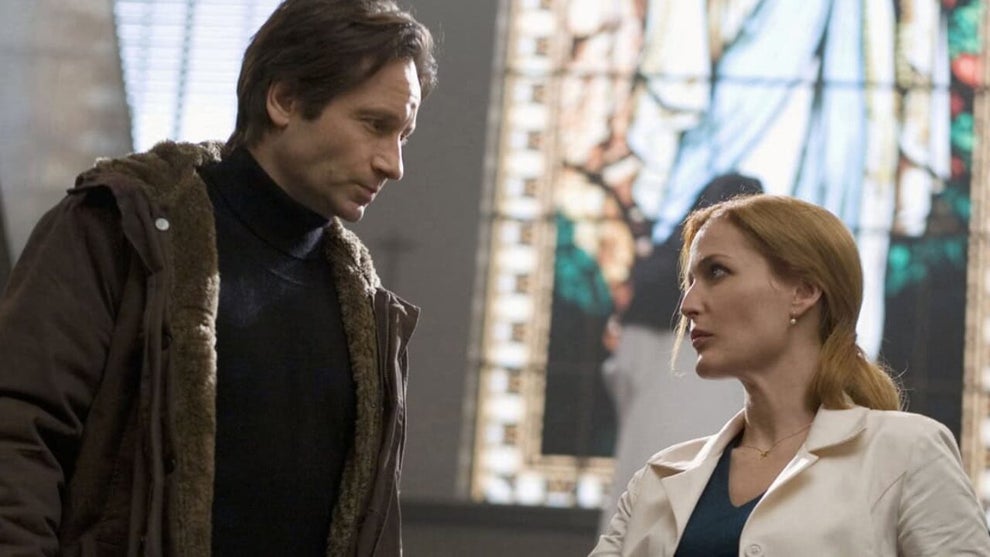
In 2008, “The X-Files: I Want to Believe” was released theatrically, six years after the series came to an end and a whopping 10 years since the last movie, 1998’s excellent “The X-Files: Fight the Future,” came out.
Meant as the first in a series of standalone theatrical “X-Files” entries, the movie saw Dana Scully (Gillian Anderson), now a doctor working for a Catholic hospital and Fox Mulder (David Duchovny), a disgraced recluse living in a cabin alone (Unabomber beard and all), drawn back into a mystery involving a pedophilic priest with psychic abilities and a mad doctor practicing fringe science. (It’s a lot.)
Unfortunately, “The X-Files: I Want to Believe,” beset by iffy plotting and a distinct lack of thrills, had the misfortune of being released a week after Christopher Nolan’s cultural phenomenon “The Dark Knight.” The new “X-Files” quickly sank, making $68 million worldwide on a budget of $30 million, and grounded the once lucrative franchise for nearly 10 more years.
But now “The X-Files: I Want to Believe” is back, in a new director’s cut supervised by director and co-writer Chris Carter, the creator of the original series. This new iteration, dubbed “The X-Files: I Want to Believe – Vrach Frankenshteyn,” is now available on Hulu. Running a svelte 98 minutes, compared to the original release’s 104 minutes, what was once an unnecessarily baggy mystery has become tighter, more contained and more ruthlessly bloody.
By removing the extraneous bits, “I Want to Believe” has finally become what it always set out to be – a killer standalone “X-Files” episode, free of unneeded mythology and instead focused on being as efficient and unsettling as it possibly can be.
Carter said that the process of making “I Want to Believe” truly began back in 2007, when he was asked to make a new “X-Files” movie by 20th Century Fox executives “for a price.” “It was roughly a third of the budget of the original, ‘Fight the Future,’ so we really set out to make a good standalone ‘X-Files’ story, and along the way, that idea hit some rocky road,” Carter explained to TheWrap ahead of the release of the new version on Hulu.
Some of that “rocky road” included a grueling, low-budget shoot in snowy Vancouver, where much of the original show was shot (until, after “Fight the Future,” the production was moved to balmy Los Angeles) – a “forbidding environment,” according to Carter. “I tell people that I went through nine pair of shoes, I could not find a pair that would keep my feet warm,” Carter said. “Just appreciate that my feet are always frozen directing this movie.”
Rumors persisted that the movie was rushed into production to avoid an upcoming writers’ strike, which Carter denied. He said they didn’t know there was going to be a writers’ strike and were already in shooting when the strike happened. “Because we were already in production, we were given the ability to work and not have to man the picket lines,” said Carter.
But the rockiest patch of road was saved for after the shoot was completed. That’s when Carter showed an initial cut of the movie to a group of Fox executives – the same executives who had finally commissioned the movie just a year earlier.
In short, Carter said, “I got reamed.”
“The X-Files: I Want to Believe” that Carter had delivered was not acceptable to the studio. “It was not the PG-13 movie that they had imagined. It was much darker and scarier. And I think the words they used were torture porn,” Carter said. The executives compared his cut of the movie to something like “Saw” or “Hostel.” (David Edelstein, critic for New York Magazine, coined the phrase “torture porn” in a 2006 piece. It was very much a part of the cultural conversation at the time.)

Carter described the situation as “disappointing.” He went back to his original cut and began reshaping the movie; he jettisoned elements and sequences that the executives deemed too intense and would have earned him a harsher R rating. When he re-submitted the movie to the Motion Picture Association of America, responsible for issuing ratings, they still found it to be too much. “They said, ‘This isn’t a PG-13 movie.’ We had to cut it back even further,” Carter said.
For him, “The X-Files: I Want to Believe” took on a different shape entirely. “It became a Mulder and Scully relationship movie that happened to have an element of an X-File in it,” Carter said, still sounding defeated. He felt at the times that the executives “really didn’t know ‘The X-Files.’ They knew it was a success, and they knew we had done well with the first movie,” Carter said.
He remembered that he and co-writer and producer Frank Spotnitz were in London on the promotional tour for “I Want to Believe” when they got a call from a Fox executive, telling Carter and Spotnitz that Fox wasn’t going to advertise the film. “They were simply going to rely on word of mouth from fans,” Carter said. “And so they jettisoned the movie, and I felt like they had jettisoned something that was never the movie I intended to make. It was disappointing on that level too.”
While an extended cut of the movie came out on home video that reinstated four additional minutes, it still wasn’t what Carter had initially envisioned. That version remained – in true “X-Files” fashion – just out of reach. Something to believe in. Carter didn’t lose hope, exactly, but he wasn’t sure that his original vision would ever be restored.
Years later, Carter would be having a conversation with Steve Asbell, president of production at 20th Century Studios, about another project entirely. But at the end of the conversation, Carter casually asked him, “Would you ever consider doing a director’s cut?” To which Asbell replied, “Yeah, let’s talk about it.”
“Not only did we talk about it, these guys, bless their hearts, they got behind it,” Carter said. He was given a small budget and two editors, who worked to get “I Want to Believe” back to the place that Carter thought it should be. “I set about fine tuning the material that I had to work with,” Carter said. “We laid heavily into the darkness and took a way a little of the romance, which I felt like I had shoehorned in there to please the original executives.”

In 2025, while appearing on David Duchovny’s “Fail Better” podcast, Carter revealed that he had just gotten the go-ahead to start working on an updated version of “I Want to Believe.” “That’s awesome,” Duchovny replied.
And Carter had very specific goals for what he wanted to achieve with this new cut.
According to Carter, “we had gotten our fill of [the relationship] in the reboot seasons.” In the original version of “I Want to Believe,” Carter said, “the fact that they’re in bed together is played as a big reveal – aha! Now it had a different storytelling quality.” He also wanted to up the horror, to keep in line with his initial vision of the project.
“We set out to make a Frankenstein movie originally, and I love that Frankenstein story so much. I love Mary Shelley’s book. I love the movies,” Carter said. He remembered reading a story about a doctor who had transplanted the head of a monkey onto another monkey. At the time he thought to himself, This is “X-Files” territory. And it’s a “Frankenstein” story. He visited the doctor in Cleveland, Ohio.
“He sat with me and kindly and took me through what it would take to transplant this monkey head. The transplant was successful but it was short-lived. The monkey ended up dying,” Carter said.
Not that the concerns around longevity have lessened in the past 20 years.
“People are talking now about living forever. They’re talking about life-maxxing, looks-maxxing. All the tech bros think if they do the right things, they can, in fact, live forever,” Carter said. “And certainly, you have to consider transplanting your head onto a younger body a way to live forever. I think the story has relevance in a way right now than it didn’t quite back way back when.”
One of the odder trims to the movie is the removal of a George W. Bush joke from the original version, with Mulder looking at the then-president’s portrait while the spooky “X-Files” theme from Mark Snow gingerly plays over the moment. “It didn’t feel relevant in 2026,” Carter said.

And while there are currently no plans for a physical media version of this new iteration of “X-Files: I Want to Believe,” it’s something that Carter wants. “My DVD player is waiting for it,” he said. (The season sets of “X-Files” on Blu-ray are currently out of print.)
It does feel like “The X-Files” is having a moment.
Just a couple of weeks ago, LEGO released an elaborate “X-Files” set. (If you ordered early enough, you were treated to an additional little set of Scully in the morgue, ready to perform an autopsy.) A rebooted series, this time from Ryan Coogler, is in the works that seems to maintain the continuity of the original series, with stars Danielle Deadwyler and Himesh Patel playing two new agents assigned to the X-Files. And there’s also just the continued cultural conversation and fascination with UFOs, which the government has more or less admitted to actually being real. (The August 7 Time Magazine cover story was titled “America Is Finally Taking Extraterrestrials Seriously.”)
In 2021, Carter was even asked by The New York Times to write an editorial for the paper. The resulting piece, “I Created ‘The X-Files.’ Here’s Why I’m Skeptical of the New U.F.O. Report.,” was a thoughtful, emotional piece about how the conspiracy theories of the show have now been dismayingly (and dangerously) adopted by Americans with an axe to grind. And how even as the government releases more documents pertaining to the existence of life outside our own, Carter remains unsure. “Ordered up by a bipartisan group of legislators during the Trump administration, the interim report revealed nothing conclusive about U.F.O.s or their extraterrestrial origins. And the portions that remain classified will only fuel more conspiracy theories,” Carter wrote.
Still, Carter is impressed (and surprised) at the series’ continued longevity.
“That the show is relevant over 30 years later is a mind-blower,” Carter said.
Not that he’s done with the series, either. During filming of the 11th season, Gillian Anderson had remarked that it would be the last time she would put on the wig. Carter was dismayed by this (he called it a “disappointment”), as was Duchovny. (Duchovny spoke to Anderson about this on an episode of his “Fail Better” podcast from earlier this year.)
“If you remember the reveal at the end of season 11, is that she’s pregnant, and I have somewhere that I want to take that revelation – a bigger story, maybe the biggest story to tell, and I’d like to do that in either a movie or a series. But you know what? I don’t want to do anything to get in the way of Coogler’s vision,” Carter said.
But he’s not sitting idle. Carter has what he described as “a horror fable fantasy odyssey” that he made independently in Vancouver recently called “Queens for a Day” that has a political angle (he said he hopes to have it out “before the midterms”). “I know ‘X-Files’ fans are going to love it,” Carter said.
And while he is not involved in the Coogler reboot of the show, besides little bits that he hears from friends on the production in Vancouver (“secret spy tidbits about what he’s doing”), Carter is extremely excited to watch it and could not be more supportive. “I’m like everyone else. I’m going to sit down and with a bowl of popcorn and watch his series,” Carter said.
We wondered why, with all the interest around “The X-Files” currently, two of Carter’s other shows – “Millennium,” his tricky, shape-shifting series killer series that starred Lance Henriksen and was eventually revealed to take place in the same universe as “The X-Files,” and “The Lone Gunmen,” the “X-Files” spinoff series centered around the three goofball conspiracy theorists that would occasionally help Mulder and Scully on their cases, were unavailable on home video or streaming. Carter said that both are filled with “music that needs to be licensed that is very expensive.”
“It’s really not any about anything other than the cost,” said Carter.
Because the only thing scarier than mad scientists, government conspiracies or the threat of alien abduction is royalty payments. But hey, the truth is out there.
“The X-Files: I Want to Believe – Vrach Frankenshteyn” is on Hulu and Disney+ now.
