
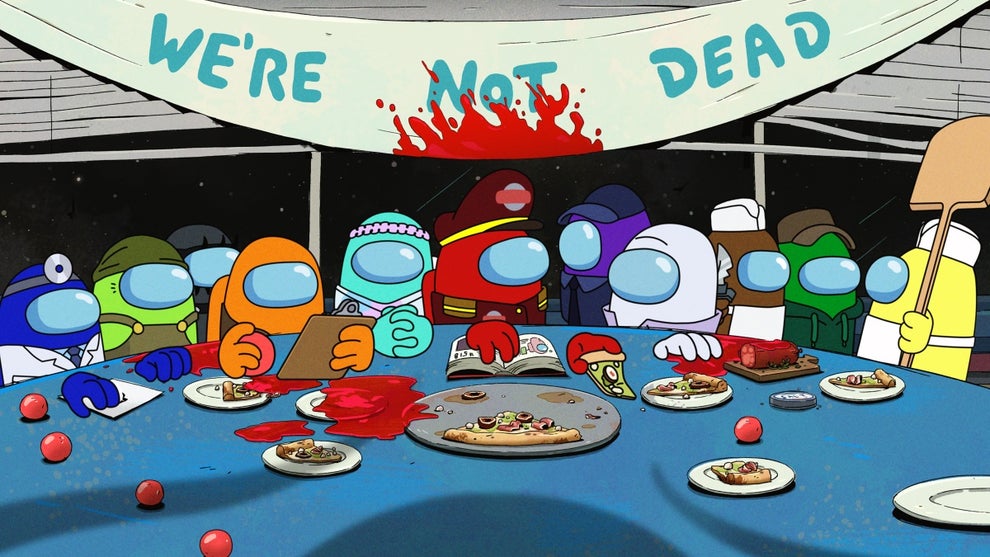
Owen Dennis isn’t afraid to break “Among Us.” That’s why Paramount+’s latest animated series, which premiered as a surprise drop Friday, feels as tense and delightfully silly as the wildly popular indie game it’s based on rather than a corporate cash grab.
“The ‘Among Us’ character design is the most iconic in the past 10 to 15 years. Everybody knows it,” the creator and executive producer told TheWrap. “That means that you can really do weird things with it, and people will still see it as that character and it’ll be fine.”
Practically, what that means is that the show’s cartoon astronauts blush through their visors when they’re feeling flustered. Chaotic emotions are portrayed through anime-inspired scenes that drastically depart from the show’s typical visual style. Characters without mouths, faces or arms often use their whole bodies to brood or panic, a trick that Dennis learned from animating One-One from “Infinity Train,” a confused, mouthless robot with two vertical eyes.
“I really wanted the board artists and our artists who were working on each of those sections to make this emotionally work for them and go hog wild,” Dennis said. “That’s why you end up with these characters that look really strange in some spots.”

At first glance, “Among Us” seems like a video game that would be impossible to adapt. Released in 2018 by Innersloth, the multiplayer game takes place on a space station where players are assigned one of two roles: Crewmates or Imposters. As the Crewmates complete their assigned tasks, they have to vote out suspected imposters. At the same time, the Imposters have to kill the Crewmates one by one. The social deduction game is essentially a digital version of longtime party games “Mafia” or “Werewolf,” and it became a massive hit during the COVID-19 pandemic. By November 2020, the game became so popular it had nearly 500 million monthly active users.
Adapting a show that relies so heavily on player choices is no easy feat. But Owen Dennis is no ordinary showrunner.
Dennis’ first major project was as a writer and storyboard artist on “Regular Show,” J. G. Quintel’s brilliantly bizarre slacker comedy. Then, in 2019, Dennis created his own show for Cartoon Network, the wildly imaginative “Infinity Train,” an anthology series where characters have to confront their personal faults in the hopes of escaping a seemingly endless train full of maddening cars.
In a television climate where animation — particularly animation aimed at children — is often ignored, “Infinity Train” broke out, earning widespread critical acclaim for its complex characters, imaginative world and distinct visual style. Like “Over the Garden Wall” and “Steven Universe” before it, “Infinity Train” was often hailed as an animated television masterpiece.
That mass praise is a big reason why the series’ conclusion was so disappointing. Despite Dennis and his team wanting to continue the series, “Infinity Train” was given a fourth and final season in 2021. A year later, it was one of 37 titles pulled from HBO Max as part of a wider Warner Bros. Discovery mandate to pull away from children’s and family programming. The show is now only available to watch via VOD.
“I can’t lie; it’s a really tough spot to be in right now,” Dennis said when asked about the current state of animation. “A lot of companies that have animation see it as mostly for children, and a lot of companies have given up making animated things for children because kids are on YouTube, so they say, ‘Why are we trying to get them?’ That means that a lot of animators are out of work now.”
It’s partially because of the bleak state of the industry that “Among Us” feels like such a love letter to animation. Dennis recruited artists from “OK K.O.! Let’s Be Heroes” for many of the show’s more ambitious, anime-inspired scenes. Much like “Adventure Time” or “Spider-Man: Into the Spider-Verse,” “Among Us” is more interested in using animation to convey the emotional truth of its story rather than sticking to any particular style.
Dennis approached his take on “Among Us” by first focusing on the overall themes around the game. “Who do you trust? Why do you trust who you trust?” Dennis said. “I wanted the whole TV show to be throwing little rocks at that theme.”
Once he settled on that central theme, Dennis started building out his roster of doomed Crewmates complete with their own complex relationships. Red (Randall Park) is a cocky captain with a mysterious history with the skeptical chief of security (Ashley Johnson). Black (Liv Hewson) is a goth geologist at odds with her hippy gemologist coworker Cyan (Kimiko Glenn). The cooks — Yellow (Debra Wilson) and Brown (Phil LaMarr) — are best friends. Then there are the outliers, characters with less obvious allies and enemies: the overly cheery head of human resources Orange (Yvette Nicole Brown), the eager unpaid intern Green (Elijah Wood), the rich contest winner White (Patton Oswalt), the competent and handsome doctor Blue (Dan Stevens) and the conspiracy-loving engineer Lime (Wayne Knight).

After that, creating “Among Us” was a matter of letting this crew loose on a space station that’s been secretly invaded by a body-shifting monster. Dennis cited “The Thing,” “Alien,” “Star Trek” and “Brooklyn Nine-Nine” as inspirations for his show.
“It’s basically a workplace comedy,” Dennis said.
Like the horror staples that inspired both Dennis and this game, the “Among Us” TV adaptation doesn’t shy away from gore. Most character deaths are accompanied by cartoonish pools of red blood and shots of comically large bones.
“Anyone who’s watched ‘Infinity Train’ will know that I’ve definitely killed characters in ways that are upsetting. There are a lot of ways you can make deaths be upsetting that aren’t necessarily about pulling organs out of somebody’s body,” Dennis said.
The team set a pretty standard bar to determine how much gore to include in the series. “We tried to make it like if you’re OK with your kids playing the game, you’re OK with what we did,” he said.
But when it comes to what is and isn’t age appropriate, Dennis noted that the lines are always blurred. Teenagers and children always watch shows designed for the next age up, especially when it comes to animation.

“I’ve always liked making things for the kids and teenagers who are watching things they’re not really supposed to be watching, but they’re kind of into it. We all did that,” Dennis said. “The stuff we’d watch at a friend’s house because our mom wouldn’t let us or a babysitter showed to us because the babysitter didn’t give a shit — that stuff’s good. It sticks in your brain really well.”
Though it’s been a difficult time for the animation industry between studios scaling back their investment in the medium and the threat of AI, Dennis is still optimistic about the art form. The “Among Us” showrunner noted that the medium has “never been more popular,” explaining that animated movies consistently make up 20 to 25% of all box office sales and that the popularity of video games have led to more audiences embracing animation. Additionally, the indie scene has seen a major boom thanks to the rise of the creator economy.
Dennis also has several projects that he’s passionate about making. “I’d love to work on Star Fox,” Dennis said. “There’s a book I read called the ‘Ratman’s Notebooks’ by Stephen Gilbert that’s really good. I would love to make that into an animated movie that’s for adults and teens.”
But Dennis noted that most of these ambitious animated projects can’t get made without backing from studios, streamers and networks. In order to make the next slate of generation-defining animation, these corporations need to start gambling on more lower cost bets rather than praying another $150 million movie will float the industry for a few more months.
“The audience is there, but also you have to build the ecosystem,” Dennis said. “You don’t get to just keep farming on the same land without tilling the soil.”
“Among Us” is now streaming on Paramount+
