

The fight for streaming dominance remains alive and well, even as quarterly disclosures from the major Hollywood players are becoming more sparse, which will eventually make it tougher to distinguish the winners and losers.
The latest round of media earnings showcased how much of a key growth driver streaming has become as it’s now on a path of consistent profitability across the industry, though for now, the balance of power isn’t meaningfully shifting.
Netflix remains king of subscribers, revenue and profits despite facing concerns about stalling engagement growth, which was up just 2% in the first half of the year. Ahead of its third-quarter report, the streamer laid off 6% of its total workforce and fired Chief Content Officer Bela Bajaria and film chief Dan Lin. Bajaria has been replaced by former Disney and Fox executive Peter Rice. It also forecast that its total revenue will grow at a slower rate in the fourth quarter and that ad revenue will come in shy of its initial 2026 projection.
Trailing behind it is Disney, whose streaming business continued to see strong profit and revenue growth as Disney+’s “digital centerpiece” transformation under CEO Josh D’Amaro is taking shape. In December, the long-awaited fully unified Disney+-Hulu app will launch, which will include live TV and select premium add-ons. Disney+ will also introduce creator content under its TikTok partnership, add more vertical video, live sports and podcasts, and ramp up its output of original local content over the next three years.
David Ellison’s Skydance is also poised to be a major force to be reckoned with in streaming now that the ink is officially dry on the Paramount-Warner Bros. Discovery merger. While the $110 billion deal puts its subscriber scale within striking distance of Disney, the company still remains well behind Netflix. Paramount’s streaming business also remained behind both Netflix and Disney on the profit and revenue fronts. Skydance’s third-quarter results did not include the financials for the combined company nor break out the Warner Bros. Discovery side of the business.
Meanwhile, Peacock is on a profitability streak as NBCUniversal prepares to separate from parent company Comcast next year, but continues to trail its rivals on key streaming metrics. Notably, Peacock is a domestic-only streaming service, while its competitors are global. It is also the only major streamer left to continue disclosing subscribers on a quarterly basis, which held steady at 48 million. It is poised to expand its reach in 2027 through a new distribution deal with YouTube.
This analysis does not include Apple TV and Amazon’s Prime Video, which do not break out streaming subscriber, revenue or profitability metrics on a quarterly basis since they remain a small part of each respective tech giant’s business.
During its third quarter earnings call, Amazon CFO Brian Olsavsky said that Prime Video is “profitable in its own right” with a revenue run rate in the “tens of billions” of dollars. An NFL presentation to the FCC has previously pegged the streaming service’s total subscriber base at roughly 180 million. While Amazon has not publicly confirmed that figure, it has disclosed that Prime Video’s ad-supported tier reaches more than 315 million monthly viewers globally.
Meanwhile, Apple reported that it has over 1.5 billion paid subscriptions in its Services business, an all-time high and double-digit growth over the prior year period. However, it’s unclear how much of that total comes specifically from Apple TV, which is lumped in with other services like Apple Music, iCloud and the App Store. Services Vice President Eddy Cue has previously confirmed that the streamer has “significantly more” than analysts’ initial estimate of 45 million subscribers, but declined to disclose a specific figure.
Check out the full breakdown of the numbers below.

Subscribers
The era of streaming subscriber counts is coming to an end as Skydance will become the latest to jump on the bandwagon of paring back its quarterly disclosures starting next quarter.
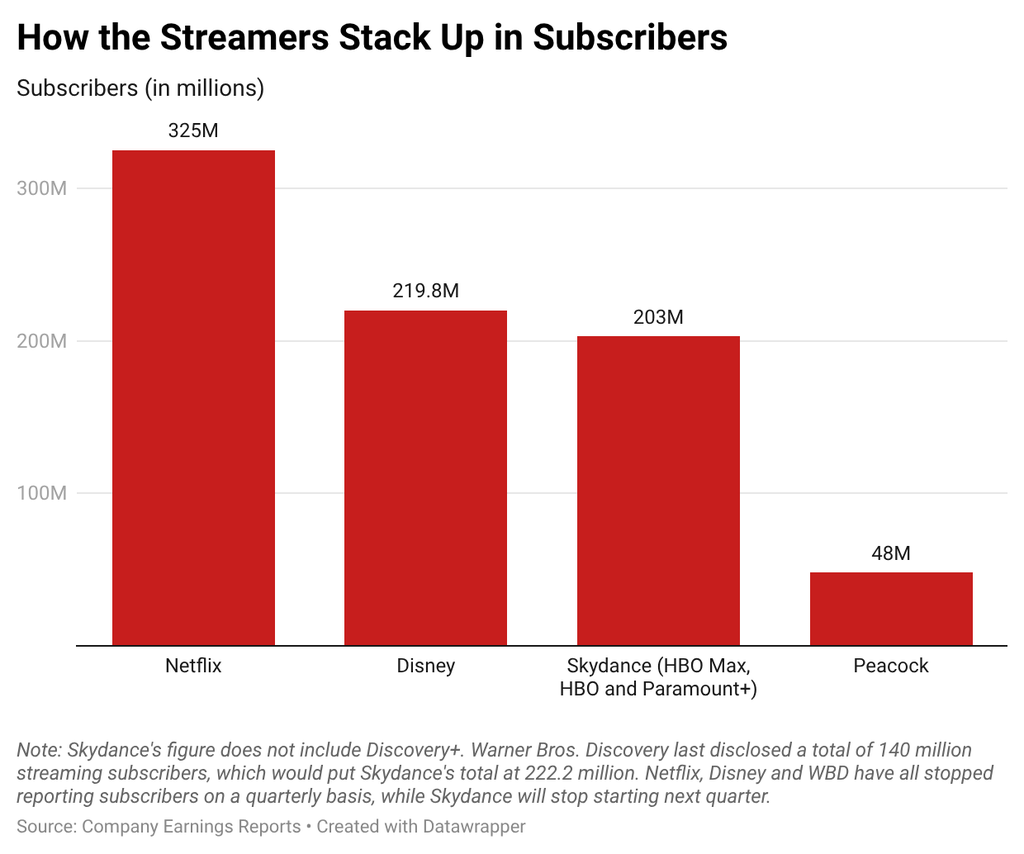
In its first quarter since closing the Paramount-Warner Bros. Discovery merger, the David Ellison-led media giant reported a total of 203 million subscribers globally across Paramount+, HBO Max and HBO. Paramount+ accounted for 82.2 million of that total after adding 600,000 subscribers, while HBO and HBO Max accounted for the remaining 120.8 million.
Notably, Skydance’s subscriber figure does not include Discovery+. Prior to the closing of the merger, WBD said it had surpassed 140 million total streaming subscribers, which would put Skydance’s total across its streaming services at around 222.2 million. In addition, Skydance revealed that free ad-supported streamer Pluto TV has approximately 75 million monthly active users, a decline of 5 million from the 80 million MAUs last disclosed in 2023.
The 203 million figure for Paramount+, HBO Max and HBO comes in behind Netflix’s 325 million subscribers and Disney’s last disclosed 219.8 million subscribers across Disney+, Hulu and ESPN+. Both Netflix and Disney previously stopped reporting subscribers on a quarterly basis.
In October, Disney also acquired a 70% majority stake in Fubo, which has since been merged with the Hulu + Live TV business. As of Fubo’s fourth quarter, the combined business had a total of 6.1 million subscribers, including 5.8 million in North America. Fubo will stop disclosing subscribers on a quarterly basis going forward.
NBCUniversal’s Peacock is the remaining holdout on the streaming subscriber disclosure front. The company reported a total of 48 million subscribers globally, holding steady from last quarter.

Revenue
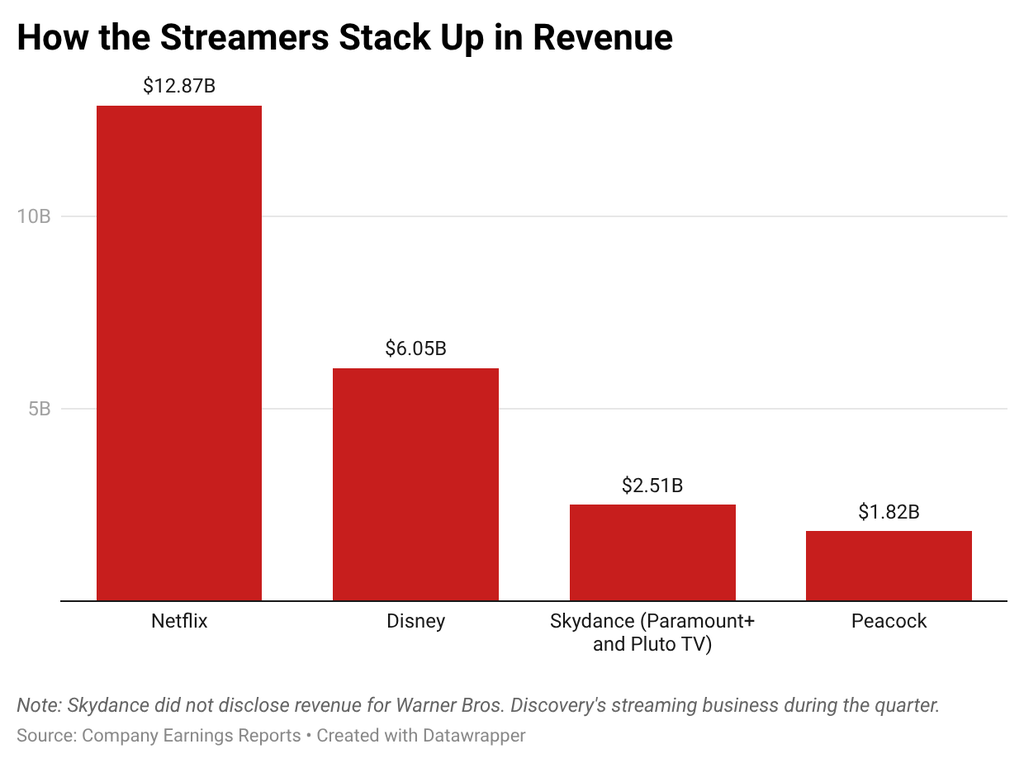
Netflix’s revenue for the quarter grew 11.8% to $12.87 billion, driven by growth in subscriptions and advertising, as well as price increases. For the fourth quarter, it is expecting revenue growth of 11.5% to $13.4 billion. Meanwhile, for the full year, it expects revenue to grow 13% to $51.1 billion. It also expects 2026 ad revenue to come in at $2.7 billion, a $300 million cut from its previous guidance of $3 billion.
Disney’s entertainment streaming revenue grew 19% to $6.05 billion, driven by growth in subscription fees and advertising. The company is currently generating more revenue from its streaming business than it is from linear TV and expects that shift to continue to grow over time. Though Disney continues to see a long runway for streaming growth, it did not offer specific guidance for streaming revenue in 2027.
Paramount’s streaming business saw total revenue grow 11% to $2.5 billion. Paramount+’s revenue increased 21% to $2.13 billion – its fastest quarterly growth this year – reflecting subscriber and advertising growth and its January price increase. The company did not break out streaming revenue figures for the WBD side of the business.
In the fourth quarter and 2027, Skydance expects strong top-line growth and expanded streaming margins as it works towards bringing HBO Max and Paramount+ together. An HBO Max-Paramount+ bundle will launch in early 2027 and the two services are set to merge onto the same backend within the first year of the merger’s closing.
Peacock’s revenue grew 34% to $1.8 billion, driven by higher distribution and advertising, its August price increase and the World Cup.

Profit
Netflix posted a profit of $3.67 billion in its third quarter and is projecting a profit of $2.8 billion in the fourth quarter.
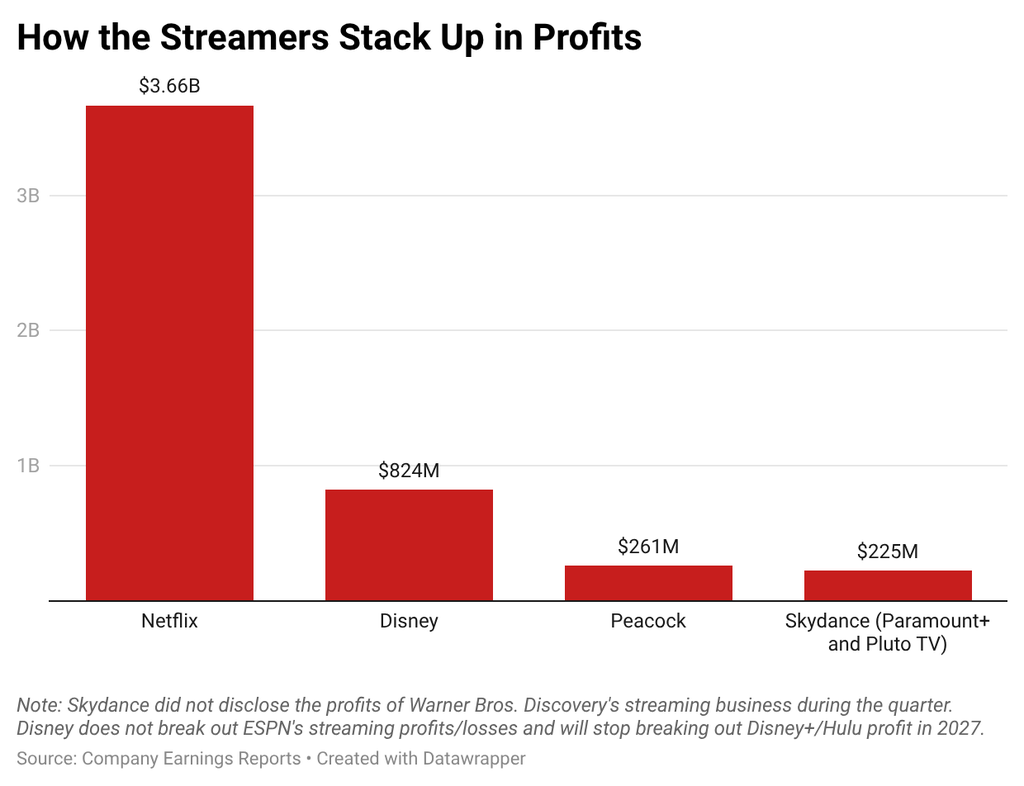
Disney+ and Hulu’s combined profit more than doubled to $824 million in its fourth quarter. For the full year, the streaming business achieved a double-digit operating margin of 11.5%, which is expected to continue to grow over time. Disney does not break out financials for its ESPN streaming service and will stop breaking out Disney+/Hulu’s combined profit starting in 2027.
Paramount’s streaming business posted a profit of $225 million despite higher costs from planned investment in its programming schedule in the quarter, including the UFC and original programming. Skydance did not disclose profits for Warner Bros. Discovery’s streaming business.
After turning its first-ever quarterly profit in the second quarter, Peacock’s streak continued with a $261 million profit in the third quarter, compared to a loss of $217 million in the prior year period. Looking ahead, Comcast president Mike Cavanagh warned that Peacock’s profits would be “lumpy” in future quarters based on the timing of when rights kick in for NBCUniversal’s different sports properties.
