
Note: This story contains spoilers from “Grey’s Anatomy” Season 22, Episode 18.
“Grey’s Anatomy” said goodbye to one of its longest-running and most polarizing main characters with its Season 22 finale. The actor behind the character, Dr. Owen Hunt, also directed the show-changing episode.
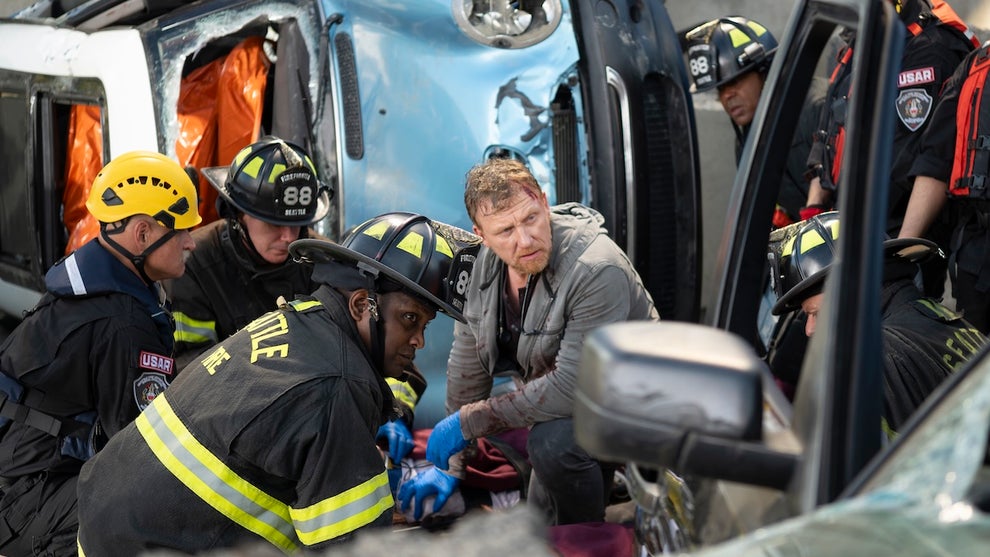
Episode 18, titled “Bridge Over Troubled Water,” followed as Owen (Kevin McKidd) woke up inside his nearly submerged SUV after falling into open water following a massive bridge collapse. He took himself out of danger and then helped save a family who had gotten stuck in their car in the devastation. By the end of the episode, he had saved their lives, another impressive rescue at the hands of the longtime Grey Sloan Memorial trauma surgeon.
The near-death experience — one of many the character has endured across 18 seasons on the ABC medical drama — made him realize it was time to choose the love of his life, deciding to uproot his life to follow Dr. Teddy Altman (fellow departing cast member Kim Raver) to a new job opportunity in Paris. It was a happy ending that McKidd himself hadn’t envisioned for his character, but one he felt honored to have coincidentally been tasked with directing.

“For a long time, I thought he should die in some heroic death, saving people. I thought that would be a fitting end,” McKidd told TheWrap. “But the world feels kind of scary at the moment, so this positive narrative of them going, ‘This is the next chapter of our lives and we want to recommit to each other’ spoke to the writers more than some tragic death.”
“I learned to direct on this show. So it felt really right in a weird way to do [direct this episode]. It was very sweet, but also very emotional and quite cathartic. It helped me to do it. Having the task of being a director and keeping things on time and prepping gave me that to focus on — so I wasn’t really feeling anything,” he added.
The episode, McKidd’s 48th installment as a director since first joining the show as a series regular in Season 5, felt like a final thesis of sorts to the actor — a culmination of all that he had learned and the boundaries he had pushed within himself as as an actor and his cast mates as a director.
Below, McKidd breaks down bringing the end of Owen and Teddy’s journey, looks back on his legacy and shares his plans after “Grey’s.” This conversation has been edited for length and clarity.
TheWrap: How was it to direct your own farewell episode?
McKidd: I knew I was going to direct this episode before the final decision was made that this would be the last season for me. Debbie Allen was directing on Broadway, so she asked me months ago. Then the decision came and I remember I was like, “Should I do this? Is this too much for me to take on?” But I realized no, this was really right for me.
I was not a director before I started on “Grey’s,” I learned to direct on this show. So it felt really right, in a weird way, to do it. It was very sweet, but also very emotional and quite cathartic. It helped me to do it. Having the task of being a director and keeping things on time and prepping gave me that to focus on — so I wasn’t really feeling anything.
But by the last couple of days, I was definitely having a lot of feelings, and then saying goodbyes was tough, because we are a family, and essentially, we always will be. This is almost 20 years that I’ve been on the show. It’s definitely a family for me. I think it was hard for a lot of people to see me go, and for me too. But I’ll be back in a different form.
And at the same time, it was a very big finale for us. Doing that bridge collapse was logistically tough and also a physically challenging sequence for me as an actor. I’m very proud of this episode. It’s almost like my final thesis for “Grey’s Anatomy.”

Owen ends up in the water after the big bridge collapse, but pulls off an impressive emergency rescue in and out of the OR before leaving Grey Sloan for Paris with Teddy. What was your reaction to the conclusion of your character’s journey on the show?
It’s funny. I always imagined over the years what would be Owen’s ending, if I decided to leave. For a long time, I thought he should die in some heroic death, saving people. I thought that would be a fitting end. But I think ultimately, [showrunner Meg Marinis] and everybody on the writing side, I think they felt a couple of things. There’s been quite a few deaths recently on the show, and I think there’s only so much stomach that the fans and the writers and everybody has for that story. We’ve done that quite a bit.
But the world feels kind of scary at the moment, quite dark. So this positive messaging of them going, “This is the next chapter of our lives and we want to recommit to each other” spoke to the writers more than some tragic death.” It also leaves the door open [for a return], so who knows what might happen in the future.
There were so many great full-circle moments and references to the characters’ history on the show. Owen gets to come back to the hospital in the ambulance after doing a crazy rescue — mirroring when we first met him in Season 5. And then Teddy and Owen’s conversation in the scrub room mirrored the first time Teddy left in Season 8. How was it bringing those moments to life?
The crike pen first showed up in the show, Owen treated somebody in the field with a ballpoint pen. In this episode, Teddy discovers it and that’s how she finds out that he’s still alive. There’s all these callbacks that Meg brilliantly wrote into the script and gives it a feeling of the circle being complete.
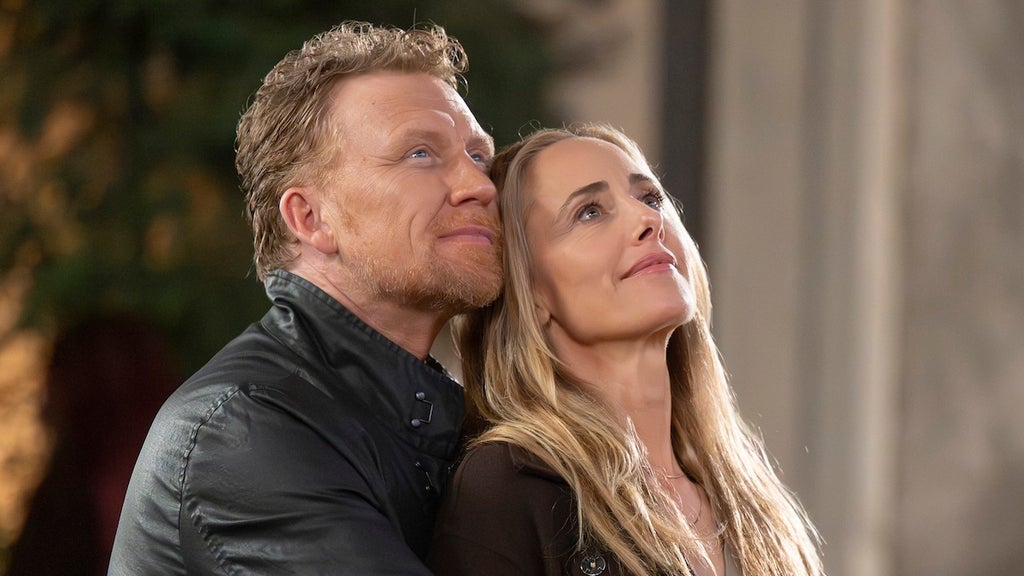
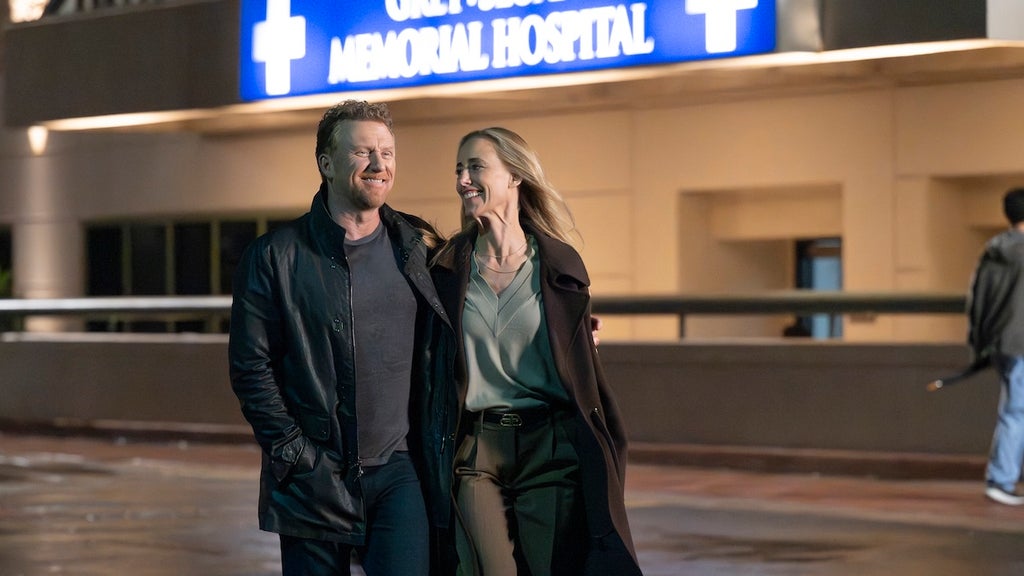
There’s other little things we added, where Owen and Teddy stand and look at the hospital before they walk away. She leans against his chest and that’s a callback to the Germany episode, where she sat in his arms looking up at the snow in her apartment [before she got pregnant and returned for Owen again.] Subtle things like that came up during production, because we know these characters so well that it felt like the natural progression to tell it this way.
What was the last scene you guys shot for the finale? How was it on set as you and Kim wrapped things up?
The bridge collapse was a huge build that took a huge amount of effort, so that had to be the very last two days of shooting. We were out in Valencia, California, in the middle of nowhere, where they built the collapsed bridge — it took weeks to build. Those final two days, we were on location, which was very emotional in its own way. And it was really sweet. A lot of people, my kids, came down to visit, my partner Danielle and a lot of the cast came down to see me while we wrapped up the whole thing.
That was a really special, emotional and tough two days. It’s not easy to get that all done in two days, so it was challenging but really cathartic and beautiful.
Kim and I’s last scene together was the one in the scrub room. The big emotional conversation where they both recommit to each other and share what’s in their heart to each other. Which I love because it took us a while to figure out where to set that scene, and I thought it should be the scrub room because Teddy and Owen over the years had so many intense moments in scrub rooms. They always end up in a scrub room crying, screaming at each other — after surgery they just stand there and speak the truth to each other.
That was an emotional scene for both of us. I think a lot was coming up for us, and I was very much in director mode and I remember I laughed at one point, because Kim had tears in her eyes and I remember saying “Kim, you have to remember that even though we’re feeling sad at the moment, Teddy and Owen are really happy about this … we have to be careful that our own feelings don’t bleed in too much into what’s happening.”
Kim was really great in this episode. There’s something so magnetic and powerful about her performance.
“Grey’s” has been your TV home since 2008, making you one of the longest-tenured cast members in the show’s history. It’ll be weird not to have Owen around. How was it to learn of this decision and come to terms with saying goodbye to this character and the show?
It’s funny, I just heard Jon Hamm in an interview talking about the ending of “Mad Men,” and how you kind of go through this grieving process because you’re leaving family.
I think with that show it’s different, because that show actually just ended. The fact that “Grey’s” carries on and that there’s still an open door helped in a weird way for me. It felt less like a complete loss, but just adjusting to change. There’s definitely a bittersweet feeling. I remember this feeling when I was doing theater as a teenager and the play would be over. Everybody would be crying on the last night, not because you’re not going to see each other again. You’ll see each other at school tomorrow, but that moment, that combination of those people under that set of circumstances, that pressure, and the fact you’re all generating this thing together, that’s changing and it won’t be the same. But that’s part of life isn’t it? Things change, they have to and they always will.
Owen is among the show’s most talked about characters, with fans quick to poke fun at his suffering and blaming him for things like the plane crash, while also sticking by him through the years. How do you look back at your relationship with the show’s passionate fanbase?
I remember when I met Shonda Rhimes she said “I want to create this trauma surgeon, and he just doesn’t care. He just does his own thing.” He was kind of designed as an antagonist element. That was the original concept, and I think we’ve held on to that. It’s a testament to the writers and that original concept, and hopefully the work I did too, that there’s two sides to this man.
I love seeing people debate like, “I hate when Owen did that” and “No, I actually liked it.” There’s nothing worse than a character where [the response is],”Oh yeah, I kind of like that guy.” That’s not interesting. That would be a fail on my part … the fact people have heated debates and strong feelings about what my character has done — people that defend him and people that attack him — I think is a fantastic thing. It’s what TV is all about.
You’ve played a key role in many of “Grey’s Anatomy’s” biggest storylines and episodes, which storyline stands out to you as you look back at your history on the show across your time on the show?
Obviously, that initial season that Owen turns up. We meet him and then he goes to Iraq, and then he comes back and he’s broken. He was a broken man. I thought there was some really brave writing in those early seasons around that character, and they let him go to some really dark places, especially for a network TV show. I was scared sometimes. I remember going into Shonda Rhimes’ office and I went, “OK, like, I want to have a job, and I’m stabbing all these pigs and I’m strangling Cristina Yang and doing all this stuff.” And she was like, “Don’t worry. I got you, just trust.” I really took those words to heart and did trust her and committed fully to it, which is our job as actors. And she did me right. She created something that I think is pretty iconic.
Then Teddy came in and there was this whole love triangle. Shonda has this amazing ability to encourage people to go on the journey, whether you’re driving them nuts or not. That’s the point. You know? It’s to create strong feelings for the audience.
And then Owen went through all that period where his missing sister came back, and he completely broke down and had to reconnect with her. And then there’s a season where he had to go on the run because he’s helping veterans with physician-assisted suicide. The writers have gone to dark places with the character, and I feel really proud of that legacy.
You were also one of the first actors to step behind the camera to direct on the show, alongside Chandra Wilson, and helped build a directing pipeline for the show’s cast. How do you look back at that part of your “Grey’s” legacy?
The director part is something I’d always wanted to do, and I never thought I’d ever get a chance, but Shonda Rhimes and Rob Corn and everybody at this show said yes. I was shocked that people said yes to me. I’m so used to hearing the word no, and so that really is a testament to Shondaland, to Shonda Rhimes, to everyone who helped me along the way — Herbert Davis, who is the DP, the toughest DP I’ve ever met. It was almost like you were at the Herb Davis film school.
I think it’s been a great thing to allow actors to become directors, because I think actors really like other actors. We understand how hard it is to stand in a mark and to sell an emotion or to sell a speech. It’s not easy. We try to make it look easy. So I think actors make really good directors, because we like actors and we empathize with actors. We’re here to help. That’s all I’m doing when I’m directing. I’m just here to help the actor take what they can do and go, “Oh my god, I raised my bar. I did something I didn’t think I was able to do.” The best compliment I get from an actor is when they say, “My God, I didn’t think I’d be able to get to that place with that scene, but you really helped me do it and prove something new to myself.” That is such a gift as a director, if you can help an actor do that.

You’ve directed many episodes and often pushed the boundaries of the typical “Grey’s” hour through the years. What episode or moment stands out to you from your time in the director’s chair?
That big Germany episode [Season 14, Episode 17, titled “One Day Like This”] there were three stories happening. It was Sarah Drew’s character, April, confronting her faith with a rabbi. It was the first time that Scott Speedman appeared in an episode, and then Owen goes to Germany to reunite with Teddy after all those years. Then this huge blowup happens at the end and she kicks him out. That episode, for me, felt creatively and esthetically beautiful. I’m really proud of that episode.
In Season 19, there’s the episode that started with Addison coming in on a gurney having just been attacked. That whole first act was written as a normal act. And I read it and said, we could do this as a one-shot. It took a lot of convincing and Krista Vernoff, who was the showrunner at the time, took a leap of faith and let me do it — and it worked.
Those are just two of many. I’ve taken some risks, and hopefully succeeded more than failed.
Since news of your “Grey’s” farewell, you’ve announced a new leading role on the ITV series “The Only Suspect,” along with a new partnership for your company, Ferryman Films, with STV Films to produce new projects. What are your goals for this new chapter in your career?
There’s so many things I want to do now. These 18 years have been such a blessing, but you only have a few months in a year to do that. I haven’t done a Broadway play, I haven’t been on the West End in many years. So the thought of doing that really excites me.
My production company just signed this deal with STV. We have a slate of about 15 projects, and quite a few of them are in pre-development now, and pushing those developments takes a long time. But we’re pushing those all up the hill to get a green light. Some of which I’ll act in, some of which I’ll just produce. It’s a Scotland-based production so all the slate is very much internationally minded. So hopefully everyone will hopefully love the shows we do. And I’m a working actor, I’m doing “Only Suspect” back in the U.K. with great British actors and Farren Blackburn, who is one of the best British TV directors out there. It feels really busy.
I’ve just finished doing “Highlander” with Henry Cavill — a huge action film, I just got back from Scotland [on Monday.] It’s busy and exciting for me.
“Grey’s Anatomy” Seasons 1-22 are now streaming on Hulu.
