
We’re four days into Cannes and feeling good! Today we’ve got recaps of standing ovations, directors with some of the festival’s hottest titles and more piping hot reviews.
This Year’s “Flow” Debuts
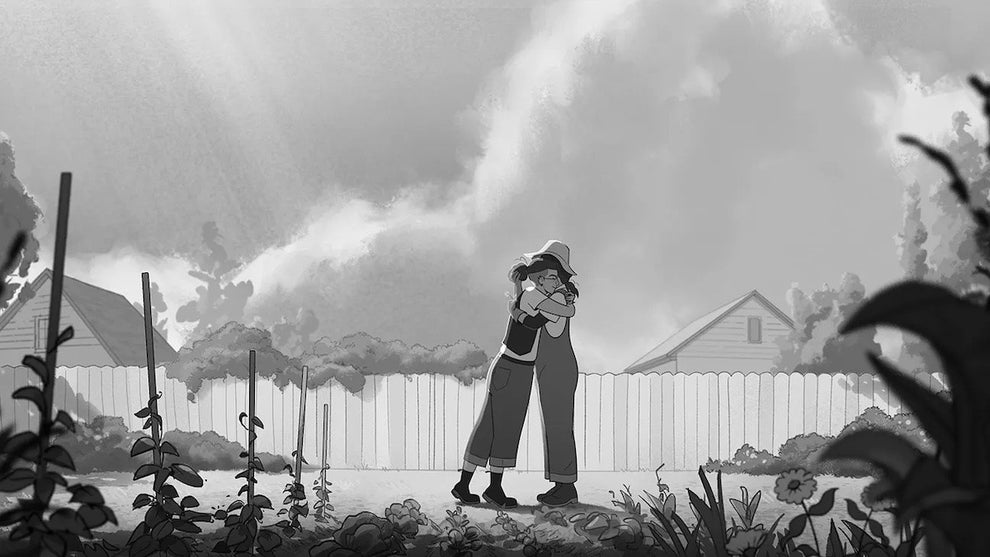
On Thursday there was a special screening of “Tangles: A Story About Alzheimer’s, My Mother and Me” an animated feature Canadian director Leah Nelson. By all accounts, the screening received overwhelmingly positive reviews, complete with a seven-minute ovation and tears from Lauren Miller Rogen, the film’s producer (and Seth Rogen’s wife). It’s enough to make you wonder if “Tangles” could be this year’s “Flow” – another small animated movie that debuted at Cannes and went on to become an unlikely box office hit, as well as the underdog winner of the Best Animated Feature Oscar.
“Tangles” features voice work from Julia Louis-Dreyfus, Rogen, Abbi Jacobson and Samira Wiley and was produced by Vicky Patel and Sarah Leavitt, whose graphic novel memoir serves as the inspiration for the “Tangles” movie. The official program describes the movie’s story as follows: “When Alzheimer’s begins to erase her mother’s vibrant personality, Sarah leaves her exciting life as an activist and artist in 90’s San Francisco to return to her eccentric family in the conservative small town she recently fled.”
The reviews have been universally positive, with our own review by Ben Croll saying that the film “often plays like an animated scrapbook, something Sarah herself underscores when she notes that ‘anytime could be the last time’ with that particular facet of her mother. What else can the filmmakers do but capture each moment gone by?”

For those keeping track of the standing ovations at Cannes, “Club Kid,” directed by and starring “I Love LA” star Jordan Firstman, got a six-minute standing ovation, so slightly shorter than “Tangles.” But it did feature Firstman planting a big fat kiss on star Diego Calva, which is pretty cute.
Asghar Farhadi Takes a Stand
Iranian filmmaker Asghar Farhadi is back at Cannes with “Parallel Tales,” which is based on a section of Krzysztof Kieślowski’s “Dekalog” starring Isabelle Huppert, Virginie Efira, Vincent Cassel, Pierre Niney and Adam Bessa. While the movie has been getting middling reviews at the festival, Farhadi was of course asked about the current conflict between America and Iran, and the filmmaker responded thoughtfully.
He told journalists gathered at the press conference that “Any murder is a crime.” Farhadi was in Tehran last week and reflected on two tragic events that he has witnessed. “One of these events was the death of a number of innocent people, children, members of the civilian population who died in the war. And before this war, we had the death of a number of demonstrators, people who went to the streets to protest, and they were equally innocent but were massacred. These two events are extremely painful and will never be forgotten.”
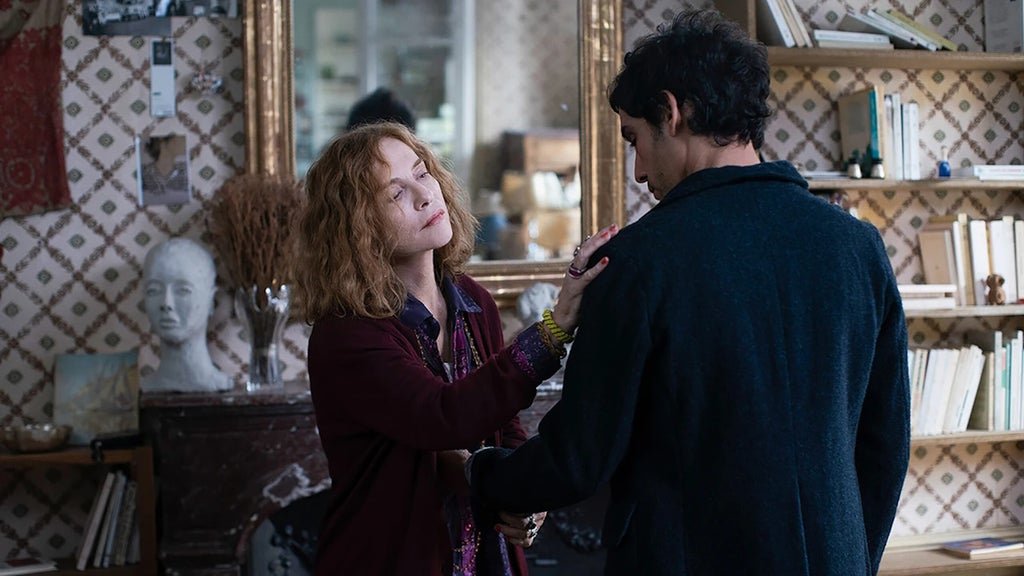
He continued: “Any murder is a crime. Under no circumstances can I accept the fact that another human being should lose his or her life, be it a war, be it executions, be it massacres of demonstrators. It’s extremely cruel and tragic to know that in the world today, despite all the progress which we are supposed to have made, every morning we wake up with news of new innocents being killed without any reason whatsoever.”
Our review of “Parallel Tales,” by Zachary Lee, was warmer than most of the notices coming out of Cannes. “While there’s an intoxicating draw in filling new details into the contours of people we barely know, Farhadi seems to understand that this needs to be done responsibly,” wrote Lee.
Bong Joon-ho Owns Up
Bong Joon-ho, the South Korean auteur behind “Snowpiercer,” “Okja” and “Parasite,” was at Cannes, not screening a new film but drumming up interesting for his upcoming animated feature “Ally,” about undersea creatures, that will be out next year from Neon. (Do we already smell a Best Animated Feature frontrunner?)
In an interview about “Ally,” director Bong took a moment to take full responsibility for “Mickey 17,” his misunderstood sci-fi satire from last year that fizzled both commercially and critically. When the question arose as to whether the version that was released was Bong’s intended film, considering it was his first movie with a budget of over $100 million (and his first film working with a traditional Hollywood studio) he owned up to the movie – faults and all.

“Director’s final cut was part of my contract and everyone at the studio and at my agency tried their best to protect me. Of course, during post-production, there was lots of discussions and a lot of opinions going back and forth, but it wasn’t ever like someone was forcing something on me or giving me pressure. And so luckily, all my films have been released as my director’s final cut, even a movie as big as ‘Mickey 17,’ and all the good parts of that film and all the bad parts of that film came from me. I take full responsibility. So shit on me if you didn’t like it!”
There you have it. Blame Bong if you didn’t like “Mickey 17.” But also you should like “Mickey 17.”
‘Fatherland’ Director and Star Open Up
“Fatherland” director Pawel Pawlikowski and star Sandra Hüller spoke about the film at a press conference attended by our own Steve Pond. Pond describes the film as following “the German author Thomas Mann and his daughter Erika as they travel back to post-World War II Germany to receive an award in 1949.” Pawlikowski, of course, is the Oscar-winning director of “Ida” and “Cold War,” both films that, like “Fatherland,” are period and shot in black-and-white.

And when asked why he made another period film, Pawlikowski said, “I am lost today. I have no idea what period we are in. That’s why I did a period film. So I try to make films that kind of convey that life is complicated, and there’s no one narrative, and everyone is paradoxical in some way. And try and convey that in the simplest possible way, which cinema can do well through images, scenes, sound …”
Hüller, who also starred in this year’s “Project Hail Mary,” was asked if she feels guilty as a German woman playing Nazi characters. (She also recently starred in the Oscar-winning “The Zone of Interest,” where she played the wife of a prominent Nazi official.) The actress responded, “I understand that question. Yes, I feel the guilt every day. And also, I never get bored of it, to feel the guilt, because it’s necessary in order to act right.”
Famously “Fatherland” came together when another project, “The Island,” starring Rooney Mara and Joaquin Phoenix, fell apart weeks before production was set to begin, thanks to the actors’ strike. Pawlikowski quickly zeroed in on “Fatherland.”
“I thought that could be an interesting film. Not a kind of historical reconstruction, but if we can abstract everything away and focus on the … three characters, and the moment, and reduce what was a complicated long journey,” explained Pawlikowski. “And it’s a family story in it, an incredible historical context as well, which is always something that I like doing: telling history through people, through relationships.”
Not that he didn’t make changes to the actual story.
“The actual journey happened with Katia, the wife of Thomas Mann, who wasn’t dramatically so interesting, so we dismissed her and brought in Erica, (who) was very interesting,” said Pawlikowski.
Mubi will release “Fatherland” later this year.
Yet More Reviews!
You want reviews? We’ve got them. In addition to the “Tangles” and “Parallel Tales” reviews we’ve linked to above, we have some additional write-ups out of Cannes.
Zachary Lee reviewed Guillaume Canet’s latest “Karma,” starring Marion Cotillard and Leonardo Sbaraglia and shot by the wonderful cinematographer Benoît Debie, which he described as “a punishing, tense and brutal odyssey to hell and back with a reliably great performance from Cotillard.”
In “Karma” Cotillard plays a woman living in Spain who accused of a crime who must hideout in the cult she left years before. If you want more of a taste of “Karma,” you can actually watch a teaser below. It’s like we’re in Cannes!
And while there were certain aspects of the film that dazzled our reviewer, he concluded that “while Debie’s cinematography, Canet’s direction and a chilling, organ-heavy score that feels like experiencing a jump scare every time it is deployed make this more than mediocre, you’ll find it hard to distinguish these stories from other tales you can probably find on Netflix of people finding liberation from cults.” Ouch!
Our own Steve Pond reviewed “All of a Sudden,” the latest film from “Drive My Car” filmmaker Ryusuke Hamaguchi, which Pond points out, despite its title, runs a leisurely three-hours-and-sixteen-minutes.
And while that runtime might have been punishing, Pond seems to have enjoyed his stay with the filmmaker – mostly. “As he did in ‘Drive My Car,’ the director turns to theater as a way to cope with the thorniness of life, and he defaults to moody resonance over explanation at every turn. ‘All of a Sudden’ circles back to the idea of hope in impossible situations; it gently insists that no one is normal, and it helps us find the beauty in that,” Pond wrote.
