

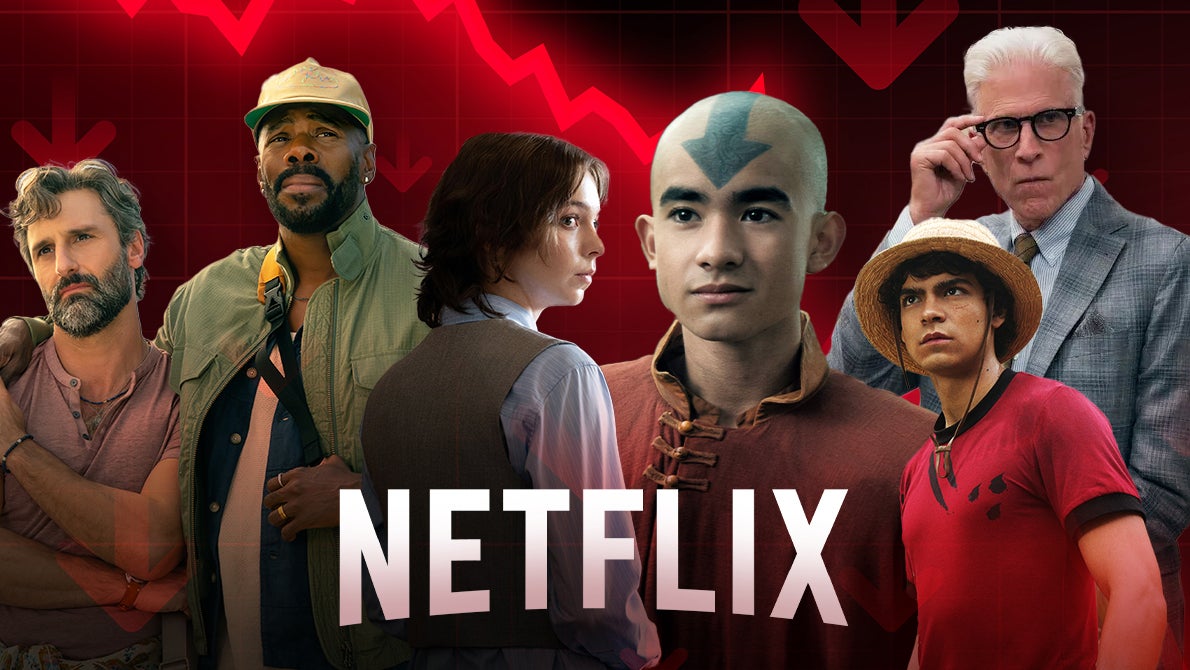
Netflix is in the midst of a serious second season problem as new installments of once-buzzy shows have seen plummeting viewership of up to 75 percent.
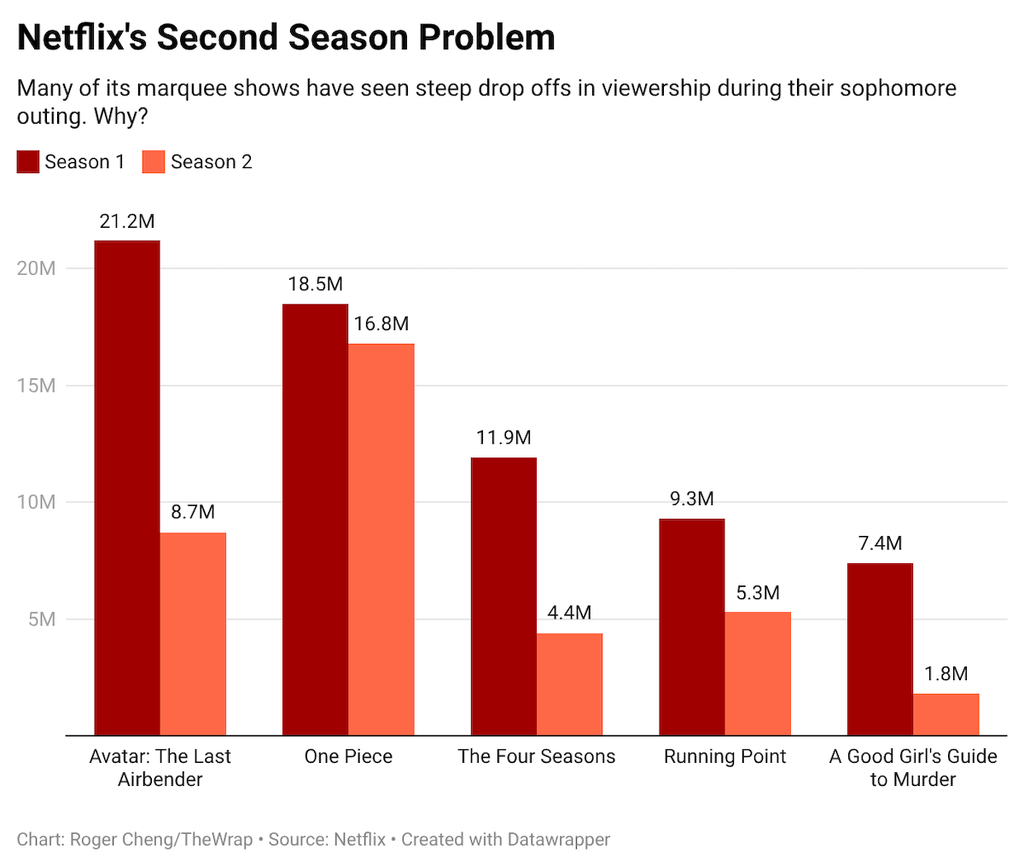
The streamer’s latest massive decline came with “Avatar: The Last Airbender,” an expensive and ambitious live-action adaptation of a beloved animated classic that saw a nearly 60% drop in viewership from Season 1 to 2. The ratings downtick of “Avatar,” as well as several other 2026 releases, prompted online discourse after Bloomberg called it out, while reporting that the streamer has been studying the trend.
TheWrap dug into the slump and found the same pattern, several times over. This year, Netflix has released second seasons of seven shows that were well-watched and largely well-received when they first premiered: “A Good Girl’s Guide to Murder,” “The Four Seasons,” “Avatar: The Last Airbender,” “Running Point,” “One Piece,” “Beef” and “A Man on the Inside.” The second season viewership for four of those shows — “A Good Girl’s Guide to Murder,” “The Four Seasons,” “Avatar: The Last Airbender” and “Running Point” — dropped by at least 40%. Of those listed, “A Good Girl’s Guide to Murder” saw the biggest dip at 76%.
But no show has it worse than “A Man on the Inside.” Two days after its 2024 debut, the Ted Danson-starring comedy scored 6.9 million views and landed atop Netflix’s global list of the top 10 English-language shows. Season 2 never even appeared on any of Netflix’s lists.
The troubling trend highlights a problem that’s surfaced as the streaming giant attempts to service its more than 325 million subscribers. Between confusing release schedules, binge releases, long gaps between seasons and the regular flood of new content making it difficult for any new release to stand out, Netflix’s scale is quickly becoming its own worst enemy.
“It’s likely a combination of an increased competition and [Netflix’s] shift to be the McDonald’s of streaming, more than anything,” Evan Shapiro, former corporate executive, producer and self-described “media cartographer,” told TheWrap. “Consumers’ only loyalty is to the shows, not the platforms. If you leave them hanging and bury their best stuff in a basket of French fries, they’ll move onto series that don’t let them down — and the selection is endless right now.”
Netflix declined to comment for this story, but one insider noted that season-over-season viewership declines are prevalent across linear and streaming. One example is “Poker Face” on Peacock, which had a strong first season, but returned for Season 2 to little fanfare and was canceled post-release.
While the Netflix machine can keep churning out new content to keep subscribers hooked in the near term, it raises the question of whether they’ll stick around in the long term if none of Netflix’s newer shows can sustain the following that classic hits like “Bridgerton” or “Emily in Paris” enjoy. That trend could also have multiple other consequences, from its ability to keep turnover low to undermining its plans to merchandize the hit franchises that populate its Netflix House locations. While hits like “Wednesday” remain, it’s had trouble restocking the lineup with zeitgeist-dominating shows like “Stranger Things” and “Squid Game.”
This isn’t a quality problem so much as a strategy problem. With the exception of “Beef” and “A Man on the Inside,” the second seasons of every aforementioned show received higher critical ratings than their first seasons. “One Piece” Season 2, which saw the most modest decline, even scored a coveted 100% on Rotten Tomatoes. Even more telling, it’s also not a problem that’s limited to sophomore seasons. Season 3 of “The Night Agent” — a series with a debut season that was one of the most-watched Netflix shows in the first half of 2023 — launched to just 8.4 million views when it returned in February, putting it behind “Reality Check: Inside America’s Next Top Model” and down from the 13.9 million views Season 2 garnered in its first week.
“It feels like [every other streamer] finally has an identity of some sort,” Tamara Fuentes, entertainment editor at Cosmopolitan and a member of the Television Critics Association, told TheWrap.
HBO is home to awards heavy-hitters; Apple is niche but prestigious; Amazon is making great young adult shows; and Paramount+ has found an avenue making action shows for your dad. But what about Netflix?
“Netflix often found its identity via the hit show at the time,” Fuentes said. “It is like they are trying to figure out that formula again — trying to see what the next big thing can be — but they don’t often lean into what they find as success.”
The fall from season to season is becoming so noticeable that some are wondering if Netflix even cares about launching multiple seasons. After all, as long as a viewer stays on Netflix, what does it matter?
Myles McNutt, associate professor of media studies at Old Dominion University and editor-in-chief behind Episodic Medium, noted that how Netflix defines success is “the eternal question we don’t have an answer to.”
“Netflix is very good at making one-season hit shows and not very good at making multiple-season hit shows. Is that a problem for Netflix?” McNutt asked TheWrap. As scripted content is having a harder time breaking through the noise, it very well could be.

Netflix’s confusing release schedule
There’s one basic reason why Netflix has probably seen such dramatic drops from season-to-season. Its release schedule often works against its original shows. It’s not uncommon for three years to go by between seasons, as was the case with “Avatar” and “One Piece.” “Beef” was even more confusing as it returned with a completely new story; the second installment of a limited series that became an anthology following its successful launch.
And if a show is popular enough, Netflix started releasing new seasons in multiple parts, like the streamer did for “Stranger Things” Season 5, a finale that was broken into three installments over Thanksgiving, Christmas and New Year’s Eve. That strategy may help shows stay in the cultural spotlight longer, but it asks a lot of viewers.
“A lot of people are feeling like, ‘Why am I going to put time into something if I’m going to have to wait forever? I may or may not remember the details, so I have to do homework to watch Season 2 or it’ll just get canceled anyway,” Fuentes said, referring to Netflix’s habit of quietly axing shows. By June, the streamer canceled nine shows after their first seasons.
“‘Emily in Paris’ comes out with the new season blocked off in different parts and you’re just confused as to why that’s happening,” Fuentes said. “A couple of people have told me that — even for ‘Bridgerton’ — they were going to wait until everything’s done. Then, lo and behold, they forget.”
Netflix seems to be moving away from the fragmented release, for the most part, with chief content officer Bela Bajaria noting the two-part release for “Bridgerton” Season 4 came from the show’s creative team.
“We are being really intentional, thoughtful and trying to not be set in one way of doing it,” Bajaria said when asked about how Netflix plans out its release schedule at a press event that included TheWrap.
Does Netflix even need multiple seasons?
There is a larger question to consider. As long as people are still watching Netflix, does it really matter if they’re watching a prestige awards darling or the true crime slop of the week? When you consider this argument — that all views are equal — the need for multiple seasons seems less clear.
While streamers have de-emphasized subscriber numbers, they remain important (that’s why Netflix gave an update in January). Returning shows are great for reducing churn, but new shows are key for getting new members. The Guardian’s Stuart Heritage summed up Netflix’s priorities well while breaking down the lackluster ratings around “A Man on the Inside” Season 2: “The entire business model revolves around dangling something shiny and new in front of viewers, and Danson’s quaint retirement home series is neither of those things.”
McNutt pointed to the recent cancellation of “The Boroughs” as proof of how Netflix’s success metrics seem to vary from the rest of the industry. Executive produced by the Duffer Brothers, the sci-fi series appeared on Netflix’s global Top 10 list of English-language shows four weeks in a row, accounting for over 20.8 million hours, and earned a 97% on Rotten Tomatoes. The series was expensive for a middling scripted hit, costing $10 million an episode, and was ultimately canceled.
For other streamers and networks, giving a promising hit more time to grow may seem like a no-brainer. But since Netflix doesn’t rely as much on multiple seasons, its focus is different.
“[‘The Boroughs’] was not a failure by metrics that are available to us, but whatever Netflix is seeing internally told them that this just wasn’t a fit for the direction they wanted to go,” McNutt said. “The problem with this is that it likely means that many of these shows will not continue, meaning the fans who are invested are going to run into the other problem of Netflix canceling shows early, not giving them time to develop and then making people feel like they shouldn’t be investing in Netflix shows at all, lest they end up in this situation.”
Because Netflix is making itself the everything-for-everyone streamer these days rather than developing a specific brand identity, it’s even more difficult to keep track of new releases. It’s easier to remember that Peacock — a streamer that’s home to beloved reality shows like the Bravo universe and “The Traitors” — has “Love Island USA” than that Netflix has a broad comedy like “Running Point.”
“When you only make six to 10 episodes at a time, then wait 18 months or more to bring a show back, while simultaneously pumping out a high volume of high-calorie-low-nutrition content all year, don’t be surprised when the audience loses interest in that one show you spent tens of millions on. They forgot,” Shapiro said. “In other words, Netflix has fallen into the very trap they set for the rest of traditional media.”
The broad appeal behind much of Netflix’s content can also inversely impact the platform. For one thing, it’s surprisingly difficult to make four-quadrant hits that appeal to a mass audience. Sometimes you can use IP, proven talent and a clever idea to find success, like Netflix did with “Wednesday,” but more often than not, shows or movies that become pop culture hits were initially niche, like “Stranger Things” or “KPop Demon Hunters.” Also, when you create shows specifically for as broad of an audience as possible, that attracts a certain kind of viewer.
“These are normal people. When they watch a TV show, they don’t think that much about it after the fact,” McNutt said. “What would convince that person to tune in and catch up on something when there’s so much else on that platform, let alone with all the platforms to choose from?”
He added: “I think they’re seeing the perils of building a brand around a lack of brand.”

What about other streamers?
Second season viewership declines happen across other streamers, as the Netflix insider pointed out. But it seems to be hitting that streamer in a particularly notable way that suggests there are downsides to the binge model.
Several shows with weekly releases across other streamers have grown their viewership in their second season, including HBO Max’s “The Pitt,” which benefited from growing buzz throughout its weekly release in Season 1. While the medical drama inevitably benefits from its subsequent awards buzz and loud fandom, Season 2’s viewership was roughly 50% higher than it was for Season 1 during its first 90 days.
Apple TV’s “Severance,” another show with a massive gap between seasons, also saw a viewership spike, both between Seasons 1 and 2 and week by week. Season 2’s finale saw a 29% increase in viewership compared to the season’s previous high, and the series gathered 6.4 billion streaming minutes in the U.S. during its Season 2 rollout.

The “Severance” boost in particular proves that large gaps between seasons aren’t necessarily a death knell. And elsewhere, staggered releases for Hulu’s “Paradise” and Paramount+’s “Landman” saw second-season viewership rises. In all of those cases, those shows were marketed heavily and served as centerpieces of their respective service’s offerings, making them more essential than Netflix’s TV show of the week.
Extending a season’s run also enables it to enter into the cultural conversation if it wasn’t already. Just take Peacock’s “The Traitors,” which broke out in its second season and has seen viewership growth every season since. The same can be said for Peacock’s “Love Island USA,” which employs a daily release schedule and saw its sixth season break out. Since then, the reality show has grown to its strongest ratings yet.
While the TV landscape has become too saturated to have one set watercooler show, lengthening a show’s episodic release cadence creates a routine and community among viewers — especially for zeitgeisty shows like “The Traitors,” “Love Island” or even “The Pitt” — to unpack their thoughts on a season’s biggest moments and let those moments have a distinct impact on viewers, rather than just flushing narrative highs in a binge. It’s that investment that makes the chances of retention higher, as opposed to one weekend of binge watching a year or two ago.
Beyond the sophomore slump
Outside of multi-season hits, Netflix has found its stride in buzzy scripted limited series. “I Will Find You,” the streamer’s latest adaptation of Harlan Coben’s library, boasted 24 million views in four days, its biggest series debut so far this year. True crime also continues to be a bright spot, with film doc “Maternal Instinct” lighting up the charts recently.
Additionally, 2026 has been a surprisingly bright year on the film side thanks to action and thriller original films like “Apex,” “The Rip” and the Alan Ritchson-led “War Machine,” which is now one of the streamer’s most-watched movies ever.
Netflix’s continued investment in this type of content may be an indication of what counts as success to the streaming giant. It’s also investing more on flashy live events like “Skyscraper Live!” and “The Roast of Kevin Hart,” and passive watching options like video podcasts — things that both keep Netflix on top of consumers’ minds and keeps them on the platform.

Still, there is reason to believe that Netflix is invested in a certain kind of multi-season show. Both “One Piece” and “Avatar: The Last Airbender” — live-action adaptations of animated properties with highly devoted fanbases — were given Season 3 renewals ahead of their second seasons to bring the shows back faster, albeit now with smaller audiences. “One Piece” wrapped production on Season 3 in June with a planned 2027 release date, and “Avatar” filmed its second and third seasons back-to-back. Season 3 is expected to be the show’s last, which is in line with the original Nickelodeon series.
Maybe it will be all limited series and podcasts after that. But that’s a narrow lane for such a big streamer.
Jose Alejandro Bastidas contributed to this story.

What’s Netflix’s Next Growth Engine?